- หน้า 1 - |
หน้าแรก-เวบธรรมะ / ดัชนี-หน้า-ถอด-เทป-ธรรมะ / ดัชนี-สังสารวัฏ / V-FBd-01-01-02-A-690915-0614 |
คำถอดเทปเรื่อง เราทุกคนเคยเกิดเป็นคนพิการ, คนรวย มาหลายภาพหลายชาติ Transcript We Have All Been Born Disabled, Wealthy, and Lived Countless Different Lives ( ข้างล่างนี้ - see below ) |
|
|
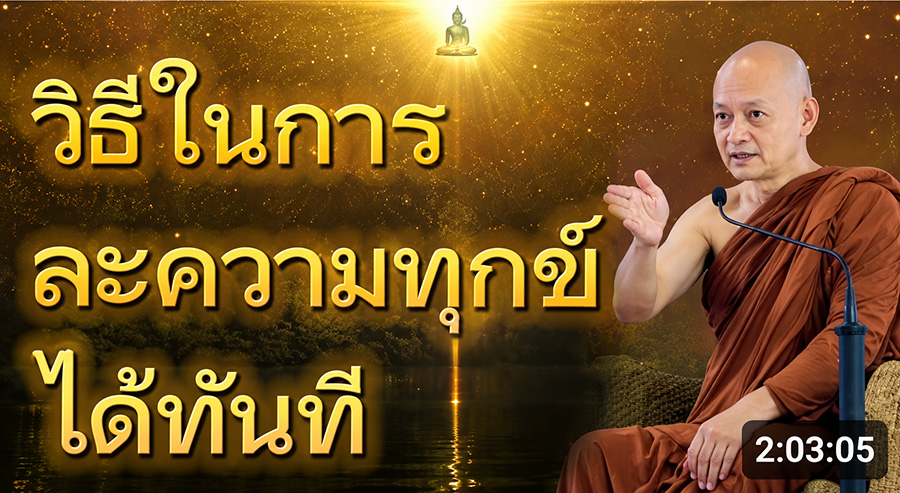
| วิธีในการละความทุกข์ได้ทันที ของ บิ๊กจินไตร เผยแผ่ พุทธศาสนา |
|
|
คำถอดเทปเต็ม Full Transcript ( ข้างล่างนี้ - see below ) |
* * * จากคลิปวีดีโอ : เรื่อง : วิธีในการละความทุกข์ได้ทันที ของ: บิ๊กจินไตร เผยแผ่ พุทธศาสนา วิธีในการละความทุกข์ได้ทันที - YouTube https://www.youtube.com/watch?v=YHVpYxFYIcc Transcript: (00:00) พระพุทธเจ้าบอกอย่างนี้พระองค์บอกว่า ปุถุชนผู้ไม่ได้สดับในธรรมเมื่อทุกขเวทนา ถูกต้องแล้วย่อมน้อมนึกไปถึงกามสุขนะเวลา คนมีทุกข์เนี่ยจะนึกไปถึงกินเหล้าดีกว่า ไปดูหนังดีกว่าฟังเพลงดีกว่าไปเที่ยวทะเล เที่ยวน้ำตกนี่กามสุขทั้งนั้นสุขอันเกิด จากรูปเสียงกลิ่นรสสัมผัส ค่าช่องทางของกาย และเมื่อเขาไปเสพความสุขตรงนั้นราคานิสัย ย่อมนอนตามบุคคลคนนั้นก็คืออนุสัยความเคย ชินต่อสุขกับเวทนาก็ไปนอนตามเขาอีกทุกก็ ไม่ได้แก้เพราะเขาไปเปลี่ยนอารมณ์นะ ส่วนปุถุชนผู้ทุกเวลาถูกต้องเนี่ยไม่รู้ การดับทุกข์ตามที่เป็นจริงก็เมาหมดนั่ง สรรเสริญนะม 6 อยู่กับกองทุกข์ตรงนี้ไม่ (00:50) รู้จักอุบายเครื่องออกไปพ้นจากทุกข์ตาม ที่เป็นจริงปาฏิหาริย์ย่อมนอนตามเขาก็ถึง ความมีเอ่อการร้องไห้คร่ำครวญทุกอกร่ำไห้ ถึงความเป็นผู้มีสติฟั่นเฟือนนะไปเมาหมก อยู่กับทุกขเวทนานะนี่อีกพวกหนึ่งพวกที่ เมาหมกกับพวกที่เบี่ยงไปทางราคาสายไปหา สิทนาอันเกิดจากรุ่นเสียงกินรถนะงั้นพระ เจ้าให้ทำยังไง ให้เราเนี่ยรู้จักทุกข์ตามที่เป็นจริง ว่าทุกข์ทั้งหลายเกิดจากผัสสะพระพุทธเจ้า บอกผู้ใดกล่าวอย่างนี้ชื่อว่ากล่าวตรงตาม ที่เรากล่าวไม่เป็นการกล่าวตู่เราด้วยทำ ให้จริงทุกทั้งหลายนั้นเกิดจากผัสสะมี ผัสสะเป็นเหตุนะ สมณพราหมณ์เหล่าใดที่บัญญัติเรื่องทุกข์ (01:39) ขึ้นมาสมณะพราหมณ์เหล่านั้นก็อาศัย ผัสสาวะทั้งหลาย 6 ประการนี้เอง ปฏิจจสมุปบาท ผัสสะเป็นเหตุให้เกิดเวทนาคือทุกข์สุขเฉย ๆนะงั้นเมื่อบุคคลมีผัสสะกระทบแล้วไม่ว่า จะเป็นตังค์ตาหูจมูกลิ้นกายใจก็ตามเวทนา ย่อมเกิดขึ้น นี่คืออาการของธรรมชาติและถ้าโยมรู้ว่า มันเป็นเพียงแต่อาการของธรรมชาติโยมก็จะ หมดปัญหา แล้ววิธีในการละความทุกข์เอ้ยทันทีก็คือ การละนันทินันทิแปลว่าความเพลินนะ แก่ภิกษุผู้เพลิดเพลินซ้ำพร่ำสรรเสริญสยบ มัวเมาอยู่ซึ่งรูปเสียงกลิ่นรถโมตะปะ ธรรมารมณ์นั้นนั่นแหละนันทิย่อมเกิดขึ้น เมื่อนั้นที่มีอยู่ศาลาค้าความพอใจอย่าง (02:29) แรงกล้าย่อมมีเมื่อความพอใจอย่างแรงกล้า มีสันโยคะการผูกจิตติดกับอารมณ์ย่อมมี เป็นเพราะเราเนี่ยไปผูกจิตกับอารมณ์นั่น เองทุกเวทนาเลยเกิดขึ้นพระตถาคตจึงสอนให้ ละนันทิโยนทิ้งทันทีจิตโยมไปจับอารมณ์ ปั๊บทิ้งทันทีเลยอย่าก่อเอาไว้ทิ้งแล้ว กลับมาอยู่กับอะไรทิ้งแล้วกลับมาอยู่กับ กายเข้าไว้เดินรู้ว่าเดินนั่งรู้ว่านั่ง ไม่ได้ทำอะไรรู้ลมหายใจเข้าออกเอาไว้ถ้า ทำงานให้ใจรู้งานที่ทำอยู่เรียกสติ อธิษฐานการงานกวาดบ้านนู้นกวาดบ้านขับรถ รู้ขับรถสอนหนังสือรู้สอนหนังสือดึงจิต กลับมาตรงนี้ทันทีอย่าไปใส่ใจเนื้อหาของ ทุกขเวทนานั้นไม่ต้องสนใจโยนทิ้งก็จะเห็น (03:14) การดับการเกิดทันทีเห็นเกิดดับเป็นปัญญา แล้วนี่คือสุดยอดปัญญาไม่ต้องไปใช้เหตุผล ให้คนอะไรมากนี่คือสุดยอดของเหตุผลแล้ว คือเกิดระดับสมุทัยกับนิโรธ ใครเห็นสมุทัยเห็นนิโรธคนนั้นชื่อว่าเห็น อย่างที่ศาสดาเห็นคือเห็นอริยสัจ 4 นั้น เองนะทุกข์นี่ก็เป็นอันหนึ่งเพราะฉะนั้น ทุกบรรยายไปได้อเนกปริญญา กู้หนี้ก็เป็นทุกข์คนจนก็เป็นทุกข์นะต้อง ใช้ดอกเบี้ยก็เป็นทุกข์นะประสบกับสิ่งไม่ เป็นที่รักที่พอใจก็เป็นทุกข์ อยากมาด้วยกันอยากไปด้วยกันกับคนที่อยาก ไปไม่ได้ไปก็เป็นทุกข์ไม่อยากไปไม่อยากมา กับคนที่เราเกลียดแต่ได้ไปได้มากับคนที่ (04:03) เราเกลียดก็เป็นทุกข์นะการต้องมาด้วยกัน การต้องไปด้วยกันกับคนที่เราไม่ชอบเป็น ทุกข์การไม่ได้มาด้วยกันไม่ได้ไปด้วยกัน กับคนที่เราชอบเป็นทุกข์ นี้บรรยายไปได้อเนกัลยาเยอะมาก งั้นทุกอย่างในโลกหมดนะ งั้นอะไรที่เป็นทุกข์บ้างพระเจ้าจึงบอก ขันธ์ 5 เป็นทุกข์รูปเป็นทุกข์เวทนาเป็น ทุกข์สัญญาเป็นทุกข์สังขารเป็นทุกข์ วิญญาณเป็นทุกข์ทุกอย่างเกิดดับหมดเลยโยม นะหนังสือนี่ก็เป็นทุกข์นะมีคนถามว่า หนังสือมันเป็นทุกข์ยังไงครับเขาไปคิดว่า ความทุกข์เนี่ยคือความรู้สึกทุกข์เท่า นั้นแต่จริงๆในอริยสัจหมายถึงธรรมชาติใด ก็ได้ที่มันเดินไปสู่การแตกสลายได้นั้น (04:50) เนี่ยธรรมชาตินั้นถูกเรียกว่าทุกกษัตริย์ ทั้งหมดกองทุนนะความทุกข์ก็เป็นทุกข์ เพราะความทุกข์เป็นไปสู่การดับความสุขก็ เป็นทุกข์ไม่ใช่สุขแล้วมันมีความทุกข์สุข มันเดินไปสู่ความดับจึงเป็นทุกข์สุขจะ เป็นทุกข์เพราะเดินไปสู่ความดับความทุกข์ ก็เป็นทุกข์เพราะความทุกข์เต็มไปสู่ความ ดับสัญญาก็เป็นทุกข์สังขารก็เป็นทุกข์คิด อดีตมาแล้วก็ดับคิดปรุงไปในอนาคตก็ดับมี ใครคิดอดีตทั้งวันไม่มีคิดอนาคตทั้งวัน ไม่มีมีใครสุขทั้งวันไม่มีทุกอย่างเดินไป สู่การดับหมดนี่แหละธรรมชาติเป็นทุกข์หมด เลยโยมนะนี่คือสัจจะความจริงที่พระ พุทธเจ้าเข้าไปเห็นนั้นด้วยการใช้มักวิธี (05:31) ละนันทิจบอะไรง่ายๆและการละได้เร็วยังบอก ว่าเอ๊ะมันละได้แต่มันไปอีกไม่เป็นไรมัน ไปได้เราก็ละได้มันไปใหม่เราละใหม่มันไป ใหม่เราละใหม่สิ่งที่เราจะเห็นคือทุกข์ เกิดดับเกิดดับเกิดดับเกิดดับตลอดเวลาเลย เห็นเกิดดับมีประโยชน์อะไรเราจะเข้าใจ อนัตตาณวันหนึ่งต้องทำตรงนี้ซ้ำๆๆๆๆๆๆๆไป เรื่อยๆ นะนี่เคล็ดลับอุบายและมักวิธีนี้พระ พุทธเจ้าสอนบ่อยด้วยในครั้งพุทธกาล โยมคีย์คำว่านันทิเข้าไปจะเจอพระสูตร 4 500 ก็สูตรเต็มพืชไปหมดเลยนะถ้าโยมเจอ พระพุทธเจ้าดิชั้นจะแก้ทุกข์ไงพระเจ้าบอก รักนันทิโร่นะอ่าใช่มั้ยแล้วอันนั้นที่ อย่างเดียวแล้วตั้งไว้ซึ่งกายัคคตาสติ (06:15) ตั้งจิตอยู่กับกายตัวกายัค พระพุทธเจ้าเปรียบเหมือนเสาเขื่อนเสาหลัก ปักเสาเขื่อนเสาหลักลงไป จับสัตว์ 6 ชนิดมาจับงูจับนกจับจระเข้ สุนัขสุนัขจิ้งจอกจับปลิงมาปลูกด้วยเชือก เหนียวกับเสาเขื่อนเสาหลักอันมั่นคงนะพอ ปล่อยไปปั๊บไอ้งูนกจระเข้พวกนี้มันก็ยื้อ ฉุดกันไปเข้าที่หากินที่อาศัยของตนงูจะ เข้าจอมปลวกจระเข้จะลงน้ำนกจะบินขึ้น อากาศสุนัขจะเข้าบ้านสุนัขจิ้งจอกจะไปป่า ลิงลิงจะไปป่าช้าเนี่ยเมื่อสัตว์ทั้งหลาย เนี่ยฉุดกันไปเต็มที่แล้วผลที่สุดมันเป็น ยังไงหมดแรงมันก็จะมานั่งเก่านอนจับอยู่ ที่เสาเขื่อนเสาหลักฉันใดก็ฉันนั้นถ้าเธอ (06:57) ละนันทิเรื่อยๆผลที่สุดให้อารมณ์ทางตาหู จมูกลิ้นกายใจมันจะหมดแรงจิตโยมจะสงบณ เวลาหนึ่งเมื่อโยมทำมากพอเพราะฉะนั้นถ้า เราเพิ่งทำก๊องๆแกร่งๆอย่าไปคิดว่ามันจะ หายเร็วนะสังสารนี่มันยาวไกลเราติดอนุสัย เมาอู๊ยแน่นหนาเลยให้ใช้เวลาทั้งร้อยปี เพื่อเจริญมาก็ยังถือว่าเร็วอย่าไปคิดว่า ช้านะ 100 ปีกับแสนล้านปีที่นิยมติดกิเลส มาตลอดเลยโยมใช้ 100 ปีก็จิ๊บเดียวนะอ่า เห็นมั้ย ที่เมื่อกี้บอกว่า ติดมาแสนล้านปีเนี่ยจะทราบว่าแล้วมันจริง หรือไม่ที่ที่พูดบอกว่ามันแสนล้านปีหมื่น ๆอสงไขยอะไรอย่างนี้มันเทียบกันมันคือ อะไรแล้วมันเป็นความจริงอย่างนั้นไหมแล้ว (07:49) เราจะทราบได้อย่างไรคือความกับอสงไขยต่าง ๆเนี่ยพระพุทธเจ้าตรัสไว้ว่ากลับเนี่ยนาน ขนาดไหนพระองค์บอกว่าภูเขาหินแท่งทึบไม่ โพรงไม่กลวง ยาว 16 กิโลกว้าง 16 กมมีบุตรคนหนึ่ง 100 ปีเอาผ้ามารูดทีนึงภูเขาศึกไป อีก 100 ปีทำอย่างนี้ไปเรื่อยๆจนภูเขาหิน นี้ราบเรียบ นั่นน่ะกลับมาโยมเติม 0 กี่ตัวนะไอ้แสน แสนล้านปีนี่ยังน้อยไปนะเติม 0 นับไม่ ถ้วนเลยซึ่งพระองค์บอกว่าเธอไม่ได้เกิดมา เพียงแค่กลับเดียว แสนกลับเกิดมามากกว่านั้นอีกนานนักน้ำตา ที่เธอเคยร้องไห้เนี่ยถ้าเก็บเอาไว้เนี่ย มากกว่าน้ำในมหาสมุทรทั้ง 4 เมื่อที่เคย ไหลออกจากคอเธอเพราะเธอเคยถูกตัดคอก็มาก (08:47) กว่าน้ำในมหาสมุทรทั้ง 4 เธอเคยถูกตัดคอ เพราะอะไรเพราะเธอเคยเกิดเป็นแพ็คเกจไก่ สุกรชช้างโคมาลา ถ้าเธอเคยเห็นคนรวยไม่ต้องอิจฉาเธอก็เคย รวยมาแล้วตลอดกาลยาวนาน นะเพราะฉะนั้นถ้าจะคุยเรื่องรวยบอกว่าฉัน เคยรวยมาแล้วพระพุทธเจ้ายืนยันใช่ไหมเป็น คนเคยรวย ใช่ไหม เห็นคนพิการก็บอกว่าไม่ต้องดูถูกเลยเราก็ เคยพิการมาแล้วตลอดกาลยาวนานเป็นมาหมด แล้วนะพระพุทธเจ้าให้เบื่อไงสังสาระนี้ ให้เบื่อซะ เพราะฉะนั้นในภูมิความรู้พวกนี้ในสิ่งที่ เรายังไม่รู้เนี่ยเราจะเชื่อพระพุทธเจ้า ไว้ก่อนแต่เราตรวจสอบ ในธรรมะที่เราตรวจสอบได้คืออะไร ปฏิจจสมุปบาทคือทำชั้นลึกที่เราตรวจได้ (09:37) ด้วยตนเองเป็นปัจจัตตังด้วยเช่นว่าโยมเคย ไปห้างไหม เคยไปห้างมาร์ชเคยใช่ไหมเคยซื้อเสื้อผ้า มาใส่ไหม เธอทำไมโยมอยากได้เสื้อตัวนี้ไม่อยากได้ เสื้อตัวอื่นมีตั้งหลายร้อยตัวในห้างทำไม โยมอยากได้เสื้อตัวนี้เพราะอะไร โยมชอบสีสวยใช่ไหมแต่นั่นแสดงว่าโยมต้อง ชอบก่อนจึงมีความอยากถูกต้องไหมมีใครว่า โยมคนนี้โกหกไหม ไม่มีใช่ไหมเพราะโยมก็เป็นอาการอย่างนั้น ใช่ไหม มีใครซื้อเสื้อไม่ชอบมาใส่มั้ยตัวนี้แพง ก็แพงใช่มั้ยไม่มีใช่มั้ย ต้องชอบก่อนนะคราวนี้ถามโยมต่อว่าก่อนโยม ชอบอะไรเกิด เมื่อกี้อยากเกิดทีหลังชอบแล้วถึงอยาก ก่อนชอบเกิดอะไรเกิดใครตอบได้ (10:29) เห็นไหมทางนู้นตอบได้ค่ะคุณสุภาพบุรุษ ยังไม่ตรงกับพระพุทธเจ้า ถูกเหมือนกันนะแต่ถูกแบบอ้อมๆนิดนึง ต้องมีตาไปเห็นเสื้อก่อนจริงไหมมีใครเดิน หลับตาซื้อเสื้อมีไหม ไม่มีไม่มีต้องมีอายตนะต่างๆ ถ้าโยมเดินหลับตาโยมจะได้อะไร ได้ CD ครับ ภาษาต่างหูในห้างเปิดเพลงเอ้ยเพลงนี้เข้า ท่าไหนไปซื้อมาให้หน่อยสิใช่ไหมเกิดผัสสะ เกิดพอใจเกิดตัณหาความอยากเกิดความยึด จ่ายเงินนี่เชื่อฉันแต่ก่อนเสื้อห้างเห็น ไหมมาเป็นเสื้อฉันละเสื้อห้างหายโยมไม่ ทุกข์นะเสื้อโยมหายโยมทุกข์ใช่ไหมอ่า เสื้อฉันหายมีฉันและเห็นนะเนี่ยเพราะ ฉะนั้นเราตรวจได้ไหมผัสสะเกิดเวทนาเกิด (11:32) ปัญหาเกิดอุปทานตรงเป๊ะเห็นไหมนี่เป็น ธรรมะชั้นลึกที่จะหลุดพ้นจากความตายเพราะ ฉะนั้นทำให้อื่นที่เรายังตรวจไม่ได้เราก็ เลยเชื่อไว้ก่อนเหมือนทฤษฎีของไอน์สไตน์ บัญญัติมาเยอะแยะเลยณวันนี้นัก วิทยาศาสตร์ยังโจทย์ทฤษฎี Style ไม่หมด เลยแต่ก็เชื่อแล้วเพราะว่าญี่ปุ่นไม่ เชื่อใช่ไหมหย่อนลงไปรูปหายไป 10,000 บาท ทฤษฎีเขาทำได้จริงแสดงว่าทฤษฎีอื่นเนี่ย น่าจะเป็นจริงด้วยนี่เขาก็นั่งไล่ตรวจสอบ ไปเรื่อยๆ ต้องไล่ตรวจสอบทฤษฎีของพระพุทธเจ้าและ ทฤษฎีของพระเจ้าไม่ใช่ทฤษฎีอย่างนัก วิทยาศาสตร์ทั้งหลายมันคือ fax ความจริง ที่พระเจ้าเข้าไปสังเกตและโยงคิดดูว่า (12:20) 2000 กว่าปีที่แล้วมนุษย์ก็มีอาการจิต อย่างนี้พระเจ้าก็มีอาการจิตเหมือนโยม ผ่านมา 2,000 กว่าปีโยมจะมีอาการจิต เหมือนที่พระเจ้าพูดไว้เลยธรรมะนี้จึงถูก เรียกว่าอกาลิโกถูกต้องตรงจริงไม่ถูก จำกัดด้วยการเวลาเห็นไหมสิ่งที่พระ พุทธเจ้าพูดมาไม่มีผิดเพี้ยนเลยและเป็น ปัจจัยคือรู้เฉพาะตนได้อาตมาจึงถามว่ามี ใครคิดว่าคนนี้โกหกไหมไม่มีเพราะว่าตัว เขาก็มีเหมือนกันและโยมคิดว่าชาวคริสต์ก็ มีอย่างเราไหมมีอิสลามมีไหมมีฝรั่งมีไหม มีจีนไทยเหมือนกันหมดเลยขอให้เป็นมนุษย์ เหมือนกันนะใช่ไหมพระพุทธเจ้าจึงเข้าไป เห็นหลักของธรรมชาติตามที่เป็นจริงนะไม่ (13:02) ได้จะไปล้มล้างลัทธิใดลัทธิหนึ่งหรือ ต้องการประกาศตนเป็นศาสดาอะไร การให้เราเข้าถึงความเมตตาเข้าไปเห็นความ จริงแล้วมาประกาศความจริงให้เราเนี่ยเข้า ไปตรวจสอบเข้าใจไหมพระพุทธเจ้าจึงบอกว่า ธรรมะทนต่อการเพ่งพิสูจน์นะใครเพ่ง พิสูจน์ฉันทะจะเกิดขึ้นเขาจะพอใจเขาจะมี ความเพียรพยายามอย่างนี้และธรรมะนี้เป็น สิกขีปูโตเป็นพยานในตนเองได้ไม่ต้องอาศัย การเชื่อหรือการฟังตามๆกันมาโยนบอกว่าจำ มาผิดมั้งลอกมาผิดต้อง 2 พันกว่าปีตรวจ ได้และช่วยกันตรวจด้วยและโยมจะยิ่งมี ศรัทธาในพระประธานคนเข้าใจไหม คะสำหรับอสงไขยได้ทราบ มันก็จะเป็นท่านรู้และท้ออาจารย์โอ๋นี่ (13:53) มันยาวจังเลยดีเหมือนกันคุณบอกใครเป็นพระ องค์ไม่ชอบ เนี่ยค่ะมันก็เป็นเรื่องที่อยากจะกราบรวม ฐานท่านต่อเลยนะคะว่าสุดท้ายก็เคยเป็นมา แล้วนะคะ [เพลง] มันเป็นได้ทำอะไรบ้างถึงได้เป็นมนุษย์ บ้างถึงได้รับหลงไปเป็นสัตว์ ตัวศีล 5 มีอุโบสถ 8 ประการ อย่างพระศาสดาเคยแนะนำหน้าว่าถ้าอยากจะ ได้สภาพเป็นมนุษย์ให้รักษาอุโบสถ 8 ประการทุกวันพระคือทุกวันเพ็ญ 15 ค่ำหรือ 14 ค่ำหรือ 8 ค่ำแห่งปัดอย่างนี้ ตัวศีล 5 เนี่ยเป็นไปเพื่อสุคติโลกสวรรค์ จะได้สภาพตั้งแต่มนุษย์ขึ้นไปแต่ไม่ได้ ยืนยันว่าทุกคนนะเพราะฉะนั้น 90 กว่า เปอร์เซ็นต์แค่นั้นนะถ้าจากการพลาดอีกนิด (14:55) นึงคือต้องทำสมาธิด้วยถึงจะได้ 100% ถ้า อาจารย์ครับ จะกลับมาเป็นมนุษย์ได้อีกครั้งทำไงค่ะ โยมวนอีกยาวเลย เพราะว่าพระพุทธเจ้าตรัสอย่างนี้โยมเกิด เป็นมนุษย์ใช่ไหมแล้วตายไป พระพุทธเจ้าบอกมนุษย์พระสูตรหนึ่งบอก มนุษย์ที่กลับเป็นมนุษย์อีกเนี่ยเหลือ เท่ากับเศษดินที่ปลายเล็บนะพระองค์เอา เล็บเขียนเศษดินขึ้นมาบอกกับสาวกว่าดินใน ปฐพีกับดินในเล็บอันไหนมากกว่ากันสรุป ปฐพีมากกว่าเยอะบอกนี่แหละมนุษย์ที่ตาย แล้วกลับมาเป็นมนุษย์อีกหรือเท่ากับเศษ ดินที่ปลายเล็บไปคิดเปอร์เซ็นต์เองแล้ว กันว่า 7 พันกว่าล้านคนในโลกมันจะเหลือ กลับมากี่คนกันใช่ไหมนี่นัยยะหนึ่งอีก (15:49) นัยยะหนึ่งเมื่อโยมหลุดไปแล้วไม่ได้กลับ มาเป็นมนุษย์อีกโยมจะวนอยู่ในลูปไปเป็น วิสัยเดรัจฉานสัตว์นรกเป็นปมเป็น เทวดาไปยาวเลยนะกว่าจะกลับมาเกิดเป็น มนุษย์อีกความนานขนาดไหน พระองค์อุปมาอย่างนี้เปรียบเหมือนโลกใบ นี้มีน้ำท่วมถึงกันทั้งหมดมีบุตรคนนึง หย่อนออกไม้ไผ่ซึ่งมีรูเดียวตรงนี้ ลมก็พัดแตกนี้ไปทิศเหนือใต้ออกตกนะ ในน้ำมีเต่าตาบอดร้อยปีโผล่มาหายใจที หนึ่งพระองค์ถามว่าเป็นการง่ายไหมที่เต่า ตาบอดร้อยปีโผล่มาหายใจทีหนึ่งจะเจอแอบ ไม่ไปนี้แล้วยืดคอเข้าไปในรูซึ่งมี รูเดียวสาวกบอกยากมากนะไอ้เต๋าก็ตัวนิด เดียวตาก็บอดน้ำก็ท่วมทั้งโลกมันจะเจอกัน (16:39) ได้ไหมเนี่ยแถมต้องยืดคอเข้าไปในรูซึ่งมี รูเดียวนั่นแหละความยากของสิ่ง 3 สิ่ง 1 ความยากในการได้เป็นอนันตสมาสัมพุทธเจ้า 2 ความยากในการได้อัตภาพมาเป็นมนุษย์ 3 การ ที่ศาสนาจะแผ่ไพศาลไปทั่วโลกนี้คือยาก เสมอกันไม่ง่ายนะงั้นพระพุทธเจ้าจึงบอก ว่าขณะนี้นะเออก็ได้อัตภาพเป็นมนุษย์แล้ว นะอย่าประมาทให้พึงกระทำโยคะกรรมไม่รู้ ว่านี้คือทุกข์นี่คือเหตุให้เกิดขึ้นใน ทุกข์นี่คือความดับทุกข์นี่คือข้อปฏิบัติ ให้ถึงความดับทุกข์ดังนี้เถิดนะนั้นถ้าไป วนอยู่ในเทวดาก็โชคดีไปแต่มันไม่มีความ แน่นอน พระเจ้าบอกว่าคนที่ต่ำกว่าโซดาเนี่ย เปรียบเหมือนการซัดไม้ขึ้นไปในอากาศ (17:28) บางคราวก็เอาคนลงบางคราวก็เอาปลายลงบาง คราวก็เอาท่ามกลางวงไม่มีความแน่นอนเลย โยมอยากเป็นเทวดาให้ตายก็เป็นไม่ได้ถ้า โยมไม่สร้างอนุสัยความเคยชินในกุศลธรรม เอาไว้ จิตจะไปเกาะอัตภาพใหม่ตามอนุสัยของโยมนะ ว่าโยมเคยชินกับธรรมที่เป็นกุศลหรืออกุศล พระตถาคตจึงบอกว่าถ้าอกุศลเกิดขึ้นในใจ เธอแล้วเธอต้องใช้ฉันทะวายามาอุตสาหะ ปัจจุบันมีสติสัมปชัญญะอย่างแรงกล้าเพื่อ จะดับอกุศลนั้นเสียโดยด่วนเปรียบเหมือน บุรุษมีไฟไม่ลุกลงเสื้อผ้าหรือฝ่ายไม่หลง หมุนศีรษะเธอต้องใช้ฉันทะความพอใจวาย อย่างนะความพยายามอุตสาหะความเปลี่ยน กุศลฮีความเพียรอย่างแรงกล้าปฏิวัติความ (18:18) เพียรอย่างไม่ถอยกลับสติสัมปชัญญะเพื่อจะ ดับไฟนั้นเสียโดยด่วนชั้นใดก็ฉันนั้นเห็น มั้ยไม่งั้นมันจะเกิดเป็นอนุสัยนั้นเวลา โยมโกรธใครประเทศไทยรีบทิ้งนะอย่าเมาหมก กับอารมณ์นั้นอย่าผูกติดกับอารมณ์นั้นไป นะพระพุทธเจ้าบอกว่าไม่เกิดประโยชน์ อันตรายจะเกิดขึ้นแก่เธอนะเพราะฉะนั้น เวลาโยมเกลียดใครโกรธใครอันตรายไม่ได้ เกิดกับเขานะอันตรายเกิดแก่โยมและการที่ โยมต้องไปเกิดในเดรัจฉานหรือสัตว์จำพวก มินิบาตพระพุทธเจ้าบอกว่าพระองค์ไม่เห็น การจองจำอื่นใดที่ทารุณเจ็บปวดโหดร้าย ยิ่งกว่าการถูกจองจำในนรกกำเนิดในรัชกาล ที่ 8 วิสัยคือมันจองจำกันยาวนานมากโยม (19:05) กลับมาเป็นมนุษย์ได้อีกก็จริงแต่มันยาว นานระหว่างความยาวนานนั้นโยมต้องทนทุกข์ ทรมานขนาดไหนใช่ไหมเนี่ยเป็นอย่างนี้ เรื่องนึงที่จะแถมให้นิดนึงซึ่งเป็นความ เข้าใจผิดของชาวพุทธอยากสร้างความเข้าใจ ใหม่อีกเรื่องหนึ่งที่ยังไม่ได้บอกโยม อย่างที่ 2 ก็คือเรื่องเทคนิคง่ายๆนะ อันดับแรกนะเอาเรื่องนี้ก่อน เรียกว่าวิญญาณเรียนว่ายตายเกิดยังว่า วิญญาณเวียนว่ายตายเกิดมาใช่ พยักหน้าพยักหน้าใช่กันหมดถูกต้องนะแต่ ปรากฏว่าถ้าใครพูดว่าวิญญาณเวียนว่ายตาย เกิดพระพุทธเจ้าจะตำหนิว่าเธอเป็นงู ซวยซะแล้ว นะเห็นไหมว่ามันคนละเรื่องกันเลยจึงบอก (19:54) ว่าวันนี้มันจะมาเปิดโลกทัศน์ใหม่จริงๆนะ ล้างสมองต้องเป็นการล้างสมองกันใหม่เลยนะ ยุงไปดูพระสูตรนี้นะสติจริงหรือตามที่ได้ ยินว่าเธอมีทิฏฐิอันลามกเกิดขึ้นแล้ว อย่างนี้ว่าเราย่อมรู้ทั่วถึงทำตามที่พระ ผู้มีพระองค์แสดงแล้วว่าวิญญาณนี้นี่แหละ ย่อมร่ำไปย่อมท่องเที่ยวไปหาช่างสิ่งอื่น ไม่ดังนี้เราชาวพุทธจะคิดว่าวิญญาณนี้ แล่นไปท่องเที่ยวไปในสังสรรค์ ว่าวิญญาณนี้นี่แหละย่อมเล่นไปย่อมท่อง เที่ยวไปหาช่างสิ่งอื่นไม่ดังนี้สติ วิญญาณนั้นเป็นอย่างไร ตั้งแต่พระพุทธเจ้า ว่าอย่างไร เธอรู้ทั่วถึงถึงที่เราแสดงแล้วนี้เมื่อ แสดงแก่ใครเล่าไม่ถามเลยในอนาคต (20:59) เรากล่าววิญญาณว่าเป็นปฏิจจสมุปบาทโดย ปริยาเป็นอันมากถ้าเว้นถาดจากปัจจัยแล้ว ความเกิดขึ้นอยู่วิญญาณ วิญญาณเนี่ยเป็นปฏิจจสมุปบาทธรรมคือเกิด ดับและเกิดเพราะเหตุปัจจัยเหตุปัจจัยของ มันคือนามรูปเกิดดับตลอดเวลามันไม่ใช่ ชีวิตมันเป็นธาตุรู้ที่เกิดดับตลอดเวลา เมื่อเป็นอย่างนั้น เธอชื่อว่าย่อมกล่าวถึงเราถึงที่ตนเองถือ เอาผิดด้วยย่อมขุดตัวเองได้ย่อมประสบสิ่ง มีชีวิต ทั้งหลายพวกเธอจะสำคัญความข้อนี้ว่าอย่าง ไรที่ส่งสติยังพอจะนับว่าเป็นพระสงฆ์ใน ธรรมวินัยนี้ได้บ้างไหมนะสถาปออกจากพระ เลยนะเห็นไหมว่าเราชาวพุทธเข้าใจผิดจาก ที่ศาสดาบอกจริงๆแล้วโยมเข้าใจถูกว่า (22:05) มันต้องมีใครสักคนเนี่ยที่เวียนว่ายตาย เกิดเพราะพระพุทธเจ้าเองก็เคยพยากรณ์ อดีตชาติของท่านจริงนะ แต่สิ่งนั้นใช้คำเรียกว่าวิญญาณไม่ได้ เพราะวิญญาณไม่ได้เวียนว่ายตายเกิดวิญญาณ เกิดดับเกิดดับตามประสาของมันไปผู้เวียน ว่ายตายเกิดจริงๆพระตถาคตเรียกว่าสัตว์ ผู้มีอวิชชาเป็นเครื่องกั้นมีตัณหาเป็น เครื่องผูกชื่อยาวหน่อยถ้าจะเรียกสั้นๆคำ เดียวเรียกได้ว่าสัตว์หรือผู้มีรายวิชา เป็นเครื่องกลั้นหรือผู้หลงนั่นเองถ้า วิชาคือความหลงความไม่รู้นะดูว่าสุดนี้ พิสูจน์ทั้งหลายสัตว์ที่มีอวิชชาเป็น เรื่องกั้นมีตัณหาเป็นเครื่องผูกนั่นไป (22:47) อยู่ท่องเที่ยวไปอยู่ในสังสารสก็ทำนอง เดียวกันบางคราวแล่นไปจากโลกนี้สู่โลก อื่นบางคราวเนื่องจากโรคอื่นสู่โลกนี้ข้อ นั้นเพราะเหตุไรเพราะความที่เขาเป็นผู้ ไม่เห็นซึ่งอริยสัจทั้ง 4 นั้นอริยสัจ 4 เป็นเรื่องเร่งด่วนที่เราต้องรู้อันดับ แรกของชีวิตนะ เพราะฉะนั้นคนที่เวียนว่ายตายเกิดคือ สัตว์ผู้มีวิชาเป็นเครื่องตัณหาเป็น เครื่องผูก เพราะฉะนั้นให้เราทราบว่าไม่ใช่วิญญาณ เวียนว่ายตายเกิด เพราะฉะนั้นขณะที่โยมนั่งสมาธิได้ลองนั่ง สมาธิกันไปสักแป๊บนึงใช่ไหมอ่าโยมจะเห็น ว่าขณะที่โยมรู้ลมหายใจเนี่ยจิตมีการ เคลื่อนใช่ไหม ร้อยทั้งร้อยจะคิดว่าจิตวิ่งไปสู่อารมณ์ (23:33) นี้แล้วพอเราดึงกลับมาก็จิตวิ่งมาหาที่ เดิมใช่ไหมแต่จริงๆไม่เป็นอย่างนั้นขณะ ที่จิตมีการมาการไปนะตถาคตบอกว่าจะมีตาย และมีเกิด เห็นไหม ถ้ากระบวนการตรงนี้สั้นๆนิดเดียวที่จิต ขยับ นะแต่มันดับมันเกิดแต่เร็วมากจะไม่ต่าง กับที่โยมเห็นไฟแผงโฆษณามันวิ่ง ไปดูใกล้ๆไฟตรงนี้ดับเดี๋ยวนี้เกิดดวงดับ นี่สว่างมันไม่ได้วิ่งไฟไม่ได้วิ่งแต่แสง สว่างมันดับเกิดดับเกิดดับเกิดทำให้โยม รู้สึกว่ามันวิ่งเหมือนกันไม่มีผิดเลยโยม จิตจะเกิดดับเกิดดับตลอดเวลาขณะที่โยม เป็นจิตกลับมานี่จิตดวงนี้จะดับจิตดวง ใหม่จะเกิด สัตว์ผู้มีวิชาเป็นเครื่องกั้นตัวสุญญตา (24:27) ตรงนี้เป็นตัวเข้าไปจับยึดวิญญาณนะแล้ว วิญญาณก็เข้ามาจับยึดตรงนี้ต่อนี่กระบวน การมันเป็นอย่างนี้เห็นไหมว่าขั้นตอนตรง นี้มันแทบจะหนึ่งในล้านวินาที [เพลง] ไม่มีทางรู้เลยว่าจิตเกิดดับตลอดกาลเลย เพราะจิตเกิดดับรวดเร็วมาก 3 คำให้เราทราบว่ามันคืออันเดียวกันจิต มโนคือใจวิญญาณมันคือสิ่งเดียวกันคือผู้ รู้แจ้งในอารมณ์นะพระเจ้าตรัสไว้อย่างนี้ องค์กรทั้งหลายสิ่งที่เรียกกันว่ามโนบ้าง วิญญาณบ้างนั้น ตลอดคืนมันไม่ใช่ชีวิต มันเป็นธรรมชาติที่เกิดดับเปรียบเหมือน อะไรยากด้วยพระเจ้าบอกอุปมาปัญญาเนี่ย เกิดดับหรือไม่ยากจะหาอุปมาโดยปกติ (25:24) เหมือนฟองน้ำที่เกิดบนผิวน้ำขณะที่ฝนตกฝน ตกลงมาแล้วเกิดเม็ดฟองขึ้นบนผิวน้ำ [เพลง] ในแม่น้ำทะเลสาบมหาสมุทรเม็ดฟองเกิด มหาศาลกี่ดวงมากมายเป็นแสนเป็นล้านดวงนับ ไม่ถ้วนใช่ไหมแล้วเกิดดับเร็วไหม [เพลง] ระหว่างฟองน้ำต่อฟองน้ำถูกขั้นด้วยไหล่ ยนต์ถูกคั่นด้วยอากาศอากาศนั่นแหละคือ สุญญตาความว่างสภาวะของวิมุติที่เชื่อม ระหว่างรอยต่อของวิญญาณต่อวิญญาณ พระพุทธเจ้าบอกที่ดังไม่มีวิญญาณที่ใดไม่ มีนามรูปนั่นแหละคือที่สุดของทุกข์ ทั้งสุญญตาเป็นชื่อแทนนิพพานการปล่อยวาง วิญญาณได้สภาวะของสัตว์ผู้มีวิชาจะเป็น ผู้มีวิชาแล้วจะเข้าสู่สุญญตาตรงนี้ (26:21) สิ่งนี้พวกเรามีกันทุกคนแต่เราเข้าไม่ถึง เพราะเราเข้าใจผิดรู้ผิดคิดว่าเป็นตัวเรา เพียงแต่เราปล่อยความเข้าใจผิดปล่อยควร รู้ผิดเห็นการเกิดดับของท่านและคิดว่าทำ ให้ไม่ใช่ตัวเราของเรา เราจะเข้าสู่ความเมตตาเรานั่นเองสภาวะ เดิมของเราทุกคนนะที่พระเจ้าต้องการให้ เราเข้าถึงพอเข้าใจไหมนี่คือสิ่งที่อยาก ทำความเข้าใจกับพวกเรานั้นกลับไปฟังซีดี กันมาเยอะๆหน่อยอธิบายเรื่องนี้ไว้พอสม ควร และนักวิถีที่ง่ายนะอย่างที่โยมจิ๋วขอเอา ไว้ ไม่ต้องคิดอะไรมากคิดอะไรไม่ออกนั่งรู้ลม หายใจเข้าไว้ ทุกอย่างจะจบด้วยกระบวนการนี้กระบวนการ เดียวงั้นเราประมวลคำพระพุทธเจ้ามาเนี่ย (27:09) พระพุทธเจ้าสรรเสริญอานาปิมากตถาคตก็ใช้ เอง สรรเสริญอานาปาว่าเป็นตถาคตวิหารขึ้นอยู่ พระตถาคตเป็นอริยวิหารเครื่องอยู่ของความ เป็นพระอริยบุคคลเพราะฉะนั้นโยมคิดอะไร ไม่ออกรู้ลมหายใจเข้าไว้ถ้าจิตหลุดจากลม ละความเพลินกลับมารู้ลงเพียงเท่านี้หลุด คนได้แน่นอนร่างความเจริญตั้งจิตอยู่กาย ถ้าโยมทำงานให้รู้งานที่ทำในปัจจุบัน เรียกสติอาจารย์การงานเป็นกายกรัฐมนตรี เหมือนกันถ้าเดินให้รู้เดินเคลื่อนไหวมี บททำอะไรให้รู้ตรงนั้นเอาจิตอยู่กับ ปัจจุบันนั่นเอง ทำแค่นี้พอแล้วจิตเคลื่อนออกจากปัจจุบัน มากความเป็นหนี้อยู่ตรงนี้พอเข้าใจไหมจับ (27:54) หลักแค่นี้มรรค 8 จากรก ได้แน่นอนทำไปยันตายเลยนะ [เพลง] ใน ยังภาวนาอะไรไม่เป็นบ้างนะ เดินไปเดินมา เหมือนเราเดินไปขึ้นรถลงเรือไปที่ไหน เนี่ยเดิน เอาจิตอยู่กับกาย อย่าให้จิตมันไปคิดโน่นคิดนี่นะ เอาจิตอยู่กับกายเมื่อไหร่เนี่ย เป็นความตั้งมั่นของจิตและเป็นสมาธิแล้ว คือให้จิตมีอารมณ์อันเดียว และให้เพ่งอยู่ในอารมณ์อันเดียวและการ เพ่งอันอาศัยอารมณ์ต่างๆเสีย ความคิดความนึกความรู้สึกต่างๆเป็นอารมณ์ ต่างๆ คิดไปเรื่องอดีตเรียกว่า 6,000 ตานุทิฐิ ความเห็นที่ปรารภขันในเบื้องต้นชอบคิด (29:01) เรื่องอดีต ความเห็นที่ปรารภขันธ์เบื้องปลายไอ้พวก นี้ชอบคิดอนาคต คิดมาวางอย่าไปสนใจอยู่กับปัจจุบันถ้าโยม ทำได้อย่างนี้นี่จะเดินจะยืนจะนั่งจะนอน ก็ชื่อว่าเป็นสมาธิแล้ว จิตมีอารมณ์อันเดียว การเดินจงกรมไม่ใช่ว่าจะต้องท่าทางอย่าง นั้นอย่างนี้ไม่เกี่ยว คนนอนป่วยก็เป็นสมาธิได้ พระศาสดาบอกว่า ภิกขุแม้นอนอยู่เนี่ย แต่ถ้าเธอนั้นเมื่อเกิดความครุ่นคิดในทาง กามทางพยาบาททางเบียดเบียนขึ้นมา ภิกขุที่นอนอยู่เนี่ยก็ไม่รับเอาความ ครุ่นคิดนั้นไว้สละทิ้งไปไถ่ถอนออกบรรเทา ไปทำให้สิ้นสุดไปจนไม่มีเหลือ ภิกขุที่เป็นเช่นนี้แม้กำลังนอนอยู่ก็ (29:57) เรียกว่าเป็นผู้กระทำความเพียรเผากิเลส รู้สึกกลัวต่อสิ่งลามกเป็นผู้ปรารภความ เห็นอุทิศตนในการเผากิเลสอยู่ 1 ชนิด รูปแบบร่างกายไม่จำกัดเลยจะทำอะไรก็ได้ใจ อยู่ที่ใจ ภูมิใจความเพียรเอามาคุมใจไม่ใช่มาคุมกาย ให้มีท่าให้ยกย่องย่างอะไรไม่เกี่ยวนะมัน ปรุงแต่งขึ้น คนไปสร้างสรรค์กันขึ้นใหม่พระเจ้ามีตรัส ไหมภิกขุทั้งหลายเธอยกย่องอย่างนี้นะถ้า ทางนี้ไม่มีไม่มีนะ การจะสอนแบบใดต้องมีพระสูตรมีพุทธวจนรอง รับว่าพระองค์เคยตรัสสอนไหมไม่มีตรัสสอน วางเรากำลังมาฟังพระพุทธเจ้า เหมือนว่าผู้เช่าบอกอะไรเราจะทำอย่างนั้น น่ะเหมือนโยมเป็นปัญจวัคคีย์วันนี้ (30:53) มาเจอแต่พระพุทธเจ้า ก็ถามเลยพระพุทธเจ้าสอนอะไรยังไง ตรัสรู้อะไรทำยังไง พระพุทธเจ้าก็บอกตรงๆมาเลย อย่างท่านสอนภิกขุจะนั่งยังไง ภิกขุไปแล้วสู่ป่าสู่คนไม้สู่เรือนว่างก็ ตามนั่งคู่ขาเข้ามาโดยรอบนั่งคุกเข่า ไม่ได้บอกว่าขวาทับซ้ายซ้ายทับขวาขาขัด กันเป็นขัดสมาธิอะไรก็ไม่มีไม่ได้บอกบอก ครูข่าเข้ามาโดยรอบตั้งกายตรงดำรงสติมั่น มีสติหายใจเข้ามีสติหายใจออก เมื่อเธอหายใจเข้ายาวก็รู้ชัดว่าหายใจ เข้ายาว เมื่อหายใจออกยาวก็รู้ชัดว่าหายใจออกยาว เมื่อหายใจเข้าสั้นก็รู้ชัดว่าหายใจเข้า สั้น เมื่อหายใจออกสั้นก็รู้ชัดว่าหายใจออก สั้น ทำความรู้พร้อมเฉพาะซึ่งกายทั้งปวงหายใจ (31:57) เข้า ทำความรู้พร้อมเฉพาะซึ่งกายทั้งปวงหายใจ ออก ทำกายสังขารให้ระงับอยู่หายใจเข้า ทำไกด์สังขารให้ระงับอยู่หายใจออกถ้านั่ง สมาธิทำอย่างนี้ เราก็ฟังอย่างนี้แล้วเราก็นำไปทำ ภิกขุในครั้งพุทธกาลก็ฟังแค่นี้แล้วก็ทำ จนสำเร็จมรรคผล ไม่ต้องไปคิดอะไรงอกเพิ่มเติมอะไรไม่ต้อง พระองค์ก็บอกภิกขุทั้งหลายลมหายใจเข้าและ ลมหายใจออกนี้ เป็นกายอันหนึ่งอันหนึ่งในกายทั้งหลาย เพราะเหตุนั้นในเรื่องนี้ภิกขุนั้นย่อม ชื่อว่าเป็นผู้ตามเห็นกายในกายอยู่เป็น ประจำ มีความเพียรเผากิเลสมีสัมปชัญญะมีสตินำ อภิชาและโทมนัสในโลกออกเสียได้ ท่านก็บอกตรงๆลมหายใจเข้ากับลมหายใจออก (33:04) เป็นกายอันหนึ่งอันหนึ่งในกายทั้งหลายนะ เพราะเหตุนั้นขณะที่เธอมาทำอย่างนี้จิต รู้ลมที่ไหลเข้าไหลออก เธอเป็นผู้มีสัมปชัญญะแล้วมีสติแล้ว กำลังเป็นผู้ทำความเพียรเผากิเลสและ เราจะทำอะไรไปมากกว่านี้แล้วก็ไม่ต้องทำ มากกว่านี้ท่านบอกแค่นี้เราก็ทำแค่นี้ทำ ตรงๆ แล้วก็ฝึกตรงๆเลยนั่งคู่ขาเข้ามาในรอบ ตั้งกายตรงรู้ลมเข้าลมออกลมเข้าลมออก ทีเวลาจิตมันรู้ลมแล้วเนี่ย จิตเกิดแล้วที่สุดก็ดับ ธรรมชาติของจิตเป็นอย่างนั้น พระศาสดาเป็นผู้รู้ผู้เห็นจิตว่าจิตมี อาการอย่างไร มีใครนั่งรู้ลมและจิตไม่เปลี่ยนบ้าง มีไหม ไม่ขยับเลยนิ่งอยู่กับลมตลอดเลยไม่ขยับไป (34:06) ไหนไม่มีเห็นไหมพระพุทธเจ้าก็เหมือนกัน พระพุทธเจ้าก็ทรงบัญญัติความจริงของจิต ออกมาบอกพี่ครูทั้งหลายจิตเป็นของเปลี่ยน แปลงได้รวดเร็ว แม้จะอุปมาก็กระทำได้ไม่ใช่ง่าย พระองค์พูดอย่างนี้ก็แสดงจิตพระองค์ก็ เป็นเหมือนเรา พระองค์เป็น สัตตานังเหมือนกันเป็นโพธิสัตว์สัตว์ผู้ มีความไม่หลงเป็นตำราบังเกิดขึ้นแล้วใน โลกสัตว์แปลว่าผู้ยึดติดแต่เป็นผู้ยึดติด ที่พร้อมกำลังจะมาตรัสรู้มีความไม่หลง เป็นธรรมดา ยึดติดวิญญาณเหมือนกันเราทั้งหลายก็เป็น สัตว์ตานั้น ยึดติดวิญญาณเหมือนกัน วิญญาณดวงหนึ่งเกิดขึ้นดวงหนึ่งดับไปตลอด วันตลอดคืนพระองค์ตรัสไว้ (35:00) อุปมาเหมือนลิง กระโดดเกาะกิ่งไม้นั้นปล่อยกิ่งนี้จับ กิ่งนั้นปล่อยกิ่งนี้ บอกพี่กูทั้งหลายสิ่งที่เรียกกันว่าจิต บ้างมโนบ้างวิญญาณบ้างนั้นดวงหนึ่งเกิด ขึ้นดวงหนึ่งดับไปตลอดวันตลอดคืน ทรงอธิบายความจริงของโลกให้ฟังหมดเลย แล้วเราก็ตรวจด้วยตนเอง ก็เอาจิตมาอยู่กับลมหายใจเข้าออกสามารถ เปลี่ยนแป๊บอีกละเอากลับมารู้ลมสภาพ เปลี่ยนปลั๊กตอนเปลี่ยนน่ะทันมันไหมไม่ ทัน ก็แสดงมันเปลี่ยนเร็วนะเร็ว พระพุทธเจ้าบอกจิตเป็นของเปลี่ยนแปลงใน รวดเร็วเราลองจี้ให้ทันตอนเปลี่ยนเปลี่ยน ปั๊บเนี่ยฉันจะรู้ไม่ทัน มันเปลี่ยนไปแล้วสักพักนึงถึงรู้คิดไปยาว (35:56) แล้วนี่ เร็วจริง ทีทำยังไงเมื่อไม่ทันก็ต้องค่อยๆสร้าง กำลังขึ้น เพราะมันหลุดไปปุ๊บคิดไปสักพักรู้ตัวรีบ ละนันทิทิ้ง กลับมารู้ลงสังวรสำโรงอินทรีย์ไว้ อินทรีย์ สังวรอยู่กับอะไร อานาปานสติลมหายใจ หรือก็เรียกว่าเป็นกายัคคติก็ได้เพราะลม เป็นกายอันหนึ่งในกายทั้งหลาย ลงจึงตรัสว่าอานาปานสติก็คือกายัคสติ เราก็นั่งรู้ลมเข้าลมออกต่อไป เพราะจิตหลุดไปปุ๊บรู้ตัวเมื่อไหร่ก็รีบ ละ ความก้าวหน้าของเราก็คือ จิตที่หลุดไปรู้อารมณ์ไปนึกไปคิดเนี่ย แล้วเพลินไปเนี่ย (36:59) อาการที่เพลินไปจะสั้นลงสั้นลงสั้นลง เรื่อยๆ กว่าที่ความเพลินจะสั้นลงสั้นลง เราก็ภาวนากันเป็นหลายๆปีนะ แค่นี้แต่แค่นี้แหละคือความก้าวหน้าที่ พระพุทธเจ้าใช้เป็นเกณฑ์ในการวัดสอบเพื่อ ให้ตัวเราเนี่ยวัดสอบตัวเองว่าเราก้าว หน้าหรือยัง ดังนั้นเวลาภาวนาไปแล้วเนี่ยก้าวหน้าหรือ ไม่ก้าวหน้าชัดๆเลยพระพุทธเจ้าวางไว้ เรื่องหนึ่งก็คือและความเพลินได้เร็วไหม และเร็วขนาดไหนพระศาสดาชมดุจกระพริบตา หรือเปรียบเหมือนบุรุษดีดนิ้วต้องหายหรือ เหมือนหยดน้ำเนี่ยหยดลงไปในกระทะร้อนๆ หายหมด บอกอานนท์อารมณ์อันเป็นที่ชอบใจไม่เป็น ที่ชอบใจ (38:05) เป็นที่ชอบใจและไม่เป็นที่ชอบใจอัน บังเกิดขึ้นแล้วแก่ภิกขุนั้น ดับไปได้เร็วดุจการกระพริบตาของคน นี้เรียกว่าอินทรีย์ภาวนาฉันเลิศ หน้าที่เราก็นั่งรู้ลมเข้าลมออก อย่าลืมลม สติสัมโพชฌงค์เนี่ยผู้เช่าสั่งอย่างเดียว อย่าลืมลงหายใจพอลืมปุ๊บเนี่ยดึงกลับมา รีบละนันที่ดึงกลับมาอย่าไปอย่าคิดต่อ อย่าไปอย่าคิด เรามาปฏิบัติ 3 วันเนี่ย วางธุระหมดแล้ว เราไม่มีความจำเป็นต้องคิดเรื่องงานเลย มันอาจจะมีเรื่องงานโผล่ขึ้นมาโอ้โหนี่ เป็นไอเดียที่ดีมากเลยเอาไปใช้ในงานในน่า จะดีกว่า ไม่อยากได้ ยังเราไม่อยากได้ ความอยากที่อยากจะคิดเนี่ย พระองค์เรียกพระว่าตัณหา (39:10) หรือภาวะปฏิลาพิการนี้สันโยชนานี้ ภาวะคือพบปฏิลาภาคือการได้ สังโยชนานนี้คือเครื่องผูก พบที่ได้มาอันเป็นเครื่องผูกนี่เป็น สังโยชน์ตัวหนึ่ง เมื่อได้พบแล้วไม่พอ คิดแล้วก็อย่าคิดต่อเราก็คิดต่อไป การคิดต่อ เรียกว่าเป็นชาติ หรือเรียกว่าอุบัติหรืออุบัติเหตุ ตรงเรียกสังโยชน์ตัวนี้ว่า อุปติปิลาพิการนี้ อุปติก็คืออุบัติคือการเกิด ปฏิลาภาคือการได้ สัญโยชนานนี้คือเครื่องผูกหรือเครื่อง ร้อยละ การเกิดที่ได้มาเป็นเครื่องปลูกรับรู้ ปุ๊บได้พบตรงนี้สังโยชน์ที่สร้างภพรู้ต่อ อันนี้สังโยชน์ที่สร้างกันเกิด (40:15) การละนันทิเป็นการดับซึ่งสังโยชน์ 2 ตัว นี้ ดับสังโยชน์ 2 ตัวนี้ได้ได้อะไร [เพลง] ดับสังโยชน์ที่สร้างการเกิดได้อย่างเดียว แต่ยังสร้างภพอยู่ แต่ไม่ปรุงต่อ จะได้อันตรายปรินิพพานี จะปรินิพพานหลังกายแตกทำลาย [เพลง] ท่าละ 2 ตัวยังไม่ได้แต่สังโยชน์ 5 สิ้น สังโยชน์ 5 เบื้องต่ำละได้ ก็จะไปเป็นอุทังโสโตอาคันตคามี ไปเกิดในสุทธาวาสชั้นที่ 5 หรือถ้าแย่ที่สุดกว่านั้น แต่ยังใช้มัควิธีเหมือนเดิมอย่างนี้ก็จะ ได้เป็นสกัดทาคามี เป็นอริยบุคคลขั้นที่ 2 นี่ก็คือผลจากการละสังโยชน์ 2 ตัวนี้ (41:21) สังโยชน์ที่สร้างภพและสังโยคที่สร้างกัน เกิด นี่คือเหตุผลของการละนันทิ ลาไปทำไมและเพื่อไม่ให้วิญญาณไปมีที่ตั้ง วิญญาณเนี่ยเปรียบเหมือน พืชหรือเมล็ดพืช พบได้เปรียบเหมือนผืนนา พระศาสดาบอกถ้าบุคคลคิดถึงสิ่งใดดำริถึง สิ่งใดหรือมีจิตฝังลึกปักลงไปในสิ่งใด สิ่งหนึ่งอยู่ในสิ่งนั้นเป็นอารมณ์เพื่อ การตั้งอยู่ของวิญญาณวิญญาณไปตั้งแล้ว เมื่ออารมณ์มีอยู่ความตั้งขึ้นเฉพาะแห่ง วิญญาณย่อมมี เมื่อวิญญาณตั้งขึ้นเฉพาะแล้วเจริญงอกงาม แล้ว การบังเกิดขึ้นแห่งภพใหม่ต่อไปย่อมมี พระองค์ใช้คำว่าปูนับพระวาพินิจคติ (42:28) ภพซ้ำหรือพบใหม่ พี่คือภัยที่น่ากลัวนิพัตตินิพพะตะก็คือ สำเร็จเสร็จสิ้นแล้ว ทุกครั้งที่เรานึกคิดเรื่องใดนั้นคือภพ ใหม่ สำเร็จเสร็จสิ้นเรียบร้อยแล้วมีพบใหม่ เกิดแล้ว ถ้าร่างกายเกิดหัวใจวายตายเส้นโลหิตใน สมองแตกตาย เรากำลังคิดเรื่องใดอาจภาพของสัตว์จะเป็น ไปตามอารมณ์นั้นที่วิญญาณมันไปคิดไปนึก ตรงนั้นต่อไป อันเป็นอัตภาพมีส่วนแห่งบุญก็ดีมีส่วน แห่งอดุลก็ดี โยมกำลังคิดเรื่องอะไรล่ะ คิดเรื่องฆ่าสัตว์ลักทรัพย์ประพฤติผิดใน กามพูดโกหกพูดยุยงให้เขาแตกกัน พูดคำหยาบพูดเพ้อเจ้อโลภเพ่งเล็งอุปกรณ์ แห่งทรัพย์ของผู้อื่นเป็นมิจฉาทิฏฐิ (43:27) พระศาสดา เป็นผู้ฉลาดในผืนนาคือฉลาดในกรรม เป็นผู้มีมหกรรมวิภังญาณในการจำแนกกรรม อย่างละเอียดก็จะบอกว่าอัตภาพของสัตว์ นั้นจะได้นรก นี่คือความจริงที่เราทุกคนเรียนรู้ได้ และทุกคนมีหมดเลย แต่ถ้าโยมกำลังคิด กุศลกรรมบถ 10 ไม่ฆ่าสัตว์ไม่ลักทรัพย์ ไม่ประพฤติผิดในกามไม่พูดโกหกไล่ไป 10 ข้อ อัตภาพที่สัตว์นั้นจะได้คือมนุษย์และ เทวดา แต่ถ้าเราเนี่ยพอวิญญาณไปตั้งปุ๊บตัดออก ทันทีไปคิดใหม่ดับความคิดทันที วิญญาณหาที่ตั้งไม่ได้ ก็จะหลุดพ้นไปเพราะไม่สามารถปรุงแต่งลูก งามขึ้นมาได้ วิญญาณจะตั้งอยู่ใน 4 ธาตุ ถ้ามันไม่มาตั้งที่ลูกมันก็มาตั้งที่ (44:34) เวทนาหรือสัญญาหรือสังขาร 4 ธาตุนี้จึงถูกเรียกว่าเป็นวิญญาณทิติ ที่ตั้งวิญญาณทุกคนมีหมดเลยนั่งสมาธิ เมื่อไหร่ก็รู้มานั้น พระศาสดาก็ให้เอาวิญญาณเนี่ยมาตั้งในลม หายใจ สั่งปุ๊บ พอใจไม่พอใจ เห็นไหม มีทุกคน ใครจะนับถือศาสนาใดก็ตามลัทธิใดก็ตาม สัจจะความจริงอันนี้ก็จะเป็นอยู่อย่างนี้ ไม่แปลเป็นอย่างอื่น จับคนบูชาไฟมานั่งรู้ลมหายใจจิตก็จะวน อย่างนี้ จากคนศาสนาไหนมานั่งรู้ลมหายใจจิตจะเกิด ดับบนอยู่ใน 4 ธาตุนี้ฝรั่งก็คิดอดีต ฝรั่งก็ปรุงอนาคตฝรั่งก็รู้สึกสุขพอใจไม่ พอใจเหมือนกัน (45:39) สัจจะตรงนี้จึงถูกถูกเรียกว่าเป็น ความจริงเป็นอริยสัจที่พระพุทธเจ้าตรัส ว่ามันเป็นตถากตาคือมันเป็นเช่นนั้นเอง มันเป็นอวิปถาการคือไม่ผิดไปจากความเป็น อย่างนั้น เป็นอนันตตามันจะไม่เป็นไปโดยประการอื่น ใครก็ตามนั่งพวกรู้ลมหายใจไม่มีทางเป็นไป ประการอื่นมันจะเป็นอย่างนี้แหละ และเป็นอีกทั้งปัตยกรรมคือเมื่อมีสิ่งนี้ สิ่งนี้เป็นปัจจัยสิ่งนี้สิ่งนี้จึงเกิด ขึ้น ถ้ามีวิญญาณจะมีรูปถ้ามีวิญญาณจะมีนามถ้า มีวิญญาณจะมีนามตัวนี้มีวิญญาณจะมีนามตรง นี้ วิญญาณจะไปประดิษฐานอยู่ไปตั้งอยู่ วิญญาณดวงนี้ดับศัตรานังจะยึดวิญญาณดวง ใหม่วิญญาณเข้าไปตั้งในอารมณ์ใหม่ต่อไป (46:36) มันจะเกิดดับเกิดดับอย่างนี้ไปตลอดเวลา จิตเราเลยไม่นิ่งสักที การไม่นิ่งจึงเป็นธรรมชาติเป็นธรรมดา อย่าไปรำคาญ อย่าไปคิดว่าจิตฉันไม่นิ่งไม่นิ่งสักคน พระพุทธเจ้าก็ไม่นิ่งแต่อาศัยการฝึกอาศัย การควบคุมบังคับ จิตก็อยู่ในการควบคุมได้ ระดับหนึ่ง จึงเกิดเป็นสมาธิปฐมฌานทุติยฌานตติยฌาน อากาสานัญจาชนะไล่ถึงสัญญาเวที แต่จากควบคุมจิตให้ตั้งมั่นอย่างไรที่สุด ก็ดับ ไม่มีจิตตั้งมั่นถาวรไม่มี ดังนั้นการทำสมาธิจึงเป็นเหตุให้เห็นว่า จิตเกิดดับ ไม่เที่ยงแท้ (47:38) ไม่ใช่ตัวตนจริงเป็นตัวตนชั่วคราว ไม่ใช่ของแท้ ที่เราจะเอาเป็นสิ่งที่เราจะต้องปล่อยวาง งั้นทุกคนจะต้องปล่อยวางสิ่งที่เรียกว่า จิตมโนหรือวิญญาณ [เพลง] ที่พระอาจารย์ได้อธิบายเนี่ยเห็นทุกครั้ง ก่อนก็ชอบมากเลยเล่นทบทวนตลอดการที่เรา เนี่ยทำการชำระอุบัติเหตุนี้ไป แล้วก็กลับมาที่ลมอีกครั้งหนึ่งกลับมาที่ ลมมันทำให้ถ้าเกิดสมมุติว่าเราทำได้เร็ว ไปเรื่อยๆจนถึงเป็นภาวะปฏิลาแต่ว่าอัน นั้นถึงภาวะของอรหันต์ขึ้นมาการทำเร็วไป เรื่อยๆเนี่ยแต่ถ้าเกิดเราไม่ได้มองในมุม ของอริยสัจ 4 เป็นการทำเพื่อให้เกิดความเป็นสมถะ พอจิตเปลี่ยนเราดึงกลับจิตเปลี่ยนเราดึง (48:42) กลับไปเรื่อยๆ จะเกิดการตรัสรู้ในในเรื่องนี้ได้ไหมครับ จะยังไม่เกิดเหมือนยังไม่เป็นม้าอาชาไหน พระพุทธเจ้าตรัสตรงนี้ไว้ว่าถึงแม้เธอจะ เจริญสติปัฏฐาน 4 แต่ถ้า ไม่มีไหวพริบปฏิภาณนะไม่รู้จักสังเกต จะส่งอุปมาไว้เลยว่าเหมือนพ่อครัวที่ที่ ทำครัวให้กับพระราชามารแล้วก็ไม่สังเกต ว่าพระราชากินอะไรมากกินอะไรน้อย แต่เราจะต้องสังเกตว่าขนาดที่จิตเคลื่อน ออกไป มีการเกิดดึงกลับมามีการดับต้องเห็นเกิด ดับเพราะเกิดดับคืออริยสัจ สมุดไทยกับนิโรธ เพื่อให้เห็นว่าตัวตนของจิตนั้นไม่จริง ไม่ใช่ของจริงมีขึ้นแล้วก็หายไปมีขึ้น แล้วก็หายไป มีจริงก็ไม่ใช่ไม่มีก็ไม่ใช่แต่มีขึ้น (49:43) ตั้งอยู่หายไปคืออนัตตาต้องการเข้ามาจุด นั้น แปลว่า แม้เราจะมีความเชี่ยวชาญมากขึ้นในการดึง จิตกลับมาที่เรียกว่าอาจจะภาวะเร็วเท่า กับปกติปฏิลาเลย จะเกิดอินทรีย์ภาวนาฉันเลิกประกันใดก็ตาม แต่ถ้าเกิดเราไม่มีอริยสัจ 4 ไปจัดเนี่ย ก็ไม่แตกต่างกับฤๅษีในครั้งแต่ก่อนใช่ไหม ครับพวกนั้นจึงได้เพียงสมาธิ แต่อินทรีย์ภาวนาชั้นเลิศเนี่ยเท่ากับว่า พระพุทธเจ้าเนี่ยให้เห็น การเกิดดับแล้ว จะต้องมีการเกิดดับให้เห็นด้วยนะ แต่ถ้าไม่เห็นการเกิดดับเนี่ยมันก็ไม่ ต่างกับเราในที่พยายามที่จะอยู่กับลมจน กระทั่งได้ฌานที่ 1 ชามที่ 2 ชั้นที่ 3 อาการศาลอาจจะไล่ไปเรื่อยนั่นก็คือเราก็ (50:40) ละเหมือนกันเห็นไหมและเพื่อไม่ให้จิตผูก กับอารมณ์เพื่อให้ตั้งมั่นอยู่กับลมหายใจ จนแนบแน่นอย่างนี้เป็นสมาธิขึ้นมา ก็เหมือนกับที่โยมบอกว่าไม่ต่างกับฤาษี โยคีเขาก็ละอันที่เหมือนกันแต่ก็ไม่เห็น อริยสัจการเกิดดับ แต่ว่าถ้าเกิดเราใช้คำว่าอินทรีย์ภาวนา ฉันเริ่มตามที่พระศาสดาบอกแปลว่าคำเนี่ย คือคำที่ระนันทิพระสงฆ์อริยสัจ 4 พระสงฆ์ อริยสัจ 4 เรียบร้อยแล้ว ถ้าเกิดละนันทิดล้วนๆไม่มีอารยธรรม 4 ปลง มาเนี่ยถือว่าไม่ใช่อินทรีย์ภาวนาชั้น เลิศเพราะการและนันทิของพระพุทธเจ้าเนี่ย พระพุทธเจ้าก็จะมีเสริมเข้าไปอีกว่าขณะ ที่มีนันทิคือเพลินเธอจะเห็นเกิดขณะที่ละ (51:28) นันทิเธอจะเห็นอารมณ์ดับการเกิดดับจะเห็น ในขณะที่ละนันทิซ่อนอยู่ในนั้นอยู่แล้ว ดังนั้นคำว่าละนันทิก็จะมีแต่ของพระ พุทธเจ้าแต่ของคนอื่นเขาก็จะมีแต่คำว่า เพ่งอยู่ในอารมณ์อันเดียวใช่ไหมเขาก็จะ เพ่งอารมณ์เดียวสร้างอารมณ์เดียวเรียกว่า ฌานหรือชานะคือการเพ่งนะเมื่อเพ่งอัน เดียวเนี่ยเขาก็ต้องละอันอื่น ก็จริงๆก็คล้ายๆกัน แต่มุมมองเห็นไม่เหมือนกัน คนนี้จะเห็นได้แค่แค่หลักตรงนี้อยู่ตรง นี้ฉันจะอยู่ตรงนี้แหละ เข้าใจแล้วครับอาจารย์แปลว่าถ้าเกิด สำหรับสารภาพเราอื่นถ้าบอกว่าอยู่กับลม แล้วถ้าคิดหรือกลับมาที่ลมคำว่าดึงกลับมา เนี่ยก็ยังไม่แน่ใจว่านั่นคือคำว่า (52:19) อินทรีย์ภาวนาฉันเลยแต่ถ้าเกิดใช้คำว่า ละนันทิและอินทรีย์ชั้นเลิศเนี่ยชัดเจน เลยว่าต้องมีสมุดไทยกับนิโรธอยู่ในนั้น แน่นอนแล้วโอเคเราก็ได้ใช้ภาษาที่ที่มี องค์ความรู้ในนั้นอยู่ซึ่งไม่ธรรมดาอยู่ ในนั้นอยู่ อีกประเด็นนึงครับพระอาจารย์เรื่องของการ ทำสมถะเนี่ยตอนพระสูตรบอกว่าถ้าทำสมถะ แล้วเธอเจริญแล้วเนี่ยเธอย่อมรักราคะได้ คำว่าราคะในที่นี้ผมผมเข้าใจว่าน่าจะเป็น เรื่องของแค่แค่สัญญาหรือว่าไปถึงขนาด สังกัปปะของของราคาด้วยครับเอ่อ มีมีทุกระดับแต่ราคะคำนี้ใช้ได้ถึงตัวสุด ท้ายคือราคะไหนรูปพระธาตุเวทนาธาตุสัญญา ท่านสั่งการท่านวิญญาณธาตุภาระจนสุดตรง (53:17) นี้คือหลุดเลย แต่ถ้าเกิดเทียบกับสิ่งที่พระอาจารย์เคย สอนเรื่องของกรรม [เพลง] ที่เราเคยเข้าใจว่าถ้านั่งสมถะจะไม่ สามารถที่จะถึงวิมุตได้ก็ก็อาจจะตี ประเด็นนั้นไม่ถูกต้องทีเดียวหรือเปล่า ครับเพราะว่าเขาถึงขนาดละราคานิสัยได้ แล้วเขาละได้เพราะเขาและ กัมมธาตุ หรือว่ารูปตัดสัญญาแล้วก็ละเอ่อ สัญญาหรือว่ารูปแบบสัญญาได้เนี่ยนะ ใน 2 ส่วนนี้ซึ่งจะทำให้ สังกัปปะราคาเนี่ยมันไม่มีเพราะเหตุตรง นี้มันดับ แต่เพราะเขาไม่รู้อริยสัจในส่วนนี้ถ้ามัน เกิดมาอีกจะทำยังไง (54:23) คำนี้คือปัญหา ตรงนี้พระองค์จึงเรียกว่าเขาไม่รู้นิสรณะ อุบายเครื่องออกไปพ้นในส่วนของสังกัปปะ ดังนั้นคนนี้ละสังฆราชได้แต่ละในแบบว่า ดับเหตุ 2 เหตุนี้โดยอาศัย ฌานคือการเพ่ง อย่างนี้แปลว่าสมถะ ได้ชั่วคราว แปลว่าใช้คำว่าคำว่าสมถะยอมละราคาได้ เนี่ยก็ถูกอีกก็ถูกอีกแล้วก็เป็นนัยที่ ได้อีกหรือละถาวรเลยก็ได้อีกท่านละใน วิญญาณ สมถะกับวิปัสสนาของพระศาสดาเนี่ย (56:08) พระพุทธเจ้าบอกสมถะเจริญแล้วได้ประโยชน์ อะไรจิตจะเจริญจิตเจริญแล้วได้ประโยชน์ อะไรจากละราคาได้และราคาได้แล้วได้ ประโยชน์อะไรก็คือได้เจโต วิปัสสนาทำแล้วได้ประโยชน์อะไรคือปัญญาจะ เจริญปัญญาเจริญแล้วได้ประโยชน์อะไรและ อวิชชาได้ แล้วเอาวิชาได้แล้วได้อะไรได้ปัญญาวิทย์ แต่อย่าลืมว่าสมถะวิปัสสนาของพระศาสดา เป็นชื่อแทนมรรคมีองค์ 8 สมถะมีความหมายซ่อนอริษัทอยู่ในนั้นไม่ เหมือนสมถะของฤาษีโยคีซึ่งเป็นผู้ไม่ได้ สดับความต่างคือจะไม่เห็นเกิดดับจะไม่ เห็นแง่มุมนี้ เข้าใจนะครับแปลว่าต่อไปถ้าเราจะใคร่ครวญ พระสูตรใดแล้วก็เริ่มสับสนเนี่ยให้จับเลย (56:56) ว่ายังไงพระองค์ก็ให้ทุกมรรคมีองค์ประกอบ ของอริยสัจ 4 อยู่ในนั้นถูกต้องเราจะไม่ งงแล้วบางทีเราแยกชัดมากเกินไปว่า จบทุกอย่าง อีกประเด็นหนึ่งครับพระอาจารย์ ที่ไม่นำไปสู่อาญาสกัดทางนี้ก็มีราคา โทรศัพท์ที่เบาบาง การคำว่าราคะโทสะโมหะที่เบาบาง นั่นคือเอ่อ เราจะต้องใช้ตัว สัมมาสังกัปปะเนี่ยเขาเข้าไปสกัดเขาไปแก้ เขาให้เบาหวานคำว่าเบาบางในนี้เนี่ย มันเป็นนัยยะของคำว่าเพราะว่าพอแตก ประเด็นก็ราคาเนี่ยก็คือเอ่อกามมาฉันทะ ต่างๆ โทสะก็อาจจะเป็นพยาบาล โมหะก็มีนัยยะเป็นอวิชชา แปลว่าการจัดทำให้ราคะโทสะเบาๆเนี่ย (58:03) แลดูถ้าเกิดเราใช้ใช้การจัดของเนื้อความ นี้เนี่ยก็เป็นเรื่องใหญ่ที่คำว่าเบาบาง ถึงสกัดทำมีก็กลายเป็นเรื่องที่แลดูจะ จ่ายไปเกินตัวของคำว่าสกัดคามีนไม่ได้ เป็นไปได้ใช่ไหมครับเหมือนกับจะใหญ่เกิน ตัวดังนั้นสกาธาจึงปรินิพพานไง รวบสังโยชน์ 7 ข้อทีเดียวเลยราคาโทรศัพท์ ออกมารวบเลย อย่างนี้ พระเจ้าพิมพิสารเลยปรารถนาเป็นสกัดทาคามิ ขออยู่ในกามภพอีกสักครั้ง แต่จะปรินิพพาน แต่ว่าการจะ คืออีกราคาโทรศัพท์ เบาๆเนี่ยเราจะใช้คำว่า ราคะเบาบางก็ไม่ได้จะรวบเพียงคำว่าราคะ สังเอ่อฉันถ้าราคะนี่ได้ไหมครับ ราคะในอะไรถ้าราคะในรูปวาดเวทนาถ้าสัญญา (59:14) ถ้าสั่งการธาตุวินาโอเค แต่ถ้าราคะในส่วนตาหูจมูกลิ้นกายยังไม่ โอเคแค่สั่งโยธาเกลียง อันนี้น่าสนใจมากครับแปลว่าตอนแรกผมยัง เข้าใจว่าราคาโทรศัพท์โมหะราคะในรูป ตัวที่ 4 เลย 4 ก็คือการโยคะ แปลว่าตัวกามก็คือการมาคุณ 5 แต่ว่ายัง ไม่ได้แตะไปเรื่องของราคาในเวทนาสัญญา สังขารวิญญาณแปลว่าราคะโทสะโมหะเบาบาง ลูก แค่นั้นเอง แต่เขามีเวลาเพราะเขาจะไปเป็นเทวดาคราว เดียว เขาก็มีเวลายาวที่จะ สังโยชน์ไปได้เรื่อยๆ ประเด็นสุดท้ายครับพระอาจารย์เพราะต่อ (1:00:18) เนื่องนิดเดียวครับว่า พอเรามีการวิตกเนี่ยเรามีพยาปาทะวิตก วิหิงสาวิตก ตัว พยาบาทกับวิหิงสาเนี่ย [เพลง] มันเป็นปฏิจจสมุปบานธรรมกันไหมครับ [เพลง] [เพลง] เรื่องของความโกรธจะเพิ่มขึ้นเพิ่มขึ้น (1:01:36) เพิ่มขึ้นขนาดไหนเกิดการลบหลู่เกิดการปอง ร้ายเกิดการมันจะเข้มขึ้นเรื่อยๆถ้าคนไม่ รู้ตัวแล้วไม่รีบละมันก็จะเดินหน้าเดิน หน้าจนเกิดการประทุษร้ายขึ้นประทุษร้าย นี้คือเข้มเข้มสุดละเข้มสุดแล้วแต่ยัง อยู่ในเรื่องของมโนใช่ยังไม่ได้ลงมือพูด หรือกระทำ อย่ามโนอยู่ ครับพระอาจารย์แล้วก็อีกนิดนึง ตรงพระสูตรอินทรีย์ภาวนาชั้นเลิศที่บอก ว่าอารมณ์ที่ชอบใจและไม่ชอบใจนะฮะ คำว่าที่ไม่ไม่ชอบใจเนี่ยนั่นคือพยาบาล หรือเปล่าครับ นั่นเองพยาบาลแล้ว แต่ว่าเทวดาชั้นกรรมมาพบผู้ ปิ่น เอมไปด้วยกรรมกรรมคุณทั้ง 5 อันเป็นทีม เนี่ย เขาก็จะเห็นพยาบาลใช่มั้ยครับอ่ายังมี (1:02:40) อยู่ยังมีอยู่เพราะการยังมีอยู่พยาบาล วิ่งศาลก็ยังมีอยู่แต่เขาเขาเสกเป็นของ เป็นทริปของเขาได้เขาจะไม่เพลิดเพลิน เนี่ยโอ้โหเป็นเรื่องที่อยากมายากกว่า มนุษย์เยอะเลยนะครับใช่เพราะศุกร์นั้นปลา นี้ดีกว่าปราณีตกว่ามากด้วย สุขในการในการอันเป็นทิพย์ปราณีตกว่าที่ พระเจ้าบอกว่าถ้าเทวดาในกามภพเนี่ยไม่ เห็น กามคุณ 5 ของมนุษย์แบบไร้สาระมากเลย จะไม่อยากได้ เพราะปราณีตกว่ามาก [เพลง] อารมณ์ของพยาบาลปราณีตกว่ากามไหมครับ อารมณ์ของพยาบาล ไล่เรียงน่าจะไล่เรียงกันนะ [เพลง] ครับขอบคุณครับอาจารย์ครับ (1:03:53) นั่งสมาธิยังไงเดินจงกรมยังไงนะ เราก็ได้อ่าจะได้ไปฝึกต่อกันได้ เวลา ซ้อมมาถ้านั่งสมาธิเราก็จะได้รู้ว่าเรา นั่งยังไง เดินจงกรมเราก็เนี่ยตั้งแต่เดินลงจากห้อง ไปเลยแล้วก็กำหนดจิตอยู่กับกายคิดมาปุ๊บ มาปุ๊บเราวาง ทำหมดพยายามทำอยู่ตลอดอาบน้ำกินข้าว เวลาลิ้นสัมผัสรถกินอาหารปรุงจิตมันจะ ปรุงคิดโน่นคิดรีบทิ้ง ไม่อยากคิด ไม่อยากปรุงแต่งอะไรอยากรู้ลมหายใจ โยมก็ต้องมีฉันทะวิริยะจิตตะวิบังสารมี อิทธิบาท 4 ในการรู้ลมหายใจ มีความพอใจอยากรู้ว่าอยากรู้ลมหายใจสร้าง ฉันทะให้ตัวเอง แต่ขณะเดียวกันก็ต้องอยู่บนความพอดีด้วย (1:04:59) พระศาสดาเปรียบเหมือนการจับนกด้วยมือ บีบแรงไปนกตายจากหลวมไปนกหลุดมือจับพอดี อานาปานสติหรือกายัคคตาซิลทำมากเกินก็กาย คิดการจิตเขตครับ [เพลง] น้อยไปก็ไม่ดีต้องพอดี พระศาสดาบอกโสนะความเพียรที่ปรารภจัดเกิน ไปย่อมเป็นไปเพื่อความฟุ้งซ่าน ย่อหย่อนเกินไปย่อมเป็นไปเพื่อความเกียจ คร้านออกโซนนั้นเธอจงปรารภความเพียรแต่พอ ดี จงเข้าใจความที่อินทรีย์ทั้งหลายต้องเป็น ธรรมชาติที่เสมอกันให้เกิดให้เธอกำหนด หมายในความพอดีนั้นไว้เถิด [เพลง] เจริญอานาปาเจริญกายคตาสีมาภาวนาเราต้อง สบายต้องรู้สึกสบายผ่อนคลายไม่ใช่ตึง เครียด เราตึงเครียดเนี่ยไม่พอดีแล้ว (1:05:55) ต้องง่ายๆสบายๆ แล้วไม่ต้องไปอุดหูเย่อกันดึงแรงแบบ เอาเป็นเอาตายอย่างนี้ถ้าโยมทำบ่อยๆจับ ได้โยมจะแค่พลิกความรู้สึกพลิกความรู้มา รู้ลมนิดเดียว ไม่ต้องไปดึงอะไรมันมาก มันก็จะง่ายขึ้น เวลาเราทำชำนาญเราก็จะง่ายแค่เราเปลี่ยน ความรู้สึกมารู้ลงจบแล้วความคิดจะดับไป หมด อันนี้ก็ ก็บอกวิธีให้ความพอดีไว้นิดนึง เดี๋ยวจะเครียดครับในการภาวนา ยิ่งยิ่งถ้าคนผู้ใหม่เนี่ยไม่เคยทิ้งความ คิดเราจะเห็นความคิดมันเต็มหัวเลยเยอะมาก แต่ถ้าไม่ไหวจะต้องคิดให้คิดในเรื่อง ปฏิจจสมุปบาท พิจารณาโดยความเป็นทาสพิจารณาโดยความเป็น อายตนะ (1:06:59) ให้คิด 3 เรื่องนี้ แต่ไม่คิดเลยดีสุด พอมีกำลังไม่คิดได้เราก็ทิ้งความคิดใหม่ เกี่ยวกับลม ไม่ไหวจริงอ่ะปล่อยมันคิดแต่รากมันมาคิด เรื่องปฏิจจสมุปบาท เพราะอะไรมีอะไรจะมีเพราะอะไรเกิดอะไรจึง เกิดเพราะอะไรไม่มีอะไรจึงไม่มีเพราะอะไร ดับอะไรจึงดับทำไมนะเป็นเหตุเกิดของผัสสะ ทำไมเป็นเหตุเกิดของเวทนาเป็นได้ยังไง จริงไหมสังเกตตัวเอง เราก็จะค่อยๆแตกฉานในข้อธรรม ข้อธรรมนี้ก็คือขันธ์ 5 ของเรานี่แหละว่า มันทำงานกันยังไงพระองค์บอกโสดาบันจะรู้ กระบวนการทำงานของขันธ์ 5 ถ้าเรารู้ตรงนี้เข้าใจตรงนี้ 9 เริ่ม 9 ห้ามปุถุชนภูมิละ ขึ้นสู่ความเป็นอารยะ (1:07:59) คนส่วนใหญ่จะมองมองครบชาติเนี่ยแค่ ก้อนกรายตรงนี้มันจะเหมือนกับนิคนนิคนเขา มองแค่ก้อนกรายนี้เหมือนกันเขาก็เลยบอก ว่าเขายืนเฉยๆแล้วไม่ก้าวขาไปข้างหน้าไม่ ก้าวมาข้างหลังไม่ขยับนิ่งๆกรรมจะหมดไป ดูเหมือนจริงเหมือนกันนะถ้าคนมองแค่รูป กายเป็นหลักแต่ก็ไม่ได้มองจิตนะว่าจิตพระ เจ้าบอกจิตมันก็มีการมากันไปตลอดเวลาเลย และความเป็นเราเนี่ยความเป็นตัวตนของ สัตว์ทั้งหลายมันอยู่ที่จิตด้วยไง ไม่ก้าวไปก็จริงแต่จิตก็ไป เครียดตลอดเลยและทุกครั้งที่เราคิดถึง สิ่งใดดำริถึงสิ่งใดในพระพุทธเจ้าบอกมัน คือภพและใช่ไหม เพราะเกิดตลอด ดังนั้นจิตสัตว์เนี่ยหลง (1:08:56) หลงจิตก่อนแล้วจิตนี้เข้าไปตั้งอาศัยใน อารมณ์ นั้นๆแล้วก็หลงยึดอารมณ์อีกทีนึง สิ่งที่สัตว์ไม่เคยเปลี่ยนการยึดถือก็คือ จิต จะเกิดดับกี่ดวงก็ตามลิงจะคว้าจิตดวงใหม่ ตลอดฟ้ากิ่งไม้ใหม่ตลอดที่พระพุทธเจ้า ดังนั้นมันจะคว้าตลอดคว้าคว้าคว้าตลอดเลย อย่างนี้นี่คือสิ่งที่สัตว์ไม่เคยเปลี่ยน จากการยึดถือ แต่ขันธ์ 4 เนี่ยสัตว์จะเปลี่ยนการยึดถือ ได้ เวลามันตั้งอาศัยในรูปเบื่อเสร็จมันก็ไป เกาะอารมณ์อื่นปล่อยลูกตอนนั้นลูกไม่มี วิญญาณครองถ้าตายขนาดนั้นความเป็นเราซึ่ง อยู่ในจิตตลอดเวลามันก็จะสร้างอัตภาพใหม่ ในนามธรรมนั้นๆต่อไป ดังนั้นนำมาทำต่างๆรูปธรรมมันเปลี่ยนไป (1:09:58) เปลี่ยนมาเรื่อยๆจิตยังปล่อยอยู่สัตว์ยัง ปล่อยแต่สัตว์จะไม่เคยปล่อยสิ่งที่เรียก ว่าจิต นี่คือความต่างมุมต่างของขันธ์ทั้ง 5 สัตว์จะเกาะจิตตลอดเลย ไม่เคยพลาดจิตเปลี่ยนยังไงฉันก็ขอกอดต่อ แต่ยัง ชั้น 4 เนี่ยเช่นพวกทำสมาธิที่ปล่อยวาง ลูกได้ตั้งแต่อาคาร 3 พวกนี้คิดดูอาการสา อายุ 20,000 กับ วิญญาณัญจานะ 4 หมื่นกับกิน 60,000 กับ พวกนี้เขาปล่อยวางสิ่งที่เรียกว่าลูกไป เป็นหมื่นๆกับได้เลย แต่เดี๋ยวก็หลังจากตายนั้นก็มาเกาะใหม่ แต่นั่นก็คือแสดงให้เห็นว่า ไอ้ขันทั้ง 4 เนี่ยมันยังมีการวางได้ เป็นบางครั้งบางคราวนานๆแต่สัตว์จะไม่เคย (1:10:53) วางสิ่งที่เรียกว่าจิต ดังนั้นในอาการสาก็มีจิตพลิกไปรับรู้ อาการสาดังนั้นสัตว์ที่ท่องเที่ยวในสังคม รัฐจะไม่มีทางปล่อยวางสิ่งที่เรียกว่าจิต นี้ได้เลยนะ ดังนั้นวิธีที่จะปล่อยวางคือเห็นจิตเกิด ดับให้ได้ เห็นจิตเกิดดับก็คือเอาจิตอยู่กับกายง่าย สุดใช่ไหม พอการรับรู้ในกายหายไป อ้าวอะไรหายก็จิตไงจิตหาย ดังนั้นพระศาสดาก็ลงรายละเอียดเพิ่มไปอีก ว่าขณะมีการมาการไปเนี่ย จะมีตายและมีเกิด นั่นแสดง ว่าจิตเนี่ยไม่ได้วิ่งจากกายเราออกไปสู่ อารมณ์นั้นสู่อารมณ์นี้ แต่แท้จริงแล้วจิตที่เกาะอยู่กับกายเรา เนี่ยมันดับไป สัตว์ผู้มีอวิชชาเป็นเครื่องกั้นซึ่ง (1:11:55) เพลินพอใจในสิ่งที่เรียกว่าจิตก็จะคว้า จิตดวงใหม่ ซึ่งจิตดวงใหม่นั้นไปตั้งในอารมณ์ใดเราก็ จะรู้สึกว่าอ๋อเราคิดเรื่องนี้ขึ้นมา แต่พอเรามารู้หลักการพระศาสดาคิดเรื่อง อะไรปุ๊บรีบละความเผินกลับมาอยู่กับกาย เราก็จะเห็นอารมณ์นั้นดับไปหรือจิตดับไป เหมือนกันอย่างนี้ดังนั้นแค่เรากลับมารู้ ลมหายใจหรือเอาจิตอยู่กับกายเรื่อยๆเราจะ เห็นจิตเกิดดับตลอดเวลาโดยอัตโนมัติ เพียงแต่เรามุ่งมาสนใจสิ่งที่เรียกกันว่า จิต ความรู้ตอนนี้ไปรู้อะไรรู้อะไรอยู่รู้ อะไร อย่างน้อยสิ่งที่เราเห็นแน่ๆคือเรารู้ว่า จิตเนี่ยเปลี่ยนคือเป็นอันนี้จังไม่ (1:12:44) เที่ยง มั่นคงแน่นอนว่าจิตเปลี่ยนแน่นอนเป็น อนิจจังสานุสารี จิตเข้าสู่สัมมนานิยามนะระบบแห่งความถูก ต้องและการลงพ้นปุถุชนภูมิและ คนคนนี้ไม่ควรตายก่อนได้โสตาปิผล ข้อสำคัญก็เราต้องแยกสิ่งๆหนึ่งออกจากจิต ให้ได้ไอ้นี่เป็นเป็นเป้าหรือไง ถ้าแยกไม่ได้มันก็ไปไปเกิดอารมณ์เกิดกรรม เกิดพบอยู่นั่นแหละถูกต้องตอนนี้เราก็แยก ได้แค่ความรู้เฉยๆแต่ยากจริงๆยังแยกไม่ ได้ [เพลง] เพราะมันเกิดดับเป็นอนัตตาอ้าวแล้วใคร เป็นเรามันต้องมีอยู่สิ่งสิ่งหนึ่งที่มัน ไม่เกิดดับและมีตลอดกาลเพราะสิ่งที่เกิด ดับละเอียดสุดก็คือจิตและไม่มีอะไร (1:13:49) ละเอียดกว่านี้แล้วที่เราสังเกตเห็นได้ แต่ สิ่งที่เข้ามาหลงยึดจิตมันมีตลอดเลย อย่างนี้ เราก็จะเริ่ม เห็นด้วยปัญญาแล้ว หรือที่พระพุทธเจ้าเรียกว่ายถาปุตปัญญา อย่างนี้ เข้าใจแล้วแต่ยังวางมันไม่ได้ ยังเข้าถึงมันไม่ได้ แต่นี้จะวางยังไงก็ต้องเห็นโทษมัน เห็นโทษก็เลยต้องกลับไปดูเรื่องความไม่ เที่ยงการเกิดการดับการเป็นอนัตตา ในการพิจารณาด้วยปัญญาว่านั่นไม่ใช่ของ เราไม่ใช่เป็นเราไม่ใช่ตัวตนของเรา มันก็มีเหตุเดียว ใช่ก็คือ คือต้องทำให้จิตมีอารมณ์อันเดียว มันจะได้เกิด (1:14:53) เกิดความเห็นที่ชัดขึ้นมาว่า จิตนี้มันไม่เที่ยงแล้วมันเกิดดับเพราะ ขณะที่ที่เราเพลินพอใจกับจิตและคิดว่าจิต เป็นเราอยู่ สัตว์ที่เข้าไปยึดจิตเนี่ยมันเปลี่ยนแปลง และเกิดดับอย่างรวดเร็ว ความเป็นเรามันจะเคลื่อนไปพร้อมๆกันกับ การเกิดดับของจิตตลอด ทำให้เราไม่รู้ว่า ไม่รู้และไม่เห็นว่าจิตนี้เกิดดับเพราะ ความเป็นเราเนี่ยเคลื่อนไปพร้อมๆกัน แต่ณวันใดโยมตั้งความอยากอยู่ที่อารมณ์ อันเดียว โยมจะเริ่มเห็นเลยว่า จิตนี้ไม่ใช่เรา เพราะเราต้องการอย่างนี้เราสั่งอย่างนี้ แต่มันไม่ได้เชื่อเราเราก็จะเริ่มเห็น แล้วว่า จิตเราก็สั่งไม่ได้ บางหรือบางคนจะพูดว่าเออสมองกับจิตจะแยก (1:15:55) กันยังไง ก็ลองบอกสมองสั่งจิตให้อยู่เฉยๆ ใช่ไหม จิตก็ไม่ได้เชื่อจิตไม่ได้สนใจอะไรกับ สมองดังนั้นสมองไม่ใช่ตัวคิดตัวอะไรตัว จริงต่างหาก ที่มันเป็นคนเกิดดับเกิดดับเกิดดับ งั้นเรานั่งรู้ลมหายใจเราก็ตั้งเจตนาว่า จิตอยู่กับลมนะ อยู่กับลมเรื่อยๆนะ แล้วจิตอยู่ไหม แต่ละคนไม่ได้สามารถเอาจิตอยู่กับลมได้ ตลอดเพราะศาสดาก็เป็นเช่นเดียวกัน ไม่งั้นพระองค์จะบัญญัติว่าจิตมีการมากัน ไปได้ยังไง เพราะจิตก็คงก็เป็นอย่างนั้นพระองค์จึง บัญญัติออกมาได้อ๋อธรรมชาติจิตเป็นอย่าง นี้มีมามีไป องค์ก็บัญญัติอีกว่าภิกขุทั้งหลายสิ่งที่เรียกกันว่าจิตบ้างมโนบ้างวิญญาณบ้างนั้นดวงหนึ่งเกิดขึ้นดวงหนึ่งดับไปตลอดวันตลอดคืนเกิดดับตลอด (1:17:04) และพระองค์ก็บัญญัติอีกว่าจิตจะตั้งอาศัยได้ในทีละธาตุตั้งอาศัยในรูปบ้างเวทนาบ้างสัญญาบ้างสังขารบ้าง 4 ธาตุนี้ไม่เวียนเลยไปอักเสบธรรมชาตินี้เห็นนะ ก็ไม่ใช่เพราะว่าจิตพระองค์เนี่ยมีการมาการไปแบบของเราเลยมันเหมือนกันสัตว์โลกทั้งหมดมีปฏิจจะสู่บาตรเหมือนกัน มีการมากันไปเหมือนกันมีธรรมชาติอันนี้เหมือนกันแต่ใครจะเป็นคนที่รู้สึกว่าเรากับมันไม่ใช่ตัวเดียวกันแยกตรงนี้ออกมาแล้วเพียงแต่สังเกตว่าสิ่งนี้ทำงานอย่างไร พระศาสดามีตรงนี้แล้วก็บัญญัติออกมาว่าสิ่งที่ทำงานยังไง ดังนั้นโสดาบันจะเห็นวิญญาณไม่เวียนเลยไปจาก 4 ธรรมชาตินี้ก็เป็นความรู้ของโสดาบัน (1:17:51) ดังนั้นโสดาบันจึงเป็นผู้ที่รู้สิ่งที่ควรจะรู้เห็นสิ่งที่ควรจะเห็น สิ่งที่ควรรู้ควรเห็นของโสดาบันนั้นเรา คิดเองจะคิดไม่เป็น เราเลยต้องมาดูคำของพระศาสดาสุตตะของพระ องค์ว่าพระองค์บอกให้เราเห็นอะไร ถ้าพระองค์บอกให้เราเห็นสวรรค์แล้วเป็น โสดาบันก็โอเคเราพยายามไปเห็นสวรรค์กัน แต่นี่พระองค์ให้เราเห็นจิตของเราเองว่า มันเวียนไปอยู่ใน 4 ธรรมชาติไม่เลยไปจาก 4 ธรรมชาตินี้ เวลามันรู้เนี่ยมันก็จะรู้รูปบ้างเดี๋ยว ไปรู้สัญญาบ้างเดี๋ยวไปรู้สังขารบ้าง เดี๋ยวไปรู้เวทนาบ้าง เราจะนั่งไปกี่ปีกี่เดือนก็ตามมันก็จะรู้ แค่นี้เนี่ยเป็นองค์ความรู้ที่โสดาบัน (1:18:44) ต้องรู้ดังนั้นเราก็จะมีกรอบในการสังเกต ในการเข้าไปเห็นว่านั่งสมาธิแล้วเราจะดู อะไรก็ดูการทำงานของจิตมันไปไหนไปไหนไป ไหนบ้างแล้วเราสรุปได้ไหมว่ามันเวียนไปใน 4 ธรรมชาตินี้เนี่ยนะ ถ้าเราเห็นชัดอย่างพระศาสดาเรามั่นคงตรง นี้เราก็อ๋อใช่แล้วเห็นอย่างพระองค์เลย แล้วเราก็สังเกตสามารถยืนยันว่าพระ พุทธเจ้าพูดตรง ดังนั้นเวลาเราพูดตรงกับพระเจ้าก็ไม่ได้ อาศัยการเชื่อเพียงอย่างเดียว หรือการฟังตามๆกันมาแต่เห็นเป็นปัจจัตตัง รู้เฉพาะตนด้วย ก็เลยไม่ต้องอาศัยความเกรงใจในพระศาสดา อย่างนี้ที่พระองค์บอกว่าสาวกกับเราเนี่ย กล่าวตรงกันเพราะอะไรไม่ใช่เพราะมาเกรงใจ (1:19:40) ว่าท่านเป็นศาสดาเป็นครูอาจารย์แล้วหรือ ว่าต้องการพูดเพื่อจะขัดแย้งกับพระ พุทธเจ้า แต่จะเห็นเหมือนกันแล้วก็พูดออกมาเหมือน กันคำพูดของสาวกกับศาสดาจึงตรงกันทั้งหมด พยัญชนะโดยเป็นชนะอัฏฐานโดยอัตตา อย่างนี้ ก็จะมี ที่พระองค์ได้ตรัสเอาไว้ ไม่ยึดติดทั้งโลกเนี่ยพระองค์บอกว่าสัตว์ ทั้งหลายยึดติดเพราะเห็นแต่อักษรพระรส อะไร ถ้าโยมเห็นแต่รสอร่อยของสิ่งที่มีอยู่ใน โลกเราจะยึดติด จะไม่ยึดติดได้เนี่ย ไม่มีทางเลย เว้นแต่ว่าผู้นั้นเนี่ยมาเห็น rt นวะคือ โทษนะ โทษของสิ่งสิ่งนั้นสิ่งที่มีอยู่ในโลก และอะไรที่เราเข้าไปยึดถือในโลกจะเป็นผู้ (1:20:46) หาทุกข์โทษภัยไม่ได้มีไหมพระองค์บอกไม่มี เพราะสิ่งที่อยู่ในโลกนั้นมีการเปลี่ยน แปลง ไม่มีอะไรคงที่ สิ่งที่เราซื้อมาสักพักมันก็จะค่อยๆ เสื่อมค่อยๆชำรุดเราก็จะหงุดหงิดรำคาญใจ ของมันแล้ว เราพอใจเพราะรถอร่อยเพราะความสวยงามความ ดีงาม ความไม่บกพร่องของมันแต่ทุกสิ่งในโลกมี ความบกพร่องมีการเปลี่ยนแปลง ผมจะต้องหงอกขาวฟันจะต้องหลุดร่วงหลังจะ ต้องเหี่ยวย่น หูตาฝ้าฟางไป บ้านก็เสื่อมรถก็เสื่อม สรรพสิ่งในโลกเสื่อมหมดไม่มีอะไรไม่ เสื่อม แค่ว่ามันจะเสื่อมช้าเสื่อมเร็วแค่นั้น แต่มันเสื่อมแน่นอน ดังนั้นถ้าคนจะปล่อยวางได้ก็คือเห็นโทษ (1:21:43) พระองค์เรียกทำว่าโทษนี้ว่าอาทินวะ การเห็นอาทิโนวะการเห็นแต่คุณประโยชน์ เรียกว่าเห็นแตะอัสสาทรสอร่อย นะ ขันธ์ทั้ง 5 มีทั้งอรรถะ ทั้งหลาย ปิดกล้องอยู่ในขันธ์ 5 เพราะเห็น ยังติดข้องอยู่ในโลก และสัตว์ทั้งหลายที่หลุดออกจากโลกไปได้ นั้นก็เพราะเขาเห็น รูปคืออะไรพระองค์ก็บรรยาย ในพระสูตรเรื่อง สาวน้อยแห่ง กษัตริย์ อายุ 15 บ้าง 16 บ้างก็มีลูกประพันธ์สัน ฐานที่สวยสดงดงามแต่หลังจากนั้นก็จะ เมื่อการรุ่งเรือง [เพลง] (1:22:59) มีหนังอยู่ ก็บรรยายโทษของน้องหญิง ซ่อจนกระทั่ง ตายเปื่อยเน่าพุพองกระดูกกระจายไปคนละทาง สองทาง จนเปื่อยเป็นผุยผงไป ความไม่ยึดติด [เพลง] อีกอย่างหนึ่งก็คือที่เราจะทำได้คือการ ที่เราพยายามที่จะไม่ให้ใจของเราผูกติด กับอารมณ์ไป อำนาจความเพลินธรรมราคะธรรมะนันทินันทิ แปลว่าความเพลินราคาคือความพอใจมันทำให้ จิตเราผูกติดกับอารมณ์ไป ดังนั้นถ้าเราพยายามฝึก เอาจิตมาตั้งอยู่ที่กายเรื่อยๆ จะทำให้อารมณ์นั้นดับไป เป็นเหตุให้เกิดการปล่อยวางเราฝึกอย่าง (1:24:06) นี้เรื่อยๆการปล่อยวางจะเกิดขึ้นเองโดย อัตโนมัติ ดึงจิตกลับมาดึงจิตกลับมาดึงจิตกลับมา เรื่อยๆ แล้วก็เป็นสติด้วย เป็นสัมปชัญญะเป็นที่หลบภัยจากมารคือความ ตายคืออกุศล มารคือเทวดามีมิจฉาทิฏฐิจะทำอันตรายเรา ไม่ได้ถ้าเราเอาจิตตั้งอยู่ที่กาย ก็จะหวังความศักดิ์สิทธิ์จากที่อื่นไม่ สามารถพระเจ้า จริงๆอยู่ที่จิตของเราเอามาตั้งอยู่ที่ กาย และกายที่ไม่มีจิตตั้งอาศัยเหมือนเรือน ที่ไม่ได้รับการรักษาคุ้มครองโดยหลังคา เรือนจะผูกพันได้ง่าย จิตที่ไม่มาตั้งอยู่ในกายกายจะชำรุดผ่าน ได้ง่าย นี่เป็นเทคนิคอีกอันหนึ่งถ้าอยากจะให้กาย ดีเอาจิตอยู่กับกายเรื่อยๆเท่ากับว่ากาย (1:25:10) ได้รับการคุ้มครองรักษาพระองค์อุปมาขนาด นี้ว่าถ้าเธอปล่อยจิตออกจากกายปุ๊บเปรียบ เหมือนเพชฌฆาตเอาดาบฟันคอเธอขาดแล้วตาย แล้ว และถ้าจิตไม่กลับมาตายจริงๆนะเพราะนามรูป ต้องมีวิญญาณครองถ้าไม่มีวิญญาณครองนาม รูปจะแตกสลาย ดังนั้นร่างกายที่เราดำรงอยู่ได้นี้เพราะ ยังมีจิตนั้นตั้งอาศัยอยู่ นามรูปมีพระวิญญาณวิญญาณมีพระนามรูปนาม รูปมี 4 ธาตุคือรูปเวทนาสัญญาสังขาร วิญญาณหรือจิตหรือใจเป็นธาตุหนึ่งที่พระ องค์บอกเกิดดับอยู่ตลอดเวลาเข้าไปตั้ง อาศัยใน 4 ธาตุตั้งอาศัยในรูปบ้างเวทนา บ้างสัญญาบ้างสังขารบ้างอย่างนี้ ดังนั้นถ้า วิญญาณไม่มีนามรูปจะไม่มีถ้านำรูปไม่มี (1:26:11) วิญญาณจะไม่มีต่างอาศัยกันและกันในการ เกิดขึ้น ถ้าลูกแตกสลาย วิญญาณก็อยู่ไม่ได้ ต้องแตกสลายเหมือนกัน ก็อยู่ที่ว่าสัตว์นั้นจะยึดยังมีความยึด ถือในวิญญาณดวงใหม่ต่อไปไหมถ้าไม่ยึดถือ ก็หลุดพ้นเป็นอะไรถ้ายังยึดถืออยู่ก็จะ ยึดถือวิญญาณนั้นดวงใหม่นั้นแล้ววิญญาณก็ จะไปตั้งอาศัยในอารมณ์ใหม่ยังอัตภาพสัตว์ นั้นให้เกิดขึ้นอันเป็นอัตภาพมีส่วนแห่ง บุญก็ดีมีส่วนในบุญก็ดี นั่นคือจิตรับรู้อารมณ์ใดสัตว์จะได้ อัตภาพไปตามอารมณ์นั้น องค์จึงให้เรารักษาอารมณ์ให้ดี ถ้าเรา คิดในเรื่องที่ไม่ดีนะ ไม่ดีมีอะไร ความไม่สะอาดทางกายมี 3 อย่างฆ่าสัตว์ลัก (1:27:11) ทรัพย์ประพฤติผิดในกามไม่สะอาดทางวาจามี 4 อย่าง ดังนั้นรักษาอารมณ์เราไว้รักษาอารมณ์เรา ไว้ให้ดี เวลาคิดอกุศลปุ๊บเนี่ยพระพุทธเจ้าให้ทิ้ง ให้เร็วที่สุดรีบทิ้งรีบละให้ไว อย่าปล่อยให้ (1:28:18) ให้อารมณ์ที่ไม่ดีนั้นอยู่กับเรานาน เช่นโกรธนานๆพยาบาลนานๆ โกหกบ่อยๆนานๆพูดจาคำหยาบเพ้อเจ้อเสร็จ พวกนี้เป็นอกุศลทั้งสิ้น ก็ลดได้จะดีที่สุด จนกระทั่งไม่เกิดเลย อกุศลไม่เกิดเลยเนี่ยกุศลก็ยังเกิดอยู่นะ กุศลก็ยังเป็นภพ เพราะจิตไปรับรู้อารมณ์ใด อารมณ์นั้นก็คือภพนั่นเอง เมื่อพบมีอยู่ ชาติย่อมมี เมื่อชาติมีชรามรณะย่อมมี เราจะแก้ปัญหาความแก่และความตายไม่ได้ ดังนั้นเราแก้ปัญหาความแก่ความตายได้นั้น ก็คือเรารู้ว่าแก่และตาย มีมาเพราะเหตุอะไร โสดาบันจะเป็นผู้รู้ธรรมอันเป็นเหตุและ รู้ธรรมที่เกิดมาแต่เหตุ (1:29:23) ชรามรณะเป็นธรรมที่เกิดมาแต่เหตุคือชาติ เพราะมีชาติเป็นปัจจัยชรามรณะย่อมมี เกิดต้องมาก่อนแก่ตายจะตามมา ต้นไม้มันตายได้เพราะต้นไม้มันเกิดงอก ขึ้นมาแล้วถ้าต้นไม้ไม่มีกันงอกต้นไม้ตาย จะไม่มี สิ่งใดมีการเกิดสิ่งนั้นจะมีการดับทุก อย่างเลยทั่วโลกธาตุมีภูเขาภูเขาก็พังมี แม่น้ำแม่น้ำก็เผื่อแทน โยมบอกมีมหาสมุทรมหาสมุทรแห้งไหมครับมี เมื่อดวงอาทิตย์ เกิดขึ้นมาถึง 7 ดวงมหาสมุทรจะเกิดแห้งไป หมดนะต้องมีญาณอย่างรู้ไปข้างหน้า มหาสมุทรจะค่อยๆงวดลงงวดลงงวดลงจนกระทั่ง เหลือเท่ากับน้ำในรอยตีนโค จากนั้นอีกการนานไกลดวงอาทิตย์ดวงที่ 2 (1:30:36) จะปรากฏ ห้วยหนองคลองบึงจะเริ่มเกิดแห้งอีกการนาน ไกลดวงอาทิตย์ดวงที่ 3 จะปรากฏ แม่น้ำน้อยใหญ่จะเหลือแห้ง อีกการนานไกลดวงอาทิตย์ดวงที่ 4 จะปรากฏ มหาศาลต้นน้ำของแม่น้ำทั้งหลายจะเหลือ แห้ง อีกการนานไกลดวงอาทิตย์ดวงที่ 5 จะปรากฏ ทะเลจะเริ่มเผยแพร่ ค่อยๆแห้งไปแห้งไป พอดวงอาทิตย์ดวงที่ 6 ปรากฏแผ่นดินเริ่ม ระอุดวงอาทิตย์ดวงที่ 7 ปรากฏ มหาปฐพีละลาย พยากรณ์ไว้ 7 ดวง โลกทั้งโลกลุกเป็นไฟหมด ร้อนขนาดไม่มีควันเป็นเปลวไฟลุก ดังนั้นไม่มีอะไรเลยในโลกนี้ที่ไม่ เปลี่ยนแปลง ต้องบอกว่าใครเล่าจะรู้ว่ามหาปฐพีอันยิ่ง ใหญ่นี้จะ (1:31:43) หลอมละลายลุกเป็นไฟได้นอกจากผู้มีบทสนทนา แล้ว ก็เลยพระองค์ก็ขมวดว่าเพียงเท่านี้ก็ เพียงพอแล้วที่จะเบื่อหน่ายคลายกำหนัด เพียงพอแล้วเพื่อจะปล่อยวางเพียงพอแล้ว เพื่อจะหลุดพ้นเพราะไม่มีอะไรในโลกนี้ เที่ยงแท้เลยนะ สิ่งที่เราได้มาทุกอย่างก็เป็นของชั่ว คราว ของชั่วคราวเราจะทำยังไงให้ใช้ของชั่ว คราวที่เราได้มานี้เกิดประโยชน์อย่างสูง สุดก่อนที่ร่างกายเราจะแตกทำลายหรือตายไป ใช่ไหมเราจะทิ้งอะไรไว้ให้กับโลกนี้ทิ้ง อะไรไว้ให้กับอนุชนรุ่นหลังอะไรคือ ประโยชน์สูงสุด การที่เราจะอนุเคราะห์คนเราอนุเคราะห์ อะไร หรืออย่างเช่นมารดาบิดา (1:32:43) พระองค์บอกแม้เราจะแบกพ่อและแม่ด้วยป่า สองข้าง รวดฝันท่านอย่างดีท่านอุจจาระปัสสาวะลด เราตลอดทั้งร้อยปีพระองค์บอกว่าก็ยังไม่ เชื่อว่าเป็นการตอบแทนบุญคุณ แม้จะยกราชสมบัติให้ทั้งแผ่นดินก็ยังไม่ ชื่อว่าเป็นการตอบแทนบุญคุณ แต่บุตรคนใดเนี่ยยังมารดาบิดาผู้ไม่มี ศรัทธาให้มีศรัทธาสัมปทาคือเชื่อในการ ตรัสรู้ของตถาคต ยังมารดาบิดาผู้ทุศีลให้มีศีลสัมปทาน พยายามทำให้มารดาบิดาของเราที่ยังทุศีล อยู่เนี่ยฆ่าสัตว์ลักทรัพย์ประพฤติผิดใน การพูดโกหกดื่มสุรายาเมาให้เขามาเป็นผู้ มีศีลยังมารดาบิดาผู้มีความตระหนี่ให้มี จากค่าสัมปทานให้เขารู้จักบริจาคเสียสละ (1:33:40) แบ่งปันโดยตั้งจิตและความตระหนี่อันเป็น มลทิน ยังมารดาบิดาผู้ตามปัญญาให้มีปัญญา สัมปทาน คือให้ท่านเห็นการละนิวรณ์ 5 และอกุศล ทั้งหลายเห็นสัจจะแห่งการเกิดขึ้นและการ ดับไป คือจริงๆแล้วเนี่ยนะคะคนเรามันมีทุกข์ อยู่แล้ว จากตัวเองนี่ก็ชอบที่สนใจในเรื่องของ พุทธศาสนาลักษณะในการที่จะฝึกจิตตัวเองทำ ยังไงถึงให้จิตตัวเองเนี่ยปล่อยวางได้เรา ทราบว่าไอ้ต้นเหตุของการการเกิดทุกข์คือ เราไปหยิบไปยึดไปถือมันมาเราทราบแล้วเรา ก็รู้ว่าเราก็ต้องปล่อยวางแต่วิธีในการ ปฏิบัติในการปล่อยวางของเรามันไม่เกิดสัก ทีหนึ่งคือเราก็ยังยึดอยู่อย่างนั้นก็เลย (1:34:37) รู้ว่าต้องปล่อยแต่มันปล่อยอย่างไง กว่าจะปล่อยได้นี่เราก็แทบจะแย่อยู่แล้ว อะไรอย่างนี้ประมาณนั้นนะคะทีนี้เราจะ ปล่อยอย่างไรคือเราสร้างปัญหาว่ามันเป็น อย่างนี้แต่เราไม่รู้จะปล่อยยังไงมันถึง จะปล่อยได้ออกไปจากตัวเราณบัดดลอย่างนั้น เลย น้ำแบบโดนแล้ว มาวันนี้มาถูกวันแล้ว พระพุทธเจ้าบอกอย่างนี้พระองค์บอกว่า ปุถุชนไม่ได้สดับในธรรมเมื่อทุกขเวทนาถูก ต้องแล้วย่อมน้อมนึกไปถึงกามสุขนะเวลาคน มีทุกข์เนี่ยจะนึกไปถึงกินเหล้าดีกว่าไป ดูหนังดีกว่าฟังเพลงดีกว่าไปเที่ยวทะเล เที่ยวน้ำตกนี่กามสุขทั้งนั้นสุขอันเกิด จากลูกเสียงกลิ่นรสสัมผัส (1:35:29) 5 ช่องทางของกาย และเมื่อเขาไปเสพความสุขตรงนั้นราคานิสัย ย่อมนอนตามบุคคลคนนั้นคืออนุสัยความเคย ชินต่อสุขกับเวทนาก็ไปนอนตามเขาอีกทุกก็ ไม่ได้แก้เพราะเขาไปเปลี่ยนอารมณ์นะ ไม่รู้การดับทุกข์ตามที่เป็นจริงก็เมาหมด ต้องสรรเสริญนะเมาหมกอยู่กับกองทุกข์ตรง นี้ไม่รู้จักอุบายเครื่องออกไปพ้นจาก ทุกข์ตามที่เป็นจริง ปาฏิหาริย์ย่อมนอนตามเขาก็ถึงความมีเอ่อ การร้องไห้คร่ำครวญทุกอกร่ำไห้ถึงความ เป็นผู้มีสติฟั่นเฟือนนะไปเมาหกอยู่กับ ทุกขเวทนานะนี่อีกพวกหนึ่งพวกที่เมาหมก กับพวกที่เบี่ยงไปทางราคาอนุสัยไปหา สิทธิเวทนาอันเกิดจากรุ่นเศรษฐกิจ (1:36:25) ให้เราเนี่ยรู้จักทุกข์ตามที่เป็นจริง ว่าทุกทั้งหลายเกิดจากผัสสะพระพุทธเจ้า บอกผู้ใดกล่าวอย่างนี้ชื่อว่ากล่าวตรงตาม ที่เรากล่าวไม่เป็นการกล่าวตู่เราด้วยคำ ไม่จริงทุกทั้งหลายนั้นเกิดจากผัสสะมี ผัสสะเป็นเหตุนะ สมณพราหมณ์เหล่าใดที่บัญญัติเรื่องทุกข์ ขึ้นมาสมณะพราหมณ์เหล่านั้นก็อาศัย ผัสสายตนะทั้งหลาย 6 ประการนี้เอง ปฏิจจสมุปบาทถ้าโยมทั้งได้โยมจะรู้ว่า ผัสสะเป็นเหตุให้เกิดเวทนาคือทุกข์สุขเฉย ๆนะนั้นเมื่อบุคคลมีผัสสะกระทบแล้วไม่ว่า จะเป็นทางตาหูจมูกลิ้นกายใจก็ตามเวทนา ย่อมเกิดขึ้น นี่คืออาการของธรรมชาติและถ้าโยมรู้ว่า (1:37:11) มันเป็นเพียงแต่อาการของธรรมชาติโยมก็จะ หมดปัญหาและวิธีในการละความทุกข์ได้ทันที ก็คือการละนันทินันทิแปลว่าความเพลินนะ แก่ภิกษุผู้เพลิดเพลินซ้ำพร่ำสรรเสริญสยบ มัวเมาอยู่ซึ่งรูปเสียงกลิ่นรสนั้นนั่น แหละนันทิย่อมเกิดขึ้นเมื่อนั้นที่มีอยู่ ศาลาค้าความพอใจอย่างแรงกล้าย่อมมีเมื่อ ความพอใจอย่างแรงกล้ามีสันโยคะการผูกจิต ติดกับอารมณ์ย่อมมีเป็นเพราะเราเนี่ยไป ผูกจิตกับอารมณ์นั้นเองทุกขเวทนาเลยเกิด ขึ้นพระตถาคตจึงสอนให้ละนันทิโยนทิ้งทัน ทีจิตโยมไปจับอารมณ์ปั๊บทิ้งทันทีเลยอย่า ก่อเอาไว้ยิงแล้วกลับมาอยู่กับอะไรทิ้ง แล้วกลับมาอยู่กับใจเขาไว้เดินรู้ว่าเดิน (1:38:01) นั่งรู้ว่านั่งไม่ได้ทำอะไรรู้ลมหายใจ เข้าออกเอาไว้ถ้าทำงานให้ใจรู้งานที่ทำ อยู่เรียกปกติอธิษฐานการงานกวาดบ้านรู้ กวาดบ้านขับรถรู้ขับรถสอนหนังสือหรือสอน หนังสือดึงจิตกลับมาตรงนี้ทันทีอย่าไปใส่ ใจเนื้อหาของทุกเวทนานั้นไม่ต้องสนใจโยน ทิ้งก็จะเห็นการดับการเกิดทันทีเห็นเกิด ดับเป็นปัญญาแล้วนี่คือสุดยอดปัญญาไม่ ต้องไปใช้เหตุผลให้คนอะไรมากนี่คือสุดยอด ของเหตุผลแล้วคือเกิดระดับสมุทัยกับนิโรธ ใครเห็นสมุทัยเห็นนิโรธคนนั้นชื่อว่าเห็น อย่างที่ศาสดาเห็นคือเห็นอริยสัจ 4 นั่น เองนะทุกนี่ก็เป็นอันหนึ่งเพราะฉะนั้น ทุกบรรยายไปได้เอนกปริญญา (1:38:49) กู้หนี้ก็เป็นทุกข์คนจนก็เป็นทุกข์นะต้อง ใช้ดอกเบี้ยก็เป็นทุกข์นะประสบกับสิ่งไม่ เป็นที่รักที่พอใจก็เป็นทุกข์นะ อยากมาด้วยกันอยากไปด้วยกันกับคนที่อยาก ไปไม่ได้ไปก็เป็นทุกข์ไม่อยากไปไม่อยากมา กับคนที่เราเกลียดแต่ได้ไปได้มากับคนที่ เราเกลียดก็เป็นทุกข์นะการต้องมาด้วยกัน การต้องไปด้วยกันกับคนที่เราไม่ชอบเป็น ทุกข์นะการไม่ได้มาด้วยกันไม่ได้ไปด้วย กันกับคนที่เราชอบเป็นทุกข์เห็นมั้ยโอ้โห พระเจ้าบอกทุกอย่างไปได้อเนกัลยาเยอะมาก ทุกอย่างในโลกธาตุเป็นทุกข์หมด นั้นอะไรที่เป็นทุกข์บ้างพระเจ้าจะบอก ขันธ์ 5 เป็นทุกข์รูปเป็นทุกข์เวทนาเป็น (1:39:35) ทุกข์สัญญาเป็นทุกข์สังขารเป็นทุกข์ วิญญาณเป็นทุกข์ทุกอย่างเกิดดับหมดเลยโยน นะหนังสือนี่ก็เป็นทุกข์นะมีคนถามว่า หนังสือมันเป็นทุกข์ยังไงครับเข้าไปคิด ว่าความทุกข์เนี่ยคือความรู้สึกทุกข์เท่า นั้นแต่จริงๆในอริยสัจหมายถึงธรรมชาติใด ก็ได้ที่มันเดินไปสู่การแตกสลายได้นั้น เนี่ยธรรมชาตินั้นถูกเรียกว่าทุกกษัตริย์ ทั้งหมดกองทุน ความทุกข์ก็เป็นทุกข์เพราะความทุกข์เป็น ไปสู่การดับความสุขก็เป็นทุกข์ไม่ใช่สุข แล้วมันมีความทุกข์สุขมันเดินไปสู่ความ ดับจึงเป็นทุกข์สุขจนเป็นทุกข์เพราะเดิน ไปสู่ความดับความทุกข์ก็เป็นทุกข์เพราะ ความทุกข์เป็นสุขความดับ (1:40:15) สัญญาก็เป็นทุกข์สังขารก็เป็นทุกข์คิด อดีตมาแล้วก็ดับคิดปรุงไปในอนาคตก็ดับมี ใครคิดอดีตทั้งวันไม่มีคิดอนาคตทั้งวัน ไม่มีมีใครสุขทั้งวันไม่มีทุกอย่างเดินไป สู่การดับหมดนี่แหละธรรมชาติเป็นทุกข์หมด เลยโยมนะนี่คือสัจจะความจริงที่พระ พุทธเจ้าเข้าไปเห็นนั้นด้วยการใช้มักวิธี ละนันทิจบเลยง่ายๆ และการละได้เร็วโยมบอกว่ามันละได้แต่มัน ไปอีกไม่เป็นไรมันไปได้เราก็ละได้มันไป ใหม่เราละใหม่มันไปใหม่เราละใหม่สิ่งที่ เราจะเห็นคือทุกข์เกิดดับเกิดดับเกิดดับ เกิดดับตลอดเวลาเลยเห็นเกิดดับมีประโยชน์ อะไรเราจะเข้าใจอนัตตาณวันหนึ่งต้องทำตรง (1:40:58) นี้ซ้ำๆซ้ำๆๆไปเรื่อยๆนะนี่เคล็ดลับอุบาย และมักวิธีนี้พระเจ้าสอนบ่อยด้วยในครั้ง พุทธกาลโยงคีย์คำว่านันทิเข้าไปจะเจอพระ สูตร 4 500 พระสูตรเต็มพืชไปหมดเลยนะถ้า โยมเจอพระพุทธเจ้าดิฉันจะแก้ทุกข์ไงพระ เจ้าบอกรักนั้นทีลูกนะอ่าใช่มั้ยละอันที่ อย่างเดียวแล้วตั้งไว้ซึ่งกายัคคตาสติ ตั้งจิตอยู่กับกายตัวกายัคคตาซิเนี่ย พระเจ้าเปรียบเหมือนเสาเขื่อนเสาหลักปัก เสาเขื่อนเสาหลักลงไป จับสัตว์ 6 ชนิดมาจับงูจับนกจับจระเข้ สุนัขสุนัขจิ้งจอกจับปลิงมาปลูกด้วยเชือก เหนียวกับเสาเขื่อนเสาหลักอันมั่นคงนะพอ ปล่อยไปปั๊บไอ้งูนกจระเข้พวกนี้มันก็ยื้อ (1:41:44) ฉุดกันไปเข้าที่หากินที่อาศัยของตนงูจะ เข้าจอมปลวกจระเข้จะลงน้ำนกจะบินขึ้น อากาศสุนัขจะเข้าบ้านสุนัขจิ้งจอกจะไปป่า ลิงยังจะไปป่าช้าเนี่ยเมื่อสัตว์ทั้งหลาย เนี่ยฉุดกันไปเต็มที่แล้วผลที่สุดมันเป็น ยังไงหมดแรงมันก็จะมานั่งจ่อนอนจับอยู่ ที่เสาเขื่อนเสาหลักฉันใดก็ฉันนั้นถ้าเธอ ละนันทิเรื่อยๆผลที่สุดไอ้อารมณ์ทางตาหู จมูกลิ้นกายใจมันจะหมดแรงจิตโยมจะสงบณ เวลาหนึ่งเมื่อโยมทำมากพอเพราะฉะนั้นถ้า เราเพิ่งทำก๊องๆแกร่งๆอย่าไปคิดว่ามันจะ หายเร็วนะสังสารวัฏนี่มันยาวไกลเราติด อนุสัยเมาอู้หูยแน่นหนาเลยให้ใช้เวลาทั้ง 100 ปีเพื่อเจริญมาก็ยังถือว่าเร็วอย่า (1:42:26) ไปคิดว่าช้านะ 100 ปีกับแสนล้านปีที่นิยม ติดกิเลสมาตลอดเลยโยมใช้ 100 ปีก็จิต เดียวนะอ่าเห็นมั้ย ที่เมื่อกี้บอกว่า ติดมาแสนล้านปีเนี่ยจะทราบว่าแล้วมันจริง หรือไม่ที่ที่พูดบอกว่ามันแสนล้านปี 11 อสงไขยอะไรอย่างนี้มันเทียบกันมันคืออะไร แล้วมันเป็นความจริงอย่างนั้นไหมแล้วเรา จะทราบได้อย่างไรคือความกับอสงไขยต่างๆ เนี่ยพระพุทธเจ้าตรัสไว้ว่ากลับเนี่ยนาน ขนาดไหนพระองค์บอกว่าภูเขาหินแท่งทึบไม่ โพรงไม่กลวง ยาว 16 กิโลกว้าง 16 กมมีบุตรคนหนึ่ง 100 ปีเอาผ้ามารูดทีนึงภูเขาศึกไป อีก 100 ปีทำอย่างนี้ไปเรื่อยๆจนภูเขาหิน นี้ราบเรียบนั่นน่ะกลับมาโยมเติม 0 กี่ (1:43:28) ตัวนะไอ้แสนแสนล้านปีนี่ยังน้อยไปนะเต็ม ศูนย์นับไม่ถ้วนเลยซึ่งพระองค์บอกว่าเธอ ไม่ได้เกิดมาเพียงแค่กลับเดียว พันกับหมื่นกับหรือแสนกลับเกิดมามากกว่า นั้นอีกนานนะน้ำตาที่เธอเคยร้องไห้เนี่ย ถ้าเก็บเอาไว้เนี่ยมากกว่าน้ำในมหาสมุทร ทั้ง 4 เมื่อที่เคยไหลออกจากคอเธอเพราะเธอเคยถูก ตัดคอก็มากกว่าน้ำในมหาสมุทรทั้ง 4 เธอ เคยถูกตัดคอเพราะอะไรเพราะเธอเคยเกิดเป็น แพ็คเกจไก่สุกรช้างโคมาลา ถ้าเธอเคยเห็นคนรวยไม่ต้องอิจฉาเธอก็เคย รวยมาแล้วตลอดกาลยาวนานนะเพราะฉะนั้นถ้า จะคุยเรื่องรวยบอกว่าฉันเคยรวยมาแล้วพระ เจ้ายืนยันใช่ไหมเป็นคนเคยรวย (1:44:18) เห็นคนพิการก็บอกโอ้โหไม่ต้องดูถูกเลยเรา ก็เคยพิการมาแล้วตลอดกาลยาวนานเป็นมาหมด แล้วนะพระพุทธเจ้าให้เบื่อไงสังสาระนี้ ให้เบื่อซะเพราะฉะนั้นในภูมิความรู้พวก นี้ในสิ่งที่เรายังไม่รู้เนี่ยเราจะเชื่อ พระพุทธเจ้าไว้ก่อนแต่เราตรวจสอบ ในธรรมะที่เราตรวจสอบได้คืออะไร ปฏิจจสมุปบาทคือทำชั้นเล็กที่เราตรวจได้ ด้วยตนเองเป็นปัจจัตตังด้วยเช่นว่าโยมเคย ไปห้างไหม เคยไปห้างมาเคยใช่ไหมเคยซื้อเสื้อผ้ามา ใส่ไหม เคยทำไมโยมอยากได้เสื้อตัวนี้ไม่อยากได้ เสื้อตัวอื่นมีตั้งหลายร้อยตัวในห้างทำไม โยมอยากได้เสื้อตัวนี้เพราะอะไร โยมชอบสีสวยใช่ไหมแต่ตั้งแสดงว่าโยมต้อง (1:45:05) ชอบก่อนจึงมีความอยากถูกต้องไหมมีใครว่า โยมคนนี้โกหกไหมไม่มีใช่มั้ยเพราะโยมก็ เป็นอาการอย่างนั้นใช่ไหม มีใครซื้อเสื้อไม่ชอบมาใส่มาเจี๊ยกๆเสื้อ ตัวนี้แพงก็แพงใช่มั้ยไม่มีใช่มั้ย ต้องชอบก่อนนะคราวนี้ถามโยมต่อว่าก่อนโยม ชอบอะไรเกิด เมื่อกี้อยากเกิดทีหลัง ชอบแล้วถึงอยากก่อนชอบเกิดอะไรเกิดใครตอบ ได้ เห็นไหมทางนู้นตอบได้ค่ะคุณสุภาพบุรุษใส่ แว่นเลยค่ะ ตรงกับพระพุทธเจ้า ถูกเหมือนกันนะแต่ถูกแบบอ้อมๆนิดนึง ต้องมีตาไปเห็นเสื้อก่อนจริงไหมมีใครเดิน หลับตาซื้อเสื้อมีไหม ไม่มีไม่มีต้องมีอายตนะต่างๆ จะได้อะไร (1:46:09) ได้ CD ครับ ภาษาต่างหูในห้างเปิดเพลงเอ้ยเพลงนี้เข้า ท่าไหนไปซื้อมาให้หน่อยสิใช่ไหมเกิดผัสสะ เกิดพอใจเกิดตัณหาความอยากเกิดความยึด จ่ายเงินนี่เชื่อฉันแต่ก่อนเสื้อห้างเห็น ไหมมาเป็นเสื้อฉันละเสื้อห้างหายโยมไม่ ทุกข์นะเสื้อโยมหายโยมทุกข์ใช่ไหมอ่า เสื้อฉันหายมีฉันและเห็นนะเนี่ยเพราะ ฉะนั้นเราตรวจได้ไหมผัสสะเกิดเวทนาเกิด ปัญหาเกิดอุปทานตรงเป๊ะเห็นไหมนี่เป็น ธรรมะชั้นลึกที่จะหลุดพ้นจากความตายเพราะ ฉะนั้นทำให้อื่นๆที่เรายังตรวจไม่ได้เรา ก็เลยเชื่อไว้ก่อนเหมือนทฤษฎีของ ไอน์สไตน์ บัญญัติมาเยอะแยะเลยณวันนี้นัก วิทยาศาสตร์ยังโจทย์ทฤษฎีไม่หมดเลยแต่ก็ (1:46:59) เชื่อแล้วเพราะว่าญี่ปุ่นไม่เชื่อใช่ไหม หย่อนลงไปรูปหายไป 1 เมืองเอ๊ะฟลุ๊คมั้ง อีก 10 เมืองเออเชื่อแล้วใช่ไหมทฤษฎีเขา ทำได้จริงแสดงว่าทฤษฎีอื่นเนี่ยน่าจะเป็น จริงด้วยนี่เขาก็นั่งไล่ตรวจสอบไปเรื่อย นั่นโยมต้องไล่ตรวจสอบทฤษฎีของพระ พุทธเจ้าและทฤษฎีของพระเจ้าไม่ใช่ทฤษฎี อย่างนักวิทยาศาสตร์ทั้งหลายมันคือ fact ความจริงที่พระเจ้าเข้าไปสังเกตและโยงคิด ดูว่า 2 พันกว่าปีที่แล้วมนุษย์ก็มีอาการจิต อย่างนี้พระเจ้าก็มีอาการจิตเหมือนโยม ผ่านมา 2 พันกว่าปีโยมยังมีอาการจิต เหมือนที่พระเจ้าพูดไว้เลยธรรมะนี้จึงถูก เรียกว่าอกาลิโกถูกต้องตรงจริงไม่ถูก (1:47:40) จำกัดด้วยกาลเวลาเห็นไหมสิ่งที่พระ พุทธเจ้าพูดมาไม่มีผิดเพี้ยนเลยและเป็น ปัจจัยคือรู้เฉพาะตนได้อาตมาจึงถามว่ามี ใครคิดว่าคนนี้โกหกไหมไม่มีเพราะว่าเข้า ไปเห็นความจริงแล้วมาประกาศความจริงให้ เราเนี่ยเข้าไปตรวจสอบเข้าใจไหม พระพุทธเจ้าจึงบอกว่าธรรมะทนต่อการเพ่ง พิสูจน์นะใครที่พิสูจน์ฉันถ้าจะเกิดขึ้น เขาจะพอใจเขาจะมีความเพียรพยายามอย่างนี้ และธรรมะนี้เป็นสิกขีปูโตเป็นพยานในตนเอง ได้ไม่ต้องอาศัยการเชื่อหรือการฟังตามๆ กันมาโยนบอกว่าโอ้ยมาลี 3 รัฐจำมาผิดมั้ง ลอกมาผิดต้อง 2,000 กว่าปีตรวจได้และช่วย กันตรวจด้วยและโยมจะยิ่งมีศรัทธาในพระ (1:48:21) ประธานคนอาจารย์มาเป็นอย่างนี้ ชอบใจไหมคะสำหรับอุปสงค์ไทยที่ทราบ รู้แล้วอาจารย์ เนี่ยค่ะมันก็เป็นเรื่องที่อยากจะกราบ เรียนถามท่านต่อเลยนะคะว่าเคยเป็นมาแล้ว นะคะ [เพลง] มันเป็นได้ทำอะไรบ้างถึงได้เป็นมนุษย์ ทั้งหมดอะไรบ้างถึงได้รับหลงไปเป็นสัตว์ การจะเป็นมนุษย์เนี่ยจะต้องมีตัวศีล 5 มี อุโบสถ 8 ประการยังพระศาสดาเคยแนะนำหน้า ว่าถ้าอยากจะได้สภาพเป็นมนุษย์เนี่ย คือทุกวันเพ็ญ 15 ค่ำหรือ 14 ค่ำหรือ 8 ค่ำอย่างนี้นะตัวศีล 5 เนี่ยเป็นไปเพื่อ สุขภาพสวรรค์นะจะได้สภาพตั้งแต่มนุษย์ (1:49:27) ขึ้นไปนะแต่ไม่ได้ยืนยันว่าทุกคนนะเพราะ ฉะนั้น 90 กว่าเปอร์เซ็นต์แค่นั้นนะนั้น ถ้าจากกันพลาดอีกนิดนึงคือต้องทำสมาธิ ด้วยนะถึงจะได้ 100% ครับ เพราะว่าพระเจ้าตรัสอย่างนี้โยมเกิดเป็น มนุษย์ใช่ไหมแล้วตายไปพระพุทธเจ้าบอก มนุษย์พระสูตรหนึ่งบอกมนุษย์ที่กลับเป็น มนุษย์อีกเนี่ยเหลือเท่ากับเศษดินที่ปลาย เล็บนะพระองค์เอาเล็บเขี่ยเศษดินขึ้นมา บอกกับสาวกว่าดินในปฐพีกับดินในเล็บอัน ไหนมากกว่ากัน ปกติมากกว่าเยอะบอกนี่แหละมนุษย์ที่ตาย แล้วกลับมาเป็นมนุษย์อีกหรือเท่ากับเศษ ดินที่ปลายเล็บไปคิดเปอร์เซ็นต์เองแล้ว กันว่า 7 พันกว่าล้านคนเนี่ยในโลกเนี่ย (1:50:24) มันจะเหลือกลับมากี่คนกันใช่ไหมนี่นัยยะ หนึ่งอีกนัยยะหนึ่งเมื่อโยมหลุดไปแล้วไม่ ได้กลับมาเป็นมนุษย์อีกโยมจะวนอยู่ในลูป ไปเป็นวิสัยเดรัจฉานสัตว์นรกเป็นปม เป็นเทวดาไปยาวเลยนะกว่าจะกลับมาเกิดเป็น มนุษย์อีกความนานขนาดไหน พระองค์อุปมาอย่างนี้เปรียบเหมือนโลกใบ นี้มีน้ำท่วมถึงกันทั้งหมดมีบุตรคนนึง หย่อนออกไม่ไปไผ่ซึ่งมีรูเดียวตรงนี้น้ำ นั้น ลุงก็พัดแผงไม้ไผ่นี้ไปทิศเหนือใต้ออกตก นะ ในน้ำมีเต่าตาบอดร้อยปีโผล่มาหายใจที หนึ่งพระองค์ถามว่าเป็นการง่ายไหมที่เต่า ตาบอดร้อยปีโผล่มาหายใจทีหนึ่งจะเจอแอบ ไม่ไปนี้แล้วยืดคอเข้าไปในรูซึ่งมี (1:51:13) รูเดียวสาวกบอกยากมากนะไอ้เต่าก็ตัวนิด เดียวตาก็บอดน้ำก็ท่วมทั้งโลกมันจะเจอกัน ได้ไหมเนี่ยแถมต้องยืดคอเข้าไปในรูซึ่งมี รูเดียวนั่นแหละความยากของสิ่ง 3 สิ่ง หนึ่งความยากในการได้เป็นอนันตสมา สัมพุทธเจ้า 2 ความยากในการได้อัตภาพมา เป็นมนุษย์ 3 การที่ศาสนาจะแผ่ไพศาลไป ทั่วโลกนี้คือยากเสมอกันไม่ง่ายนะงั้นพระ พุทธเจ้าจึงบอกว่าขณะนี้นะเออก็ได้อัตภาพ เป็นมนุษย์แล้วนะอย่าประมาทให้พึงกระทำ โยคะกรรมต้องรู้ว่านี้คือทุกข์นี่คือเหตุ ให้เกิดขึ้นแห่งทุกข์นี่คือความดับทุกข์ นี่คือข้อปฏิบัติให้ถึงลำดับทุกดังนี้ เถิดนะ นั้นถ้าไปวนอยู่ในเทวดาก็โชคดีไปแต่มัน (1:52:00) ไม่มีความแน่นอนพระเจ้าบอกว่าคนที่ต่ำ กว่าโซดาบันเนี่ยเปรียบเหมือนการซัดไม้ ขึ้นไปในอากาศ บางคราวก็เอาคนลงบางคราวก็เอาปลายลงบาง คราวก็เอาท่ามกลางลงไม่มีความแน่นอนเลย โยมอยากเป็นเทวดาให้ตายก็เป็นไม่ได้ถ้า โยมไม่สร้างอนุสัยความเคยชินในกุศลธรรม เอาไว้ จิตจะไปเกาะอัตภาพใหม่ตามอนุสัยของโยมนะ ว่าโยมเคยชินกับธรรมที่เป็นกุศลหรืออกุศล พระตถาคตจึงบอกว่าถ้าอกุศลเกิดขึ้นในใจ เธอแล้วเธอต้องใช้ฉันทะวายามาอุตสาหะ ปัจจุบันมีสติสัมปชัญญะอย่างแรงกล้าเพื่อ จะดับอกุศลนั้นเสียโดยด่วนเปรียบเหมือน บุรุษมีไฟไม่ลุกลงเสื้อผ้าหรือฝ่ายแม่ (1:52:50) ประมูลศีรษะเธอต้องใช้ฉันทะความพอใจว่า อย่างนั้นความพยายามอุตสาหะความเปลี่ยน คือส่วนและฮีความเพียรอย่างแรงกล้า ปฏิวัติความเพียรอย่างไม่ถอยกลับสติ สัมปชัญญะเพื่อจะดับไฟนั้นเสียโดยด่วน ชั้นใดก็ฉันนั้นนะไม่งั้นมันจะเกิดเป็น อนุสัยนั้นเวลาโยมโกรธใครเกลียดใครรีบ ทิ้งนะอย่าเมาหมกกับอารมณ์นั้นอย่าผูกติด กับอารมณ์นั้นไปนะพระพุทธเจ้าบอกว่าไม่ เกิดประโยชน์อันตรายจะเกิดขึ้นกับเธอ เพราะฉะนั้นเวลาโยมเกลียดชายโกรธใคร อันตรายไม่ได้เกิดกับเขานะอันตรายเกิดกับ โยมและการที่โยมต้องไปเกิดในเดรัจฉานหรือ สัตว์จำพวกมินิบาตพระพุทธเจ้าบอกว่าพระ (1:53:36) องค์ไม่เห็นการจองจำอื่นใดที่ทารุณเจ็บ ปวดอวดร้ายยิ่งกว่าการถูกจองจำในนรก กำเนิดเดชาหรือวิสัยคือมันจองจำกัน ยาวนานมากโยมกลับมาเป็นมนุษย์ได้อีกก็ จริงแต่มันยาวระหว่างความยาวนานนั้นโยม ต้องทนทุกข์ทรมานขนาดไหนใช่ไหมเนี่ยเป็น อย่างนี้เรื่องนึงที่จะแถมให้นิดนึงซึ่ง เป็นความเข้าใจผิดของชาวพุทธอยากสร้าง สร้างความเข้าใจใหม่อีกเรื่องหนึ่งที่ยัง ไม่ได้บอกโยมอย่างที่ 2 ก็คือเรื่อง เทคนิคง่ายๆนะอันดับแรกนะเอาเรื่องนี้ ก่อนเรียกว่าวิญญาณเวียนว่ายตายเกิดยัง ว่าวิญญาณเวียนว่ายตายเกิดมา ใช่ พยักหน้าพยักหน้าใช่กันหมดถูกต้องนะแต่ (1:54:21) ปรากฏว่าถ้าใครพูดว่าวิญญาณเวียนว่ายตาย เกิดพระพุทธเจ้าจะตำหนิว่าเธอเป็น โมฆะบุรุษ ซวยซะแล้ว นะเห็นไหมว่ามันคนละเรื่องกันเลยจึงบอก ว่าวันนี้โยมมาเปิดโลกทัศน์ใหม่จริงๆนะ ร้านสมองเนี่ยต้องเป็นการล้างสมองกันใหม่ เลยนะโยงไปดูพระสูตรนี้ 3 ปีจริงหรือตามที่ได้ยินว่าเธอมีทิฏฐิ อันลามกเกิดขึ้นแล้วอย่างนี้ว่าเราย่อม รู้ทั่วถึงตามที่พระผู้มีพระองค์แสดงแล้ว ว่าวิญญาณนี้นี่แหละย่อมลั่นไปย่อมท่อง เที่ยวไปหาช่างสิ่งอื่นด้วยดังนี้เราชาว พุทธจะคิดว่าวิญญาณนี้ [เพลง] ว่าวิญญาณนี้นี่แหละย่อมแม่นไปย่อมท่อง เที่ยวไปหาช่างสิ่งอื่นนี้สติวิญญาณนั้น (1:55:19) เป็นอย่างไร ตั้งแต่พระองค์ผู้เจริญนั่นคือสภาพที่ เป็นผู้พูดรู้สึกซึ่งเสวยวิบากแห่งกรรมดี กรรมชั่วทั้งหลายในภพนั้นๆไม่ใช่ว่าอย่าง ไร เธอรู้ทั่วถึงถึงที่เราแสดงแล้วนี้เมื่อ แสดงแก่ใครเล่าไล่ถามเลยในอนาคต เรากล่าววิญญาณว่าเป็นปฏิจจสมุปบาทโดย ปริยายเป็นอันมากถ้าเว้นขาดจากปัจจัยแล้ว ความเกิดขึ้นอยู่วิญญาณไม่มีดังนี้ วิญญาณเนี่ยเป็นปฏิจจสมุปบาทธรรมคือเกิด ดับและเกิดเพราะเหตุปัจจัยเหตุปัจจัยของ มันคือนามรูปเกิดดับตลอดเวลามันไม่ใช่ ชีวิตมันเป็นธาตุรู้ที่เกิดดับตลอดเวลา ว่าเป็นอย่างนั้น [เพลง] [เพลง] (1:56:46) มันต้องมีใครสักคนเนี่ยที่เวียนว่ายตาย เกิดเพราะพระพุทธเจ้าเองก็เคยพยากรณ์ อดีตชาติของท่านจริงนะ แต่สิ่งนั้นใช้คำเรียกว่าวิญญาณไม่ได้ เพราะวิญญาณไม่ได้เวียนว่ายตายเกิดวิญญาณ เกิดจากเกิดดับตามประสาของมันไป ผู้เวียนว่ายตายเกิดจริงๆพระตถาคตเรียก ว่าสัตว์ผู้มีอวิชชาเป็นเครื่องกั้นมี ตัณหาเป็นเครื่องผูกชื่อยาวหน่อยถ้าจะ เรียกสั้นๆคำเดียวเรียกได้ว่าสัตว์หรือ ผู้มีรายวิชาเป็นเครื่องกั้นหรือผู้หลง นั่นเองถ้าวิชาคือความหลงความไม่รู้นะดู ว่าสูตรนี้พิสูจน์ทั้งหลายสัตว์ที่มี อวิชชาเป็นเครื่องกั้นมีตัณหาเป็นเครื่อง ผูกนั่นไปอยู่ท่องเที่ยวไปอยู่ใน (1:57:28) สังสารวัตรก็ทำนองเดียวกันบางคราวแล่นไป จากโลกนี้สู่โลกอื่นบางคราวเนื่องจากโรค อื่นสู่โลกนี้ข้อนั้นเพราะเหตุไรเพราะ ความที่เขาเป็นผู้ไม่เห็นซึ่งอริยสัจทั้ง 4 นั้นอริยสัจ 4 เป็นเรื่องเร่งด่วนที่ เราต้องรู้อันดับแรกของชีวิตนะเพราะ ฉะนั้นคนที่เวียนว่ายตายเกิดคือสัตว์ผู้ มีวิชาเป็นเครื่องกั้นตัณหาเป็นเครื่อง ผูก เพราะฉะนั้นให้เราทราบว่าไม่ใช่วิญญาณ เวียนว่ายตายเกิดนะเพราะฉะนั้นขณะที่โยม นั่งสมาธิได้ลองนั่งสมาธิกันไปสักแป๊บนึง ใช่ไหมอ่าโยมจะเห็นว่าขณะที่โยมรู้ลมหาย ใจเนี่ยจิตมีการเคลื่อนใช่ไหม ร้อยทั้งร้อยจะคิดว่าจิตเนี่ยวิ่งไปสู่ (1:58:14) อารมณ์นี้แล้วพอเราดึงกลับมาก็จิตวิ่งมา หาที่เดิมใช่ไหมแต่จริงๆไม่เป็นอย่างนั้น ขนาดที่จิตมีการมาการไปนะ ตถาคตบอกว่าจะมีตายและมีเกิด แค่กระบวนการตรงนี้สั้นๆนิดเดียวเนี่ยที่ จิตขยับปั๊บไปเนี่ยโยนนึกว่ามันขยับนะแต่ มันดับมันเกิดแต่เร็วมากจะไม่ต่างกับที่ ยนต์เห็นไฟแผงโฆษณามันวิ่งเห็นไหมพอโยงไป ดูใกล้ๆไฟดวงนี้ดับเดี๋ยวนี้เกิดดวงนี้ ดับดวงนี้สว่างนี่ดับนี่สว่างมันไม่ได้ วิ่งไฟไม่ได้วิ่งแต่แสงสว่างมันดับเกิด ดับเกิดดับเกิดทำให้โยมรู้สึกว่ามันวิ่ง เหมือนกันไม่มีผิดประโยชน์จิตจะเกิดดับ เกิดดับตลอดเวลาขณะที่โยมดึงจิตกลับมานี่ (1:59:03) จิตดวงนี้จะดับจิตดวงใหม่จะเกิด สัตว์พวกมีวิชาเป็นเครื่องกั้นตัวสูงชะตา ตรงนี้เป็นตัวเข้าไปจับยึดวิญญาณนะแล้ว วิญญาณก็เข้ามาจับยึดตรงนี้ต่อนี่กระบวน การมันเป็นอย่างนี้เห็นไหมว่าขั้นตอนตรง นี้มันแทบจะหนึ่งในล้านวินาทีเดียวพระ พุทธเจ้าจึงบอกว่าผู้ที่ชนผู้ไม่ได้สดับ ในธรรมคือไม่เคยได้ยินได้ฟังธรรมไม่มีทาง รู้เลยว่าจิตเกิดดับตลอดกาลเลยเพราะจิต เกิดดับรวดเร็วมากนะ 3 คำให้เราทราบว่ามันคืออันเดียวกันจิต มโนคือใจวิญญาณมันคือสิ่งเดียวกันคือผู้ รู้แจ้งในอารมณ์นะพระพุทธเจ้าตรัสไว้ อย่างนี้ เมื่อก่อนทั้งหลายสิ่งที่เรียกกันว่าจิต (1:59:46) บ้างมโนบ้างวิญญาณบ้าง ถัดไปตลอดวันตลอดคืนมันไม่ใช่ชีวิต มันเป็นธรรมชาติที่เกิดดับเปรียบเหมือน อะไรอุปมายากด้วยพระเจ้าบอกอุปมาวิญญาณ เกิดดับหรือไม่ยากจะหาอุปมาโดยปกติ พระเจ้าจะอุปมาเปรียบเหมือนฟองน้ำที่เกิด บนผิวน้ำขณะที่ฝนตกฝนตกลงมาแล้วเกิดเม็ด ฟองขึ้นบนผิวน้ำดูเม็ดฟองดิบนผิวน้ำในแม่ น้ำทะเลสาบมหาสมุทรเม็ดฟองเกิดมหาศาลกี่ ดวงมากมายเป็นแสนเป็นล้านดวงนับไม่ถ้วน ใช่ไหมแล้วเกิดดับเร็วไหม วิญญาณในโลกธาตุมากมายมหาศาลเกิดดับตลอด ระหว่างฟองน้ำต่อฟองน้ำถูกขั้นด้วยไหล อยู่ข้างด้วยอากาศอากาศนั่นแหละคือสุญญตา ความว่าสภาวะของมนุษย์ที่เชื่อระหว่างรอย (2:00:42) ต่อของวิญญาณต่อวิญญาณนะ พระพุทธเจ้าบอกที่ดังไม่มีวิญญาณที่ดัง ไม่มีนามรูปนั่นแหละคือที่สุดของทุกข์ แทนนิพพานนะการปล่อยวางวิญญาณได้สภาวะของ สัตว์ผู้มีวิชาจะเป็นผู้มีวิชาแล้วจะเข้า สู่สุญญตาตรงนี้นะงั้นสิ่งนี้พวกเรามีกัน ทุกคนแต่เราเข้าไม่ถึง เพราะเราเข้าใจผิดรู้ผิดคิดว่าทันรู้เป็น ตัวเราเพียงแต่เราปล่อยความเข้าใจผิด ปล่อยความรู้ผิดเห็นการเกิดดับของขันธ์ 5 และคิดว่าไม่ใช่ตัวเราของเราเราจะเข้าสู่ มนุษย์ความไม่ตายบ้านเก่าเรานั่นเองสภาวะ เดิมของเราทุกคนที่พระเจ้าต้องการให้เรา เข้าถึงพอเข้าใจไหมนี่คือสิ่งที่อยากทำ (2:01:28) ความเข้าใจกับพวกเรานั้นกลับไปฟังซีดีกัน มาเยอะๆหน่อยอธิบายเรื่องนี้ไม่พอสมควร และมักวิธีที่ง่ายอย่างที่โยมจิ๋วขอเอา ไว้ ไม่ต้องคิดอะไรมากคิดอะไรไม่ออกนั่งรู้ลม หายใจเข้าไว้ ทุกอย่างจะจบด้วยกระบวนการนี้กระบวนการ เดียวงั้นเราประมวลคำพระเจ้ามาเนี่ยพระ พุทธเจ้าสรรเสริญอานาปาไว้มากตถาคตก็ใช้ เอง สรรเสริญอานาปาว่าเป็นตถาคตวิหารขึ้นอยู่ มาตรฐานเป็นอริยวิหารเครื่องอยู่ของความ เป็นพระอริยบุคคล เพราะฉะนั้นโยมคิดอะไรไม่ออกรู้ลมหายใจ เข้าไว้ถ้าจิตหลุดจากลมและความเพลินกลับ รู้ลงเพียงเท่านี้เป็นอันนี้บุคคลได้แน่ นอนร่างความเจริญตั้งจิตอยู่กาย (2:02:16) ถ้าโยมทำงานให้รู้งานที่ทำในปัจจุบัน เรียกสติอาจารย์การงานเป็นกายัคคตาสติ เหมือนกันถ้าเดินให้รู้เดินเคลื่อนไหวทำ อะไรให้รู้ตรงนั้นเอาจิตอยู่กับปัจจุบัน นั่นเอง ทำแค่นี้พอแล้วจิตเคลื่อนออกจากปัจจุบัน และวางปืนกลับมาอยู่ตรงนี้พอเข้าใจไหมจับ หลักแค่นี้มรรค 8 จะครบไม่มุดได้แน่นอน ทางไปยังตายเลย The Buddha taught that when an ordinary person who has not learned the Dhamma experiences a painful feeling, that person tends to turn toward sensual pleasure. When people are suffering, they may think, “Perhaps I should have a drink,” “Maybe I should watch a movie,” “I’ll listen to some music,” or “I’ll take a trip to the beach or visit a waterfall.” All of these are forms of sensual pleasure—pleasure that arises through sights, sounds, smells, tastes, and physical sensations. But when a person seeks pleasure in this way, the underlying tendency toward craving remains within them. The habitual attachment to pleasant feelings continues to lie dormant in the mind. The suffering itself has not truly been resolved; the person has merely shifted their attention to something else. There is also another kind of ordinary person. When painful feelings arise, this person does not understand the cessation of suffering as it truly is. Instead, they become completely absorbed in their suffering, remaining trapped within it without knowing the way out. They may cry, lament, grieve, and become overwhelmed to the point that their mindfulness and clarity are disturbed. So there are two tendencies: one is to become consumed by painful feelings, while the other is to escape from them by turning toward sensual pleasures arising through sights, sounds, smells, tastes, and physical sensations. What, then, did the Buddha teach us to do? He taught us to understand suffering as it truly is. Suffering arises dependent upon contact. The Buddha taught that anyone who says that suffering arises from contact speaks in accordance with what he taught and does not misrepresent him. Suffering arises because of contact; contact is its condition. Whatever teachings ascetics and brahmins may formulate concerning suffering, they too depend upon these six kinds of contact. In Dependent Origination, contact conditions feeling. Feeling may be painful, pleasant, or neither painful nor pleasant. Therefore, whenever contact occurs—whether through the eye, ear, nose, tongue, body, or mind—feeling naturally arises. This is simply a process of nature. If you understand that it is merely a natural phenomenon arising according to conditions, the problem begins to fall away. And how can suffering be relinquished immediately? By relinquishing nandi. Nandi means delight—the enjoyment, gratification, and attachment that arise when one repeatedly takes pleasure in, praises, becomes absorbed in, and is intoxicated by sights, sounds, smells, tastes, tangible sensations, and mental objects. When a person delights in these things, nandi arises. It is this delight, this gratification and attachment, that keeps the mind bound to experience. When delight becomes intense, strong desire arises. And when desire becomes strong, there is saṃyoga—a binding or attachment of the mind to its object. It is because we bind the mind to an object that suffering arises. This is why the Tathāgata taught us to abandon nandi immediately. The moment the mind grasps an object, let it go. Do not hold on to it. And after letting it go, where should the mind return? Return to the body. When walking, know that you are walking. When sitting, know that you are sitting. When you are not engaged in any particular activity, remain aware of the breath as it comes in and goes out. When you are working, let the mind be fully aware of the work you are doing. This is mindfulness established in your activity. If you are sweeping the house, know that you are sweeping. If you are driving, know that you are driving. If you are teaching, know that you are teaching. Bring the mind back to the present activity immediately. Do not become involved with the content of the painful feeling. You do not need to follow it or become absorbed in it. Let it go. Then you will begin to see arising and ceasing directly. To see arising and ceasing is wisdom. This is profound wisdom. There is no need to become entangled in endless reasoning, because here you are directly seeing cause and cessation—samudaya and nirodha. Whoever sees arising and its cause, and sees cessation, is seeing in the way the Teacher saw. This is to see the Four Noble Truths. Suffering can be described in countless ways. Being in debt is suffering. Poverty can be suffering. Having to pay interest on a debt can be suffering. Encountering things and circumstances that we dislike is suffering. Wanting to be with someone but being unable to be with them is suffering. Wanting to go somewhere with someone but being unable to do so is suffering. Not wanting to be with someone we dislike, yet having to be with that person, is also suffering. Having to come and go with people we dislike is suffering, while being unable to come and go with people we love is suffering. There are countless examples like these. Ultimately, the Buddha summarized suffering in terms of the Five Aggregates. Form is suffering. Feeling is suffering. Perception is suffering. Volitional formations are suffering. Consciousness is suffering. Everything arises and ceases. Even this book is suffering. Someone might ask, “How can a book be suffering?” That question arises because we usually think that suffering refers only to the subjective feeling of pain or distress. But in the context of the Noble Truths, the meaning is broader. Whatever conditioned phenomenon is subject to change, dissolution, and cessation bears the characteristic of dukkha. Even what we call happiness is dukkha in this sense—not because happiness necessarily feels painful, but because that happiness inevitably moves toward cessation. Painful feeling is dukkha because it, too, arises and eventually ceases. Pleasant feeling is dukkha because it also arises and passes away. Perception is dukkha. Volitional formations are dukkha. A thought about the past arises and then disappears. A thought constructed around the future arises and then disappears. Does anyone think about the past continuously all day without interruption? No. Does anyone think about the future continuously all day without interruption? No. Is anyone happy continuously all day without change? No. Everything moves toward cessation. This is the nature of conditioned phenomena. This is the truth that the Buddha directly realized through the path of practice. And the method is remarkably simple: abandon nandi. You may then wonder, “I let it go, but the mind goes back to it again.” That is all right. If the mind goes back, let go again. If it returns once more, let go once more. Each time it goes back, abandon the attachment again. What will you eventually begin to see? You will see suffering arising and ceasing, arising and ceasing, again and again. And what is the benefit of seeing this continual arising and ceasing? Eventually, you begin to understand anattā—not-self. This is why the practice must be repeated over and over again. This is the practical method, the skillful means, and the path of practice. The Buddha taught this principle frequently during his lifetime. If you search the discourses for the word “nandi,” you will find it appearing again and again throughout the suttas. If you could ask the Buddha directly, “How should I overcome suffering?” the essential instruction would be: abandon nandi—abandon delight and attachment—and establish mindfulness immersed in the body, kāyagatāsati. Establish the mind firmly with the body through kāyagatāsati—mindfulness immersed in the body. The Buddha gave a simile of a strong post firmly planted in the ground. Six animals are tied to that post with strong ropes: a snake, a bird, a crocodile, a dog, a jackal, and a monkey. Once released, each animal tries to pull toward its own natural habitat. The snake wants to crawl into an anthill. The crocodile wants to enter the water. The bird wants to fly into the sky. The dog wants to run toward the village. The jackal wants to head for the wilderness, and the monkey wants to go into the forest. Each pulls in a different direction. Eventually, after struggling and pulling with all their strength, the animals become exhausted. Having no strength left to keep pulling, they finally sit or lie down beside that firmly planted post. In the same way, if you continually abandon nandi—delight and attachment—eventually the objects experienced through the eye, ear, nose, tongue, body, and mind will lose their power to pull you around. When you have practiced sufficiently, there will come a time when the mind becomes peaceful. Therefore, if you have only just begun practicing, do not expect everything to disappear immediately. Saṃsāra has been unimaginably long, and our underlying tendencies and attachments have become deeply ingrained. Even if it took us a hundred years to cultivate this practice, that would still be remarkably fast. Do not think that a hundred years is a long time when compared with the immeasurable length of time during which we have been caught in defilements. But then you might ask, “How can we know whether these descriptions of such immense periods of time are really true? What does an incalculably long period actually mean, and how could we possibly comprehend it?” The Buddha gave a simile to illustrate the immense duration of a kappa, or aeon. Imagine an enormous solid mountain of rock, without cracks or hollows, approximately sixteen kilometers long, sixteen kilometers wide, and sixteen kilometers high. Once every hundred years, a person comes and gently wipes that mountain with a piece of cloth. Another hundred years pass, and the person wipes it once again. This continues, once every hundred years, until eventually the entire mountain has been worn away. The Buddha said that even such an enormous span of time illustrates how extraordinarily long a kappa is. So when we speak casually of hundreds of billions of years, even that is insignificant by comparison. You could keep adding zeros almost beyond counting. And the Buddha taught that our wandering through saṃsāra has not lasted for merely one such aeon. We have wandered for countless aeons. He taught that if all the tears you have shed while wandering through saṃsāra could be collected together, they would exceed the waters of the four great oceans. Likewise, he described the blood shed when beings were slaughtered throughout their long wandering in saṃsāra as exceeding the waters of the four great oceans. Throughout this vast cycle of existence, beings have repeatedly been born as many different kinds of creatures—goats, chickens, pigs, elephants, cattle, horses, and many others. So when you see someone who is wealthy, there is no need for envy. According to this teaching, throughout the immeasurable course of saṃsāra, you too have experienced wealth before. And when you see someone with a disability, there is no reason to look down upon that person. Throughout this immensely long wandering, we ourselves have experienced all kinds of conditions. We have been through it all. The Buddha taught these things so that we would become disenchanted with saṃsāra and no longer wish to remain bound to this endless cycle. As for matters that lie beyond what we can presently know for ourselves, we may provisionally place our trust in the Buddha's teaching. But there are also teachings that we can examine and verify directly through our own experience. One of these is Dependent Origination, or paṭiccasamuppāda. Although it is a profound teaching, aspects of it can be observed directly for oneself. It is paccattaṃ—something to be personally known and experienced. For example, have you ever gone to a shopping mall? Have you ever bought a shirt or some other clothing there? Why did you want that particular shirt rather than one of the hundreds of other shirts in the store? Perhaps you liked its color. Perhaps you thought it looked beautiful. Notice what happened: first, you liked it; then came the desire to have it. Isn't that so? No one needs to persuade you that this process occurs, because you can observe it within your own experience. People generally do not deliberately buy clothing they dislike simply because it is expensive. First there is liking; then desire follows. Now let us go one step further. Before liking arose, what happened? We have already established that desire arose after liking. But what came before the liking? First, your eye had to see the shirt. Does anyone normally walk through a department store with their eyes closed while choosing clothes? Of course not. There must first be a sense faculty coming into relation with an object. If your eyes were closed, perhaps instead you might hear music playing in the store and think, “That song sounds good. I would like to buy it.” Again, there is contact. From contact comes feeling. With pleasant feeling comes delight, then craving—the desire to obtain the object—and then clinging. Finally, you pay for the shirt. Before you bought it, it was simply a shirt belonging to the store. But after you buy it, it becomes “my shirt.” The store's shirt has disappeared from your way of thinking. Now it is “my shirt.” If a shirt belonging to the store disappears, you do not suffer. But if “my shirt” disappears, you suffer. “My shirt has been lost.” Now there is both “I” and “mine.” So can we examine this process for ourselves? Yes. Contact arises, and feeling arises. The problem arises precisely at clinging (upādāna). Do you see? This is a profound level of the Dhamma—the kind of understanding that leads to liberation from death. So when it comes to other teachings that we are not yet able to verify for ourselves, we may provisionally accept them first. It is similar to Einstein's theories. He formulated many theories, and even today scientists have not finished testing every aspect of them. Yet when some parts of a theory can be demonstrated to be true, it gives us reason to consider that other parts may also be true. Scientists therefore continue examining and testing them. In the same way, we have to investigate the Buddha's teachings. But what the Buddha taught is not merely a theory in the sense of scientific speculation. It concerns facts—truths that the Buddha directly observed and understood. Think about this: more than two thousand years ago, human beings experienced these same mental processes. The Buddha himself observed the same workings of the mind that you experience today. More than two thousand years have passed, yet your mind still behaves exactly as the Buddha described. This is why the Dhamma is called akāliko—timeless, not limited by time. What the Buddha taught about these processes has not become outdated or distorted with the passing of centuries. And it is paccattaṃ—something that can be known and realized individually for oneself. That is why I asked whether anyone here thinks this person is lying about what he experiences. No one does, because each of us can recognize the same thing within ourselves. Do you think Christians experience these mental processes too? Yes. Muslims? Yes. Westerners? Yes. Chinese and Thai people? The same. As long as we are human beings, these fundamental processes are present in us. The Buddha therefore penetrated the principles of nature as they actually are. His purpose was not to overthrow some other doctrine, nor was it simply to proclaim himself the founder of a religion. Out of compassion, having directly seen the truth, he proclaimed that truth so that we could investigate it for ourselves. Do you understand? The Buddha therefore taught that the Dhamma can withstand close examination. When a person investigates it and begins to see its truth, chanda—a wholesome desire or willingness to pursue the practice—arises. That person develops interest and is willing to make the effort. The Dhamma can be verified within oneself. We do not have to depend merely on belief or accept something simply because it has been passed down from one person to another. Someone might say, "Perhaps it was remembered incorrectly," or "Perhaps it was copied incorrectly." But more than two thousand years have passed, and we can still test these teachings for ourselves. We can all help to examine them. And the more you verify them for yourself, the deeper your confidence in the Buddha will become. Do you understand? Now, regarding the immeasurably long course of saṃsāra, this becomes a very extensive subject. So the question is: what causes a being sometimes to be born as a human being, and at other times to fall into an animal existence? The Five Precepts are an important foundation. There are also the Eight Uposatha Precepts. The Buddha recommended that those who aspire to a favorable human rebirth observe the Eight Uposatha Precepts on the traditional observance days—the full-moon day, the fourteenth or fifteenth lunar day as appropriate, and the eighth lunar day. Observing the Five Precepts is conducive to rebirth in a fortunate destination (sugati), including the human and heavenly realms. However, this should not be taken as an absolute guarantee for every individual. There are still other factors involved. To make the foundation more complete and secure, the cultivation of meditation is also important. "But if I want to be born as a human being again, what should I do?" That question takes us into another long cycle of explanation. The Buddha taught that although we are human beings now, after death it is exceedingly rare to be reborn as human beings again. In one discourse, the Buddha illustrated this by taking a small amount of soil on the tip of his fingernail and asking his disciples, "Which is greater—the soil on the whole earth, or the tiny amount of soil on my fingernail?" Obviously, the earth contains incomparably more soil. The Buddha explained that those who, after dying as human beings, are reborn as human beings again are like that tiny amount of soil on the tip of his fingernail. You may work out the proportion for yourself. Out of the billions of human beings in this world, how many would return to the human realm again? That is one way of understanding the implication of this teaching. Another implication is that once you fall away from the human realm, you may not return to human existence for an extraordinarily long time. You may continue wandering through the cycle of rebirth—among animals, hell beings, hungry ghosts (peta), or devas—before eventually obtaining human birth again. How long might that take? The Buddha gave a simile. Imagine that the entire world were covered by a vast expanse of water. Floating upon it is a wooden yoke with a single hole in it. The winds continually blow this yoke north, south, east, and west. In that vast ocean there is a blind turtle that rises to the surface only once every hundred years to breathe. The Buddha asked: Would it be easy for that blind turtle, surfacing only once every hundred years, to encounter that floating yoke and happen to put its neck through its one and only hole? The disciples replied that it would be exceedingly difficult. The turtle is small, it is blind, the waters cover the whole world, and the yoke is constantly being carried about by the winds. How could they possibly meet at precisely the right place and time, with the turtle's neck passing through that single hole? That is how difficult it is to obtain human birth. Therefore, having now obtained a human existence, the Buddha taught us not to be heedless. We should apply ourselves diligently to the practice and understand: "This is suffering (dukkha). This is the cause of suffering. This is the cessation of suffering. This is the way of practice leading to the cessation of suffering." If after death one happens to be reborn among the devas, that may seem fortunate, but for one who has not yet attained the Stream-entry stage (sotāpanna), there is no certainty about one's future destination. The Buddha compared it to throwing a stick into the air. Sometimes it lands on one end, sometimes on the other end, and sometimes across its middle. There is no certainty. You cannot simply decide, "When I die, I want to become a deva," and expect it to happen. If you have not cultivated habitual tendencies (anusaya) toward wholesome qualities, there is no guarantee that this will be your destination. The mind inclines toward a new mode of existence according to the tendencies you have cultivated—according to whether you have become accustomed to wholesome (kusala) or unwholesome (akusala) states. That is why the Tathāgata taught that when an unwholesome state arises in your mind, you must arouse desire for its abandonment (chanda), make an effort (vāyāma), exert yourself, and establish strong mindfulness and clear comprehension (sati-sampajañña) in order to abandon that unwholesome state as quickly as possible. It is like a person whose clothes or hair have caught fire. That person would immediately arouse the determination and effort necessary to extinguish the flames. With intense energy, unwavering effort, mindfulness, and clear comprehension, he would put the fire out without delay. In exactly the same way, when an unwholesome state arises within the mind, you must work to extinguish it quickly. Otherwise, repeated indulgence in that state will cause it to become an ingrained tendency. So when you become angry with someone, abandon that anger quickly. Do not become intoxicated with that emotion. Do not cling to it or allow yourself to remain immersed in it. The Buddha taught that nothing beneficial comes from doing so; instead, danger will arise for you. Therefore, when you hate someone or become angry with someone, the danger does not primarily fall upon the person you hate. The danger falls upon you. Such accumulated tendencies can lead a being toward rebirth in the animal realm or among other states of deprivation. The Buddha taught that he saw no other form of confinement so cruel, painful, and terrible as the confinement of beings in the lower realms—because such states of existence can imprison a being within saṃsāra for an immensely long time. It is true that eventually one may obtain human birth again, but the interval can be extraordinarily long. And throughout that immense period of time, how much suffering might one have to endure? There is another point I would like to add because it concerns a common misunderstanding among Buddhists. I would like to correct that understanding before moving on to the next practical technique. We often say that "consciousness transmigrates through the cycle of birth and death," don't we? Most people would nod and say, "Yes, that's correct." But if someone were to say that it is consciousness (viññāṇa) itself that wanders through successive births and deaths, the Buddha would actually rebuke that view. Do you see how different this is from what we commonly assume? So today we really are going to open up a new perspective. We may have to completely revise some of our previous understanding. There is a discourse concerning a monk named Sāti. The Buddha asked him: "Is it true, Sāti, that this pernicious view has arisen in you: 'As I understand the Dhamma taught by the Blessed One, it is this very same consciousness that runs and wanders through saṃsāra, not another'?" This is precisely how many Buddhists tend to think—that there is a consciousness which travels through saṃsāra from one existence to another. The Buddha then asked Sāti what he meant by that consciousness. The Buddha made it clear that this was not what he had taught. He explained that consciousness arises dependently, through causes and conditions. Without the necessary conditions, there is no arising of consciousness. In other words, consciousness is a dependently arisen phenomenon (paṭiccasamuppanna dhamma). It arises and ceases according to causes and conditions. It is not a permanent life-entity traveling from one existence to another. It is a knowing phenomenon that continually arises and ceases in dependence upon conditions, including name-and-form (nāma-rūpa). Because Sāti had misunderstood the teaching in this way, the Buddha strongly reprimanded him for misrepresenting the Dhamma, harming himself through his wrong grasp of the teaching, and creating the conditions for suffering. The Buddha even questioned whether Sāti could still be regarded as having properly understood the Dhamma and Vinaya. Do you see? What many Buddhists commonly believe can actually be quite different from what the Buddha taught. Now, you are correct in thinking that there must be some continuity through the cycle of birth and death, because the Buddha himself spoke of his previous lives. But that continuity should not be described by saying that "consciousness transmigrates," because viññāṇa itself does not wander from life to life. Consciousness arises and ceases according to its conditions. So what is it that continues wandering through saṃsāra? The Tathāgata spoke of "beings obstructed by ignorance and fettered by craving"—beings for whom avijjā is the obstruction and taṇhā is the fetter. If we want to use a shorter expression, we can simply say "a being"—a being still bound by ignorance and craving. Avijjā means ignorance, not knowing things as they truly are. Such beings, obstructed by ignorance and bound by craving, continue wandering and journeying through saṃsāra. At one time they pass from this world to another world; at another time they pass from another world back to this one. Why does this happen? Because they have not seen and understood the Four Noble Truths. That is why the Four Noble Truths are among the most urgent things for us to understand in this life. Therefore, we should understand this point carefully: it is not correct to say that consciousness itself transmigrates through birth and death. Rather, beings obstructed by ignorance and bound by craving continue wandering through saṃsāra. Now consider what happens when you meditate. You have all tried sitting meditation for a little while, haven't you? When you are aware of the breath and then something else attracts your attention, it seems as though the mind moves, doesn't it? Almost everyone initially assumes that the mind itself runs toward the object. Then, when we bring it back, we think that the same mind has run back to where it was before, don't we? But that is not actually what happens. Whenever there appears to be a coming and going of the mind, the Tathāgata explained that there is cessation and arising. Even within this extremely brief process that seems like a tiny movement of the mind, one mental event ceases and another arises with tremendous speed. It is no different from an illuminated advertising sign that appears to show lights running across it. If you look closely, no individual light is actually traveling anywhere. One light goes out, another lights up; that one goes out, and the next one lights up. The lights continually turn off and on in sequence, creating the impression that a light is moving. The mind is just like that. Mental events arise and cease continuously. When you think that your mind has "returned," the previous moment of mind has already ceased and a new moment has arisen. This entire process happens with extraordinary speed—so quickly that under ordinary circumstances we have virtually no way of noticing that the mind is continually arising and ceasing. There are three terms we should understand here: citta, mano, and viññāṇa. In this context, they refer to the same knowing aspect of mind—the faculty that cognizes an object. The Buddha taught that what we call "mind" (mano), "consciousness" (viññāṇa), or "mind" (citta) is not a permanent life or self. It is a conditioned phenomenon that continually arises and ceases. Finding an adequate simile for how rapidly this happens is difficult. One comparison is with bubbles appearing on the surface of water during rainfall. When rain falls upon a river, lake, or ocean, countless bubbles appear on the surface—hundreds of thousands, millions, too many to count. And how quickly do those bubbles arise and disappear? Between one bubble and another there is a gap. There is empty space between them. In the same way, between one moment of consciousness and another there is no permanent consciousness passing continuously from one to the next. The teaching points us toward emptiness (suññatā)—toward the absence of anything that can rightly be grasped as a permanent self. The Buddha taught that where consciousness finds no footing and name-and-form (nāma-rūpa) does not become established, there lies the ending of suffering. Suññatā, emptiness, is also used in connection with Nibbāna. When attachment to consciousness is relinquished, ignorance gives way to knowledge, and liberation becomes possible. This is something relevant to every one of us, yet we fail to realize it because we misunderstand what is happening. We mistakenly know and conceive these arising-and-ceasing phenomena as "me" and "mine." If we relinquish that mistaken understanding, clearly see their arising and ceasing, and understand that these phenomena are not ourselves and do not belong to us, we move toward liberation. This is the original unburdened condition that the Buddha wanted us to realize. Do you understand? This is the point I wanted to clarify with everyone. You may want to listen again to the recordings, because this subject has been explained there in considerable detail. Now let us come to a simple method of practice. You do not need to think about anything complicated. Whenever you do not know what else to do, simply remain aware of your breathing. The whole practice can come back to this one process. When we examine the Buddha's teachings, we find that he repeatedly praised ānāpānasati, mindfulness of breathing, and practiced it himself. He described it as a dwelling of the Tathāgata and as a noble dwelling (ariya-vihāra). So whenever you are unsure what to do, stay aware of the breath. If the mind leaves the breath, abandon the delight or involvement that has drawn it away, and return to knowing the breath. That alone, when properly and continuously cultivated, can lead toward liberation. Establish mindfulness with the body. If you are working, know the work you are doing in the present moment. This too is mindfulness. Your activity itself can become a basis for mindfulness. When you walk, know that you are walking. When you move, know the movement. Whatever you are doing, be aware of that activity. Keep the mind with the present. That is enough. When the mind moves away from the present and becomes caught up elsewhere, that is where the problem begins. Do you understand the principle? Keep practicing this throughout your life. Even if you do not yet know many meditation techniques, you can practice in this way. When you walk to get into a car, board a boat, or go anywhere at all, you are walking—so keep the mind with the body. Do not allow it to wander endlessly into one thought after another. Whenever the mind remains steadily with the body, there is stability of mind; this is the development of concentration (samādhi). The mind is gathered around a single object rather than continually dispersing among many different objects. Thoughts, memories, and feelings can all become different objects that pull the mind away. When the mind goes back into the past, it becomes occupied with views and interpretations concerning what has already happened. Instead, keep bringing the mind back to what is actually present here and now. As for the past, there are views and opinions formed in relation to what has already happened. Then there are thoughts about what lies ahead—the future. When such thoughts arise, put them down. Do not become preoccupied with them. Remain with the present. If you can practice in this way, then whether you are walking, standing, sitting, or lying down, you can already be said to be in samādhi, because the mind has a single object. Walking meditation is not about having to walk in some particular posture or manner. That is not the essential point. Even a person who is ill and confined to bed can develop samādhi. The Buddha taught that even while a bhikkhu is lying down, if thoughts of sensual desire, ill will, or harmfulness arise, and he does not accept or hold on to those thoughts, but abandons them, dispels them, brings them to an end, and causes them to cease without remainder, then even while lying down he is called one who is ardent in the effort to burn away the defilements, who fears what is unwholesome, and who is resolutely devoted to the eradication of the defilements. So there is no restriction concerning the body's posture. Whatever the body may be doing, the important thing is the mind. Effort is applied to governing the mind, not to controlling the body so that it must assume some specially prescribed or revered posture. Such things are irrelevant; they are later constructions that people have created. Did the Buddha ever say, “Bhikkhus, you must walk in precisely this manner”? If there is no such teaching, then there is no such teaching. Whatever method is taught should have support in the suttas and in the Buddha's own words. Did the Buddha actually teach it? Put those other things aside. We are now listening directly to the Buddha. Imagine that today you were one of the five ascetics meeting the Buddha himself. You could simply ask, “What does the Buddha teach? What did he awaken to, and how is the practice to be carried out?” The Buddha would tell you directly. For example, when instructing a bhikkhu in meditation, he taught that the bhikkhu goes to the forest, to the foot of a tree, or to an empty dwelling. He sits down, folding his legs around him, keeping his body upright and establishing mindfulness before him. He did not specify that the right leg must be placed over the left, or the left over the right, nor did he prescribe some elaborate form of cross-legged posture. He simply instructed the practitioner to sit with the legs folded, keep the body upright, and establish mindfulness. Mindfully he breathes in; mindfully he breathes out. Breathing in a long breath, he clearly knows, “I am breathing in long.” Breathing out a long breath, he clearly knows, “I am breathing out long.” Breathing in a short breath, he clearly knows, “I am breathing in short.” Breathing out a short breath, he clearly knows, “I am breathing out short.” He trains thus: “I shall breathe in experiencing the whole body.” He trains thus: “I shall breathe out experiencing the whole body.” He trains thus: “I shall breathe in calming the bodily formation.” He trains thus: “I shall breathe out calming the bodily formation.” If you are going to practice meditation, practice in this way. We hear the teaching in this way, and then we put it into practice. The bhikkhus in the Buddha's time heard teachings such as these and practiced accordingly until they attained the paths and fruits. There is no need to invent anything further or add anything on top of what was taught. The Buddha also said: “Bhikkhus, the in-breaths and out-breaths are a body among bodies.” Therefore, in this practice, the bhikkhu abides contemplating the body in the body, ardent, clearly comprehending, and mindful, having put away covetousness and distress concerning the world. The Buddha stated it plainly: the in-breath and the out-breath are a body among bodies. Therefore, while you practice in this way and the mind is aware of the breath flowing in and flowing out, you already possess clear comprehension and mindfulness, and you are already applying ardent effort to burn away the defilements. What more is there that you need to do? There is no need to add anything beyond this. He taught this much, so we practice this much—directly and straightforwardly. Sit with the legs folded, keep the body upright, and know the breath coming in and going out: in-breath, out-breath; in-breath, out-breath. But when the mind knows the breath, that state of mind arises and eventually ceases. This is simply the nature of the mind. The Buddha was one who knew and saw the mind as it truly is and understood how it behaves. Is there anyone who can sit knowing the breath while the mind never changes at all—never moves, never shifts away, and remains fixed on the breath continuously? Is there anyone like that? No. The Buddha described the reality of the mind in the same way. He told the bhikkhus that the mind changes extremely rapidly—so rapidly that even finding an adequate simile for it is not easy. This shows that the Buddha's mind was subject to the same natural characteristics. He too arose in the world among sentient beings. Before his awakening, as a bodhisatta, he was a being progressing toward enlightenment, one destined to awaken and become free from delusion. The word “satta,” or “being,” refers to one who is attached or bound. A bodhisatta is still a being, but one who is progressing toward awakening and the ending of delusion. There is still attachment in relation to consciousness (viññāṇa), just as with all of us. We too are beings in this sense, bound up with consciousness. One moment of consciousness arises and another ceases, continuously, throughout the day and throughout the night. This is what the Buddha taught. The Buddha compared this process to a monkey moving through the forest: it grabs one branch, lets it go, catches another branch, releases that one, and then grasps yet another. He said, “Bhikkhus, that which is called ‘mind’ (citta), ‘mentality’ (mano), or ‘consciousness’ (viññāṇa)—one moment arises and another ceases, throughout the day and throughout the night.” The Buddha explained the reality of the world to us completely. And we can verify this for ourselves. Try keeping the mind with the in-breath and the out-breath. In an instant, it changes again. So you bring it back to knowing the breath. But can you catch the exact instant when the mind changes? Usually, you cannot. This shows just how quickly it changes. The Buddha said that the mind changes extremely rapidly. Try to catch the exact moment of transition. The instant it changes, can you know it immediately? Usually not. It has already shifted somewhere else, and only after a while do you realize that you have been carried away in thought. It really is that fast. So what should we do when we cannot catch it in time? We gradually develop greater strength in the practice. The moment the mind slips away, you may remain lost in thought for a while. But as soon as you become aware of it, quickly abandon nandi—the delight or enjoyment that keeps the mind attached to that object—and return to knowing the breath. Restore restraint of the sense faculties. And what do we use as the basis for this sense restraint? Ānāpānasati, mindfulness of breathing. It can also be regarded as kāyagatāsati, mindfulness directed to the body, because the breath is “a body among bodies.” That is why mindfulness of breathing can be understood within mindfulness of the body. So we continue sitting and knowing the in-breath and the out-breath. Whenever the mind slips away, the moment you recognize it, abandon that involvement immediately. Our progress can be seen in this: when the mind wanders away to another object, begins remembering or thinking, and becomes absorbed and delighted in it, the period during which we remain carried away becomes shorter and shorter. For this period of delight and absorption to become progressively shorter may take years of practice. Yet this very thing is a measure of progress that the Buddha gave us, so that we can examine ourselves and see whether our practice is advancing. Therefore, whether our meditation is progressing or not can be observed quite clearly. One important measure is this: how quickly can we abandon that delight? How quickly can we let go? The Buddha praised a degree of practice in which this happens as swiftly as the blink of an eye, as quickly as a man snapping his fingers, or like a drop of water falling onto a very hot iron pan and immediately disappearing. The Buddha told Ānanda that when an agreeable object, a disagreeable object, or an object that is both agreeable and disagreeable arises for a bhikkhu, and it ceases as quickly as the blink of an eye, this is called the supreme development of the faculties. Our task, then, is simply to sit and know the in-breath and the out-breath. Do not forget the breath. With the mindfulness enlightenment factor (sati-sambojjhaṅga), the instruction is straightforward: do not lose awareness of the breathing. As soon as you forget it, bring the mind back. Quickly abandon nandi and return to the breath. Do not continue following the thought. Do not keep thinking about it. We have come here to practice for three days, having put our other responsibilities aside. There is no need for us to think about work. A thought about work may suddenly appear: “Oh, this is an excellent idea. I could use this at work. This would probably be very useful.” We do not want it—not now. The desire to continue thinking is what the Buddha called taṇhā, craving. There is also what may be described as a fetter connected with “encountering and obtaining.” Here, “encountering” means coming into contact with something, “obtaining” means acquiring it, and saṃyojana means a fetter—something that binds. Having encountered something and mentally acquired it, we are not content simply to leave it there. A thought has appeared, but instead of stopping, we continue thinking about it. This continuation of the process is called “birth” (jāti), or arising. There is therefore another fetter associated with this arising and acquisition: something arises, is mentally acquired, and then becomes a bond that ties the mind to it. The moment something is recognized, there is the initial encounter. But when the mind continues with it, constructing further becoming (bhava), that is the fetter that perpetuates the process and gives rise to further birth. Abandoning nandi is the cessation of these two fetters. And what is gained when these two fetters cease? If the fetter that produces birth has been extinguished, while becoming (bhava) can still arise but is no longer carried forward into further proliferation, one may attain the state of an antarāparinibbāyī—one who attains final Nibbāna after the breakup of the body. If these two have not yet been completely abandoned, but the five lower fetters have been eliminated, one becomes an anāgāmī, a Non-returner, and may progress through the Pure Abodes (Suddhāvāsa). At a lower level of attainment, while still practicing according to the same path and method, one may become a sakadāgāmī, a Once-returner, the second level of noble disciple. These are the results connected with abandoning these two fetters: the fetter that constructs becoming and the fetter that gives rise to birth. This is why we abandon nandi. Why abandon it? So that consciousness (viññāṇa) will have no place on which to become established. Consciousness may be compared to a plant or a seed, while becoming (bhava) may be compared to a field. The Buddha taught that whatever a person thinks about, intends, or continually dwells upon—whatever the mind becomes deeply immersed and established in—becomes an object that provides a basis for the establishment of consciousness. When consciousness becomes established on that object, there is a foundation for consciousness. Once consciousness has become established and begins to grow, the production of renewed becoming in the future follows. The Buddha spoke of renewed or further becoming. This is the danger. Every time we become absorbed in thinking about something, a new becoming has already been brought into existence. The process has been completed: another becoming has arisen. Suppose the body suddenly dies from a heart attack or a ruptured blood vessel in the brain. Whatever we are thinking about at that moment may condition the direction in which the existence of that being proceeds, according to the object toward which consciousness has become directed and in which it has become involved. The resulting state of existence may partake either of merit or of demerit. So what are you thinking about? Are you thinking in ways connected with killing living beings, stealing, sexual misconduct, lying, divisive speech, harsh speech, idle chatter, covetousness toward the possessions of others, or wrong view? The Buddha was one who thoroughly understood the field of kamma. He possessed profound knowledge of the distinctions and workings of kamma and explained that such conduct can lead a being toward a state of existence in hell. This is a reality that each of us can learn to observe, because these processes occur within all of us. But suppose your thoughts are associated with the ten wholesome courses of action (kusala-kammapatha): refraining from killing, refraining from stealing, refraining from sexual misconduct, refraining from false speech, and so on through all ten. The corresponding states of existence are those of human beings and devas. But if, as soon as consciousness begins to establish itself on an object, we cut the process off immediately—if we do not continue thinking and bring that train of thought to an end—then consciousness cannot find a place on which to become established. It can then be released because it is unable to continue constructing and developing further formations from that object. Consciousness becomes established in relation to four bases. If it does not establish itself in relation to form (rūpa), it may become established in relation to feeling (vedanā), perception (saññā), or volitional formations (saṅkhāra). These four are therefore called the four stations of consciousness (viññāṇaṭṭhiti)—the bases on which consciousness becomes established. Everyone has these. When you sit in meditation, you can observe them for yourself. The Buddha therefore instructs us to establish awareness with the breathing. Then, immediately, liking and disliking appear. You can see this for yourself. Everyone experiences it. It does not matter what religion or belief system a person follows. This truth operates in precisely this way; it does not become otherwise. Take someone who worships fire and have that person sit and observe the breath—the mind will still move through these same processes. Take someone from any religion and have that person sit and observe the breathing: the mind will still arise and cease in relation to these same four bases. Westerners think about the past just as we do. They construct ideas about the future just as we do. They experience pleasure, liking, and disliking just as we do. This truth is therefore called a reality, an Noble Truth. The Buddha described it as tathatā: “suchness”—it is simply so. It is avitathatā: it does not deviate from being so. And it is anaññathatā: it cannot be otherwise. Whoever sits and observes the breath will find that this process cannot occur in some fundamentally different way. This is simply how it is. It is also governed by conditionality: when this exists, that comes to be; with the arising of this, that arises. When consciousness (viññāṇa) is present, there is form (rūpa); when consciousness is present, there is mentality (nāma). Consciousness becomes established and takes its stand upon an object. When one moment of consciousness ceases, a being grasps another moment of consciousness, and consciousness becomes established upon a new object. It continues arising and ceasing, arising and ceasing, all the time. That is why our minds never remain perfectly still. This lack of stillness is natural. Do not become irritated by it. Do not keep thinking, “My mind won't stay still.” Nobody's mind remains permanently still. Even the Buddha's mind was subject to this natural process. Through training, however, and through disciplining the mind, it can be brought under control to a certain degree. This gives rise to states of samādhi—from the first jhāna, second jhāna, and third jhāna onward, through increasingly refined meditative attainments. Yet no matter how firmly the mind is brought into concentration, eventually that state ceases. There is no permanently established state of mind. Therefore, the practice of samādhi itself can become a means of seeing that the mind arises and ceases and is impermanent. It is not a true, permanent self. What appears to be a self is only temporary; it is not something ultimately real that can be held on to. It is something that must be relinquished. Therefore, everyone must eventually let go of what is called citta, mano, or viññāṇa—the mind, mentality, or consciousness. A question was then asked: “What the Venerable Teacher has explained is something I have noticed repeatedly, and I find it very helpful to review it again and again. When an arising mental involvement is cleared away and we return once more to the breath, if we become progressively quicker at doing this—eventually becoming extremely quick at abandoning it—then this ability develops further and further. “But if we are not looking at the process from the perspective of the Four Noble Truths, wouldn't this simply become a practice for developing samatha, or tranquility? Whenever the mind moves away, we bring it back; when it moves again, we bring it back, repeatedly. “Can awakening arise merely from doing this?” The teacher replied: “Not yet. The Buddha addressed precisely this point. Even if you develop the Four Foundations of Mindfulness (satipaṭṭhāna), if you lack discernment and do not know how to observe what is actually occurring, the necessary understanding will not arise. “The Buddha gave the simile of a cook serving a king. If the cook never pays attention to which dishes the king eats more of and which he eats less of, he fails to learn from what is happening. “In the same way, we have to observe carefully. When the mind moves away, there is arising. When it is brought back and that previous involvement ends, there is cessation. “We must see arising and cessation, because arising and cessation correspond to the Noble Truths of origination (samudaya) and cessation (nirodha). “The purpose is to see that what we take to be the selfhood of the mind is not ultimately real. It appears and disappears, appears and disappears. “It cannot simply be said to exist permanently, nor can it simply be said not to exist at all. Rather, it arises, persists for a time, and disappears. This is to be understood as anattā, not-self. That is the insight we are trying to reach.” The question continued: “So even if we become extremely skilled at bringing the mind back—perhaps able to do it with extraordinary speed—and even if we develop the faculties to a very high degree, if we do not apply the Four Noble Truths to what we are observing, then our practice would not fundamentally differ from that of the ancient ascetics, would it? They attained concentration, but only concentration.” The teacher replied: “With the supreme development of the faculties taught by the Buddha, one must see arising and cessation. There must actually be recognition of this arising and ceasing. “If arising and cessation are not seen, then the practice is no different from trying to remain continuously with the breath until one attains the first jhāna, the second jhāna, the third jhāna, and progressively more refined states of concentration. “In that kind of practice, one is also abandoning other mental objects, isn't that so? One abandons them so that the mind will not become bound to those objects, allowing it instead to remain firmly established upon the breath until it becomes deeply unified in samādhi. “So, as you said, in that respect it is not fundamentally different from the practice of ascetics and yogis. They too abandon distracting mental objects, but they do not necessarily see the Noble Truths through the arising and cessation of those phenomena. “But when we use the expression ‘supreme development of the faculties’ in the sense taught by the Buddha, the abandoning of nandi must occur together with understanding through the Four Noble Truths. “If nandi is merely abandoned without the Four Noble Truths being discerned, it cannot properly be called the supreme development of the faculties. “When the Buddha taught the abandoning of nandi, he added another essential element: while nandi—the delight or enjoyment—is present, you see its arising; and when nandi is abandoned, you see its cessation.” When nandi is present, you see the mental object arise; when nandi is abandoned, you see that object cease. Thus, the seeing of arising and cessation is already implicit within the practice of abandoning nandi. That is why the expression “abandoning nandi” is distinctive in the Buddha’s teaching. In other traditions, one may instead hear about fixing the mind upon a single object. The practitioner concentrates on one object and develops a single meditative object. This is called jhāna, in the sense of sustained meditative absorption or contemplation. When one concentrates exclusively on a single object, one necessarily has to abandon other objects. So, outwardly, the practices may appear quite similar. The difference lies in what is being seen and understood. One practitioner may simply think, “This is my object. I will remain right here with it.” The practice stops at that level. The questioner said: “I understand now, Venerable Teacher. So if, in another meditation tradition, someone is told simply to stay with the breath and, whenever thoughts arise, to bring the mind back to the breath, we still cannot necessarily say that this is the supreme development of the faculties (indriya-bhāvanā). “But if we specifically speak of abandoning nandi in the context of the supreme development of the faculties, then it becomes clear that samudaya and nirodha—origination and cessation—must necessarily be understood within the practice. “So now we have terminology that contains a whole body of understanding within it. There is much more embedded in those words than might initially appear. “I have another question, Venerable Teacher, concerning samatha. In the suttas, it is said that when samatha is developed, rāga is abandoned. When the word rāga is used here, I had understood it as referring perhaps only to the level of perception (saññā). Or does it extend as far as intentions or thoughts associated with sensual passion as well?” The teacher replied: “It operates at every level. The term rāga can be used all the way to the final level: passion or attachment in relation to the element of form, the element of feeling, the element of perception, the element of volitional formations, and the element of consciousness. When attachment is abandoned all the way through, there is complete release.” The questioner continued: “If we compare this with what you previously taught about kamma, perhaps our former understanding—that practicing samatha cannot lead as far as liberation—was not entirely accurate. “If someone is capable of abandoning the underlying tendency to rāga, this may occur because certain supporting conditions have been brought to cessation through jhāna. When those conditions cease, sensual intention or thoughts rooted in rāga do not arise because their supporting causes have ceased. “But the problem is that the practitioner does not understand this through the Four Noble Truths. If those conditions arise again, what will he do then?” The teacher replied: “That is precisely the problem. “This is why the Buddha described such a person as not knowing nissaraṇa—the escape, the way of going beyond that condition. “So such a practitioner may abandon sensual thoughts by bringing their supporting causes to cessation through jhāna, through sustained meditative concentration. “In that sense, samatha can indeed abandon rāga temporarily.” The questioner asked: “So saying that samatha can abandon rāga is also correct?” The teacher replied: “Yes, that is correct. And there is another sense in which it can even be abandoned completely, when the abandonment reaches all the way through consciousness. “As for the Buddha’s teaching of samatha and vipassanā, the Buddha explained it in this way: “When samatha is developed, what benefit does it bring? The mind (citta) is developed. “When the mind is developed, what benefit does that bring? Rāga is abandoned. “And when rāga is abandoned, there is liberation of mind (cetovimutti). “What benefit comes from developing vipassanā? Wisdom (paññā) is developed. “When wisdom is developed, what benefit does that bring? Avijjā, ignorance, is abandoned. “And when ignorance is abandoned, there is liberation through wisdom (paññāvimutti). “But do not forget that samatha and vipassanā in the Buddha’s teaching function within the Noble Eightfold Path. The Buddha’s samatha therefore contains dimensions of understanding that are not necessarily present in the samatha practiced by ascetics and yogis who are uninstructed in his teaching. “The crucial difference is that such practitioners may not see arising and cessation. They do not see this particular dimension of the practice.” The questioner said: “I understand. So from now on, if we contemplate a particular sutta and begin to become confused, we should keep in mind that the Buddha’s path must always contain the framework of the Four Noble Truths within it.” The teacher replied: “Correct.” The questioner continued: “That makes things much clearer. Sometimes we separate the different aspects of the teaching too sharply, as though they were completely independent of one another. “I have one more question, Venerable Teacher. There is also a teaching concerning a path that leads to rāga, dosa, and moha becoming attenuated or weakened. “When the Buddha speaks of rāga, dosa, and moha becoming weaker, are we to understand that sammā-saṅkappa—Right Intention—must be brought in to restrain and counteract them so that they gradually diminish? “Because when we analyze these terms, rāga can include such things as kāmacchanda, sensual desire; dosa may manifest as byāpāda, ill will; and moha has the implication of avijjā, ignorance. “So when the teaching speaks of making rāga, dosa, and moha weaker...” The questioner continued: “If we interpret the passage in that way, however, the expression ‘weakened’ or ‘attenuated’ begins to sound like something much greater than what we normally associate with a sakadāgāmī, a Once-returner. Wouldn't that interpretation make the attainment seem too extensive?” The teacher replied: “That is precisely why a sakadāgāmī ultimately attains final Nibbāna. Taken broadly, rāga, dosa, and moha encompass a great deal. The Once-returner returns to the sensual realm only once more and then attains final Nibbāna. “This is why King Bimbisāra, for example, aspired to the state of a sakadāgāmī—to remain in the sensual realm for only one more existence before attaining final Nibbāna.” The questioner said: “But when we speak simply of rāga, dosa, and moha becoming weaker, perhaps we should be more precise about what kind of rāga we mean. Could we say that?” The teacher replied: “Yes. Rāga in relation to what? If it is rāga toward form, feeling, perception, volitional formations, or consciousness, that is one matter. But if attachment still remains in relation to the eye, ear, nose, tongue, and body, then the work is not yet complete.” The questioner said: “This is very interesting. At first, I understood rāga, dosa, and moha in a much broader sense. But now I see that sensuality here concerns the five cords of sensual pleasure, while attachment associated with feeling, perception, volitional formations, and consciousness goes further than that. “So when we say that rāga, dosa, and moha have become attenuated, it means that they have simply become weaker at that level. “But the Once-returner still has time, because there is only one more return. There is still an opportunity for the remaining fetters to be progressively abandoned. “I have one final question, Venerable Teacher, following directly from this point. “When thoughts arise, there can be thoughts of ill will (byāpāda-vitakka) and thoughts of harming (vihiṃsā-vitakka). Are ill will and harmfulness related through a process of dependent arising (paṭiccasamuppāda)?” The teacher explained: “Anger can become progressively stronger. It intensifies step by step. It may develop into contempt, then into hostility and the desire to harm. If a person does not recognize what is happening and does not abandon it quickly, the process continues forward until it culminates in a powerful intention to injure. “At its strongest point, however, it may still remain purely mental. The person has not yet expressed it in speech or carried it out bodily. It can still remain within the realm of mental activity.” The questioner then asked: “One more point, Venerable Teacher. In the sutta concerning the supreme development of the faculties, the Buddha speaks of objects that are agreeable and disagreeable. Does the ‘disagreeable’ aspect correspond to ill will (byāpāda)?” The teacher replied: “Yes. That is where ill will can arise.” The questioner continued: “Then even devas in the sensual realm, surrounded by the five cords of sensual pleasure in celestial form, can still experience ill will, can't they?” The teacher replied: “Yes, it is still present. As long as sensual desire remains, ill will can still arise as well. But their sensual objects are celestial and extremely refined.” The questioner said: “So avoiding delight and attachment must be even more difficult for them than it is for human beings.” The teacher replied: “Yes, because their pleasures are far more refined. Celestial sensual pleasures are much subtler and more exquisite. The Buddha explained that devas in the sensual realm would regard the five cords of sensual pleasure available to human beings as comparatively insignificant. They would have little reason to desire human sensual pleasures because their own are vastly more refined.” The questioner asked: “And what about an object associated with ill will? Is it more refined than an ordinary sensual object?” The teacher replied: “These mental objects can be understood in their respective progression and degree of refinement.” The questioner said: “Thank you, Venerable Teacher.” The teacher then returned to practical instruction: “So now we know how to sit in meditation and how to practice walking meditation. We can continue training from here. “When you sit in meditation, you now know how to sit and what to do. As for walking meditation, the practice can begin the very moment you walk out of your room. “Keep the mind established with the body. As soon as a thought arises, put it down. Whatever you are doing, keep practicing in this way continuously. “Whether you are bathing or eating, continue the practice. When the tongue contacts a taste while you are eating, the mind may immediately begin fabricating around that experience. Then it starts thinking about this and that. Abandon those thoughts quickly. “Do not seek to continue thinking. Do not seek further mental fabrication. Instead, remain interested in knowing the breath. “To practice in this way, you need the Four Bases of Spiritual Power (iddhipāda): chanda, viriya, citta, and vīmaṃsā. “Develop chanda—a genuine interest and willingness to know the breath. Encourage within yourself the desire to remain aware of the breathing. “At the same time, however, the practice must remain balanced and moderate.” The Buddha compared this to holding a bird in your hand. If you squeeze too tightly, the bird will die; if your grip is too loose, it will escape. You have to hold it with just the right amount of pressure. In the same way, when practicing ānāpānasati (mindfulness of breathing) or kāyagatāsati (mindfulness immersed in the body), too much effort is not good, and too little effort is not good either. There must be balance. The Buddha said to Soṇa: “When effort is aroused too forcefully, it leads to restlessness; when effort is too lax, it leads to laziness. Therefore, Soṇa, you should arouse your effort in a balanced way. Understand that the spiritual faculties must be brought into balance, and keep that balance as your guide.” When developing ānāpānasati or kāyagatāsati, our meditation should feel comfortable and relaxed. We should not be tense or strained. The moment we become tense and stressed, our effort is already out of balance. The practice should be simple and comfortable. There is no need to struggle with yourself, forcing or pulling the mind with all your strength as though your life depended on it. Once you practice frequently and become familiar with it, you will find that all you need to do is gently shift your awareness back to the breath. There is no need to force anything. As you become more proficient, it becomes easier still. You simply shift your awareness to the breath, and that is enough. The stream of thinking subsides. I am explaining this point about moderation so that you do not become stressed in your meditation. This is especially important for beginners who have never learned to let go of thought. At first, you may feel as though your head is completely filled with thoughts. If you truly cannot stop thinking, then direct your thinking toward paṭiccasamuppāda (Dependent Origination). Contemplate things in terms of the elements (dhātu), and contemplate them in terms of the sense bases (āyatana). These are three subjects you may contemplate. But if you can refrain from thinking altogether, that is best. Once the mind has sufficient strength to let go of thought, abandon thinking and return to awareness of the breath. But if you genuinely cannot do that and the mind insists on thinking, then let it think about paṭiccasamuppāda. Ask yourself: When what exists does this exist? From the arising of what does this arise? When what does not exist does this not exist? With the cessation of what does this cease? Why is this the condition for the arising of contact (phassa)? Why is this the condition for the arising of feeling (vedanā)? How does that actually happen? Is it really so? Observe it directly within yourself. Gradually, you will become more discerning and thoroughly understand the Dhamma. And what is this Dhamma that you are examining? It is none other than your own five aggregates (pañcakkhandha), and how they function. The Buddha taught that a stream-enterer (sotāpanna) understands the process by which the five aggregates function. When we truly see and understand this process, we begin to leave behind the level of the ordinary worldling (puthujjana) and enter the realm of the Noble Ones (ariya). Most people look at an entire lifetime merely in terms of this physical mass, this body. This resembles the view of the Nigaṇṭhas, who likewise focused primarily on the physical body. They believed that by simply standing still—without stepping forward, stepping backward, or moving at all—past kamma would eventually be exhausted. That may sound plausible if one considers only the physical body. But it fails to take the mind into account. The Buddha taught that the mind is continually coming and going, arising and passing away. Moreover, our sense of “I,” the sense of personal identity experienced by living beings, is bound up with the mind as well. The body may not take a single step, but the mind is moving continuously. Whenever we think about something or direct our attention toward something, the Buddha taught that this is a process of becoming (bhava). Becoming is continually taking place. Thus, beings are first deluded regarding the mind itself. The mind then establishes itself in a particular object of experience and subsequently becomes deluded into clinging to that object as well. There is one kind of clinging that beings never cease to maintain: their clinging to the mind. No matter how many moments of consciousness arise and cease, the mind keeps grasping at the next one, like a monkey continually reaching for another branch. It keeps grasping—again and again, without stopping. This is the pattern of clinging that beings have never abandoned. With the other aggregates, however, the objects of clinging can change. When consciousness establishes itself in one form or object and eventually grows weary of it, it moves on and attaches itself to another object. When it releases the previous object, that object is no longer occupied by consciousness. If death occurs at that point, the sense of “I” that has continuously been sustained through the mind gives rise to a new mode of existence within the corresponding immaterial process. Thus, nāma and rūpa—mentality and materiality—undergo change; their particular forms may change from one state to another. Nāma and rūpa keep changing in this way. Beings may let go of various things, but they never let go of what they take to be the mind. This is an important distinction among the five aggregates. Beings continually cling to the mind. No matter how it changes, they keep grasping it: “Whatever happens, I will continue to hold on to this.” The other four aggregates, however, can sometimes be relinquished. Consider meditators who attain the formless absorptions (arūpa-jhāna). They can relinquish attachment to material form for extraordinarily long periods. Those reborn in the Sphere of Infinite Space (ākāsānañcāyatana) have a lifespan of twenty thousand aeons; in the Sphere of Infinite Consciousness (viññāṇañcāyatana), forty thousand aeons; and in the Sphere of Nothingness (ākiñcaññāyatana), sixty thousand aeons. Such beings can remain without attachment to material form for tens of thousands of aeons. Yet after death, they may eventually cling to form again. This demonstrates that the other aggregates can, at least temporarily and sometimes for an immensely long time, be relinquished. But beings never relinquish what they take to be the mind. Even in the Sphere of Infinite Space, there is still consciousness that knows infinite space. Therefore, beings wandering through saṃsāra are unable to let go of this thing they call the mind. So how can it be relinquished? You must learn to see the arising and ceasing of the mind. And the simplest way to see the mind arise and cease is to keep the mind with the body. When awareness of the body disappears, ask yourself: What has disappeared? It is the mind—the particular consciousness that was knowing the body—that has ceased. The Buddha explained this in even greater detail. Whenever there appears to be a coming or a going, there is actually death and birth occurring. This means that the mind does not literally travel out from our body toward one object and then toward another. Rather, the consciousness that was established in relation to the body ceases. A being obstructed by avijjā (ignorance), delighting in and taking pleasure in what it regards as the mind, immediately grasps a new moment of consciousness. When that new consciousness becomes established in another object, we experience it as, “Oh, now I am thinking about this.” But once we understand the Buddha’s principle, the moment a thought arises, we quickly relinquish our delight in it and return awareness to the body. We then see that object disappear—or, equivalently, we see that particular consciousness cease. Therefore, simply by repeatedly returning to the breath and keeping the mind with the body, we can begin to observe the arising and ceasing of consciousness automatically. We only need to direct our attention toward what we call “the mind.” Ask: What is awareness knowing right now? What is it aware of at this very moment? At the very least, one thing becomes unmistakably clear: the mind changes. It was one thing a moment ago, and now it is something else. Therefore, it is impermanent (anicca). When this is seen with certainty—that the mind truly changes—one becomes an aniccānusārī, one who follows through contemplation of impermanence. The mind enters sammattaniyāma, the fixed course of rightness, transcending the plane of the ordinary worldling (puthujjana). Such a person is said not to be liable to die before realizing the fruit of stream-entry (sotāpatti-phala). The crucial point is that we must learn to distinguish something from the mind. That is the aim. If we cannot distinguish it, we simply continue producing objects of experience, kamma, and renewed becoming over and over again. At present, we may be able to distinguish this only intellectually. In actual experience, however, it remains extremely difficult to separate them. The mind itself arises and ceases and is anattā—not-self. So then, what is it that we call “I”? There must be something involved in this experience of continuous identification, because even the subtlest phenomenon we can directly observe—the mind itself—arises and ceases. There is nothing subtler than this that we can readily observe. And yet the tendency that comes in and mistakenly clings to the mind appears continuously. When we begin to see this through wisdom, this is what the Buddha referred to as yathābhūta-paññā—wisdom that sees things as they actually are. We begin to understand it, although we are not yet able to let go of it or fully penetrate it. How, then, do we let go? We must see its danger and its drawbacks. To see those drawbacks, we return to contemplating impermanence, arising and ceasing, and anattā. With wisdom, we contemplate: “This is not mine. This I am not. This is not my self.” There is essentially one way to make this vision clearer: the mind must be brought to a single object. When the mind remains with one object, it becomes increasingly clear that consciousness is impermanent and continually arises and ceases. Ordinarily, while we delight in consciousness and assume that the mind is “me,” the being that clings to each moment of consciousness shifts along with its extremely rapid arising and ceasing. Our sense of “I” moves together with that process from moment to moment. Because the sense of self moves along with the arising and ceasing of consciousness, we fail to recognize that consciousness itself is arising and ceasing. But on the day you firmly establish your intention to remain with a single object, you will begin to see clearly: “This mind is not me.” Why? Because you want it to remain in one place. You tell it to stay there—but it does not obey you. Then you begin to see for yourself that the mind cannot be commanded. Some people might describe this by saying that the brain and the mind begin to appear as two separate things... How can we tell whether they are separate? Try telling the brain to order the mind to remain still. Does the mind obey? The mind pays no attention to such commands. So it is not the brain that is doing the actual thinking. Rather, it is the mind that continually arises and ceases—arising, ceasing, arising, ceasing. When we sit and remain aware of the breath, we form the intention: “Mind, stay with the breath. Keep staying with the breath.” But does the mind actually stay there? None of us can keep the mind continuously with the breath. The Buddha encountered this same nature of mind; otherwise, how could he have taught that the mind has “coming and going”? The mind must have exhibited this very nature for him to describe it. He understood: “This is the nature of the mind—it comes and goes.” The Buddha also declared: “Bhikkhus, what is called ‘mind’ (citta), ‘mentality’ (mano), or ‘consciousness’ (viññāṇa)—one moment arises and another ceases, continuously throughout the day and night.” He further taught that consciousness can become established in only one of these domains at a time: form (rūpa), feeling (vedanā), perception (saññā), or volitional formations (saṅkhāra). Consciousness does not wander beyond these four. The Buddha saw this natural process directly. It is not that his mind possessed a fundamentally different nature from ours. His mind, too, exhibited this coming and going. The same principle applies to all beings. All beings operate according to paṭiccasamuppāda (Dependent Origination). All experience this coming and going, and all are subject to the same natural process. The question is: who will come to recognize that “I” and this process are not the same thing? Once that distinction is made, we can simply observe how this process operates. The Buddha directly knew this and then taught how it functions. Therefore, a stream-enterer (sotāpanna) sees that consciousness does not wander beyond these four phenomena. This is part of the knowledge possessed by a stream-enterer. A stream-enterer is therefore described as one who knows what should be known and sees what should be seen. But we cannot simply invent for ourselves what a stream-enterer is supposed to know and see. We have to examine the Buddha’s own words in the suttas and ask: What exactly did the Buddha tell us to see? If the Buddha had said that seeing heaven makes one a stream-enterer, then fine—we would all try to see heaven. But that is not what he directs us to observe here. He directs us to see our own consciousness and recognize that it revolves among these four phenomena without going beyond them. At one moment it knows form; then it knows perception; then formations; then feeling. No matter how many months or years you spend sitting in meditation, consciousness will continue to know only within these domains. This is something a stream-enterer must understand. Once we know this, we have a framework for observation. When we meditate, what should we watch? Watch how the mind functions. Where does it go? What does it know? Where does it go next? Then ask whether you can conclude from direct observation that consciousness continually revolves among these four phenomena. When we see this clearly, as the Buddha saw it, and our understanding becomes firmly established, we recognize: “Yes, this is indeed so.” Through our own observation, we can confirm that what the Buddha taught is accurate. When our understanding accords with the Buddha’s teaching in this way, it is no longer based merely on belief or on something handed down to us by tradition. We have seen it paccattaṃ—personally, directly, for ourselves. There is therefore no need to agree with the Buddha merely out of deference to him. This is why the Buddha said that his disciples and he spoke in agreement. Why did they agree? It was not because they felt obliged to agree simply because he was their Teacher. Nor did they speak merely for the sake of contradicting him. They saw the same reality, and therefore they described it in the same way. Thus, the words of the disciples and the Teacher were in complete accord, both in wording and in meaning. Now consider non-attachment to the world. The Buddha taught that beings become attached because they see only the assāda—the gratification, attraction, or pleasant aspect of things. If all you see is the pleasant and appealing side of the things that exist in this world, you will inevitably become attached to them. There is virtually no way to relinquish that attachment. To let go, one must also see the ādīnava—the drawback, danger, or disadvantage inherent in those very things. Is there anything in this world that we can cling to and be completely free from suffering, danger, and distress because of it? The Buddha said there is not. Everything in the world is subject to change. Nothing remains permanently fixed. Something we buy gradually deteriorates and becomes damaged. Eventually, this irritates and troubles us. Why were we pleased with it in the first place? Because of its assāda—its attractive qualities: its beauty, its usefulness, its goodness, its apparent perfection. Yet everything in the world contains imperfection and is subject to change. Our hair will turn gray and white. Our teeth will loosen and fall out. Our skin will wrinkle. Our hearing and eyesight will deteriorate. Houses deteriorate. Cars deteriorate. Everything in the world deteriorates. There is nothing that does not decay. The only difference is whether that deterioration happens slowly or quickly. But deterioration is inevitable. Therefore, if a person is truly going to let go, that person must see the drawbacks and dangers inherent in what they cling to. The Buddha called these drawbacks ādīnava. To see ādīnava is to see the danger, disadvantage, and unsatisfactory aspect inherent in things. By contrast, seeing only their benefits and pleasant qualities is seeing only assāda—the gratification or appealing “taste” of experience. The five aggregates contain both assāda and ādīnava. Beings remain bound to the five aggregates because they see their gratification and therefore remain attached to the world. Those who are able to transcend the world do so because they also see the drawbacks inherent in these things. What, for example, is form (rūpa)? In one discourse, the Buddha described a young woman of the warrior-noble class, perhaps fifteen or sixteen years old, possessing the height of youthful beauty and attractiveness. But after the flourishing of youth comes decline. The Buddha went on to describe the drawbacks inherent in that young woman’s body all the way through aging and death: the corpse decays, becomes bloated and putrid, the bones become scattered in different directions, and eventually they too deteriorate and crumble into dust. This is a way of seeing the ādīnava inherent in form. There is another way in which we can cultivate non-attachment: we try not to allow the mind to become bound to its objects through delight and craving. Rāga is desire or attraction, while nandi means delight. Such delight and desire bind the mind to its object. Therefore, if we continually train ourselves to bring the mind back and establish it in the body, the previous object of consciousness will cease. This becomes a condition for letting go. If we keep practicing in this way, letting go will gradually begin to occur automatically. Bring the mind back. Bring it back again. Keep bringing it back. This practice is also sati—mindfulness—and sampajañña—clear comprehension. It becomes a refuge from Māra: from death, from unwholesome states, and even from Māra understood as a deva holding wrong view. Such forces cannot harm us when the mind is firmly established in the body. There is no need to seek some sacred protective power elsewhere. The real protection lies within our own mind when we establish it in the body. A body in which the mind is not properly established is like a house that is not protected by a roof. Such a house is easily damaged. In the same way, when the mind does not remain established in the body, the body is more vulnerable to deterioration. This is another practical principle: if you want to care for the body, keep the mind with the body. In this way, the body is being guarded and protected. The Buddha used an extremely vivid simile. If you allow the mind to leave the body, it is as though an executioner has struck off your head with a sword and you have died. And if consciousness does not return, then death actually occurs, because nāma-rūpa must be sustained in dependence upon consciousness (viññāṇa). Without consciousness, nāma-rūpa cannot continue and will break apart. Thus, this body continues to exist because consciousness is still established in dependence upon it. Nāma-rūpa and viññāṇa depend upon one another. In the framework being discussed here, nāma-rūpa comprises four domains: form (rūpa), feeling (vedanā), perception (saññā), and volitional formations (saṅkhāra). Viññāṇa—consciousness, or what we commonly call the mind—is another element. The Buddha taught that it continually arises and ceases, becoming established in dependence upon those four domains: sometimes form, sometimes feeling, sometimes perception, and sometimes volitional formations. Therefore, without consciousness there is no nāma-rūpa, and without nāma-rūpa there is no consciousness. They arise in mutual dependence. When rūpa breaks apart, consciousness can no longer remain established there and must cease as well. The question then becomes whether that being still clings to a new moment of consciousness. If there is no further clinging, there is liberation. But if clinging remains, the being grasps a new consciousness, and that consciousness becomes established in a new object. In this way, a new mode of individual existence arises—one associated with merit or with demerit, according to the conditions involved. In other words, whatever object consciousness takes up becomes a condition shaping the mode of existence experienced by that being. This is why the Buddha taught us to guard the objects and states of our mind carefully. If we think about unwholesome things, what constitutes such unwholesomeness? There are three forms of bodily misconduct: killing living beings, taking what has not been given, and sexual misconduct. There are also four forms of verbal misconduct. Therefore, guard the state of your mind carefully. The moment an unwholesome state arises, the Buddha instructs us to abandon it as quickly as possible. Let it go immediately. Relinquish it without delay. Do not allow an unwholesome state to remain with you for a long time—for example, remaining angry for a long period, sustaining ill will, repeatedly lying, using harsh speech, or engaging in idle and frivolous talk. These are all unwholesome states. It is best to reduce them progressively until eventually they no longer arise at all. But even when unwholesome states no longer arise, wholesome states still arise. And wholesome states, too, remain a form of becoming (bhava). Whatever object consciousness takes up, that object becomes a basis for becoming. When becoming (bhava) exists, birth (jāti) follows. When birth exists, aging and death (jarāmaraṇa) inevitably follow. We cannot solve the problem of aging and death merely by trying to deal with aging and death themselves. To resolve the problem of aging and death, we must understand the conditions from which aging and death arise. A stream-enterer (sotāpanna) is one who understands the causal principle: one knows the condition or cause, and one knows the phenomena that arise dependent upon that condition. Aging and death (jarāmaraṇa) are phenomena that arise from a cause, and that cause is birth (jāti). With birth as a condition, aging and death come to be. Birth must come first; aging and death follow afterward. A tree can die because it first sprouted and came into existence. If the tree had never arisen, there could be no death of that tree. Whatever arises must eventually cease. This applies to everything throughout the world. There are mountains, and mountains eventually crumble. There are rivers, and rivers eventually change and disappear. You might ask, “What about the ocean? Can an ocean dry up?” Yes, it can. The Buddha described a future time when seven suns will appear, and eventually the great oceans themselves will dry up. This requires knowledge capable of seeing far into the future. The waters will gradually diminish and diminish. After an immensely long period, a second sun will appear, and streams, ponds, lakes, and reservoirs will begin to dry up. After another immensely long period, a third sun will appear, and the great and small rivers will dry up. After another immensely long period, a fourth sun will appear, and the great lakes and sources from which the rivers flow will dry up. After another immensely long period, a fifth sun will appear, and the great oceans themselves will begin gradually receding and drying away. When the sixth sun appears, the earth will become intensely heated. When the seventh sun appears, the great earth itself will be consumed. The entire world will be engulfed in fire, burning with such tremendous heat that there will be no smoke, only blazing flames. Thus, there is absolutely nothing in this world that is not subject to change. Who could know that even this vast and mighty earth will one day be consumed and destroyed by fire, except one endowed with such profound knowledge and vision? The Buddha therefore concluded that this alone is sufficient for disenchantment (nibbidā), sufficient for the fading of passion (virāga), sufficient for letting go, and sufficient for liberation. Nothing in this world is permanent. Everything we acquire is only temporary. So what should we do with the temporary things we have received? We should use them to bring about the greatest possible benefit before this body breaks apart and we die. What will we leave behind for this world? What will we leave for future generations? What is the highest benefit we can offer others? Consider, for example, how we can truly help our parents. The Buddha said that even if we were to carry our mother on one shoulder and our father on the other, caring for them perfectly for a hundred years—even allowing them to urinate and defecate upon us while we continued serving them—we still could not be said to have fully repaid our debt of gratitude to them. Even if we gave them sovereignty over the entire earth, that still would not constitute the highest repayment of our debt to them. But a child who helps parents without faith to become endowed with faith (saddhā-sampadā)—faith in the awakening of the Tathāgata—truly benefits them. A child who helps parents lacking virtue to become established in virtue (sīla-sampadā) benefits them profoundly: encouraging parents who kill living beings, steal, engage in sexual misconduct, tell lies, or consume intoxicants to abandon such conduct and become established in moral discipline. A child who helps miserly parents become endowed with generosity (cāga-sampadā) teaches them to give, sacrifice, and share, relinquishing the stain of stinginess. And a child who helps parents lacking wisdom become endowed with wisdom (paññā-sampadā) helps them understand the abandoning of the Five Hindrances and other unwholesome states, and helps them see the truth of arising and ceasing. Now, in reality, we already experience suffering in our own lives. Personally, I have been interested in Buddhism and particularly in how to train the mind. How can we train our own mind so that it genuinely lets go? We understand that the cause of suffering is that we pick things up, cling to them, and hold on to them. We know this. So we also know that we need to let go. The problem is that the actual practice of letting go does not seem to happen. We continue clinging in exactly the same way. So we know that we are supposed to let go—but how do we actually do it? By the time we finally manage to let go of something, we may already have suffered terribly because of it. That is the problem: we understand that this is what is happening, but we do not know how to release it. How can we let it go immediately, right here and now, so that it is no longer weighing upon us? You have come on exactly the right day. The Buddha explained it like this. When an uninstructed ordinary person (assutavā puthujjana) is touched by painful feeling (dukkha-vedanā), that person tends to turn toward sensual pleasure (kāma-sukha). When people suffer, they think, “Maybe I should have a drink. Maybe I should watch a movie, listen to music, go to the beach, or visit a waterfall.” All of these are forms of sensual pleasure—pleasure derived through sights, sounds, smells, tastes, and bodily sensations, the five sensory channels of the body. When a person seeks pleasure in this way, the underlying tendency toward sensual desire (rāgānusaya) lies latent within that person. The habitual tendency to seek pleasant feeling becomes established even more deeply. The original suffering has not actually been resolved. The person has merely changed the object of attention. Such a person does not understand, as it really is, the cessation of suffering or the way leading out of suffering. Another person may instead become completely immersed in the painful feeling itself—lamenting, grieving, crying, beating the breast, and becoming distraught and confused. That person becomes intoxicated, as it were, with the painful feeling, not knowing the means of escape from suffering as it truly is. So there are different ways in which beings become trapped. Some become absorbed in suffering itself, while others turn away from it and seek gratification through sensual pleasure and pleasant feeling. We need to understand suffering as it truly is. The Buddha said that all suffering arises dependent upon contact (phassa). He said that anyone who states this speaks in accordance with what he himself taught and does not misrepresent him with what is false: all suffering arises from contact; contact is its condition. Whatever ascetics or brahmins formulate teachings concerning suffering, their experience of suffering still depends upon these six bases of contact. If you understand paṭiccasamuppāda (Dependent Origination), you will understand that contact is the condition for feeling (vedanā)—whether painful, pleasant, or neither-painful-nor-pleasant. Whenever contact occurs, whether through the eye, ear, nose, tongue, body, or mind, feeling arises. This is simply how nature functions. And once you understand that it is merely a natural process, much of the problem disappears. So how can suffering be abandoned immediately? By abandoning nandi. Nandi means delight—the enjoyment and taking pleasure in an object. When a bhikkhu repeatedly delights in, praises, and becomes absorbed and intoxicated with sights, sounds, smells, tastes, or other objects of experience, nandi arises. When nandi is present, intense desire and attraction develop. When that intense desire is present, saṃyoga—the binding of the mind to its object—arises. It is because we bind the mind to an object that painful feeling becomes a problem for us. The Tathāgata therefore taught us to abandon nandi. Let it go immediately. The moment your mind grasps an object, let that object go. Do not keep feeding or sustaining it. And once you let it go, where should you bring the mind? Bring it back to the body. When walking, know that you are walking. When sitting, know that you are sitting. If you are not doing anything in particular, remain aware of the in-and-out breath. If you are working, let the mind know the work you are doing. This is remaining established in your normal activity. When sweeping the house, know that you are sweeping the house. When driving, know that you are driving. When teaching, know that you are teaching. Bring the mind back to what is actually happening right here. Do not continue attending to the content of the painful feeling. You do not need to become involved with it. Let it go. Then you will immediately begin to see arising and ceasing. To see arising and ceasing is wisdom. This is profound wisdom. You do not need to construct elaborate chains of reasoning. Here you are directly seeing arising (samudaya) and cessation (nirodha). Whoever sees samudaya and nirodha sees in the way the Buddha saw. This is, in essence, seeing the Four Noble Truths (ariya-sacca). Suffering itself can be described in countless ways. Being in debt is suffering. Being poor is suffering. Having to pay interest on a debt is suffering. Encountering what is disliked and unwanted is suffering. Wanting to go somewhere with someone you love but being unable to do so is suffering. Not wanting to go anywhere with someone you dislike, yet being forced to accompany that person, is suffering. Having to come and go with people we dislike is suffering. Being unable to come and go with people we love is suffering. Do you see? The Buddha described suffering in an enormous variety of ways. Throughout the world, there are countless manifestations of dukkha. So what, fundamentally, is dukkha? The Buddha taught that the five aggregates are dukkha. Form (rūpa) is dukkha. Feeling (vedanā) is dukkha. Perception (saññā) is dukkha. Volitional formations (saṅkhāra) are dukkha. Consciousness (viññāṇa) is dukkha. Everything arises and ceases. Even this book is dukkha. Someone might ask, “How can a book be suffering?” That question arises because we normally understand suffering only as the subjective feeling of being distressed or in pain. But in the context of the Noble Truths, whatever is subject to disintegration and cessation falls within the domain of dukkha. Whatever arises and proceeds toward breaking apart cannot provide lasting security. Even painful feeling itself is dukkha because it proceeds toward cessation. Pleasant feeling is also dukkha. This does not mean that pleasure feels painful while it is being experienced. Rather, pleasant feeling is dukkha because it too proceeds toward cessation. Pleasure is dukkha because it ceases. Pain is dukkha because it ceases. Perception is dukkha. Volitional formations are dukkha. You think about something from the past, and that thought ceases. You construct thoughts about the future, and those thoughts cease. Does anyone think about the past continuously all day without interruption? No. Does anyone think about the future continuously all day? No. Is anyone happy continuously all day? No. Everything proceeds toward cessation. This is why all conditioned phenomena have the nature of dukkha. This is the truth—the reality that the Buddha directly penetrated. And the practical method is remarkably straightforward: Abandon nandi. That is all. You may say, “I can let go, but then the mind goes out again.” That does not matter. When it goes out, let go again. It goes out again—let go again. It goes out—let go. It goes out—let go. What will you begin to see? You will see dukkha arising and ceasing, arising and ceasing, arising and ceasing, continuously. And what is the benefit of seeing arising and ceasing? Eventually, you will begin to understand anattā—not-self. One day, through repeatedly practicing in precisely this way... You have to repeat this practice again and again, continuously. This is the practical key, the skillful means and method. The Buddha taught this method frequently during his lifetime. If you search the suttas using the keyword nandi, you will find it appearing throughout a great many discourses. Suppose you could meet the Buddha and ask, “How can I overcome my suffering?” The Buddha’s answer would be: abandon nandi—abandon delight and attachment—and establish kāyagatāsati, mindfulness immersed in the body. Keep the mind established in the body. The Buddha compared kāyagatāsati to a strong, firmly planted post. Imagine six different animals tied with strong ropes to such a post: a snake, a bird, a crocodile, a dog, a jackal, and a monkey. Once released, each animal pulls toward its own natural habitat. The snake tries to reach an anthill. The crocodile tries to reach the water. The bird tries to fly into the sky. The dog tries to reach the village. The jackal tries to reach the forest, and the monkey tries to reach the trees. They all pull and struggle in different directions, each trying to reach the place it naturally prefers. But after pulling against one another with all their strength, what eventually happens? They become exhausted. Finally, they can do nothing but remain beside that firmly planted post—sitting, crouching, or lying there. In exactly the same way, if you continually abandon nandi, eventually the objects that pull you through the eye, ear, nose, tongue, body, and mind will lose their strength. At some point, after you have practiced sufficiently, your mind will become peaceful. So if you have only just begun practicing and are still somewhat clumsy at it, do not expect all of this to disappear immediately. Saṃsāra is immensely long. Our underlying tendencies (anusaya) and habitual attachments have become deeply ingrained. Even if you were to spend a hundred years developing this practice, that would still be remarkably fast. Do not think of a hundred years as a long time. Compared with the unimaginably vast period during which we have been attached to defilements, a hundred years is only a moment. Earlier I mentioned that we have been caught in this process for an inconceivably long time. You might wonder, “Is that really true? When people speak of hundreds of billions of years or eleven asaṅkheyya, what do such numbers actually mean? How could we possibly know?” The Buddha gave a simile to illustrate the immense length of a kappa, an aeon. Imagine a massive mountain of solid rock, without cracks or hollows, approximately sixteen kilometers long, sixteen kilometers wide, and sixteen kilometers high. Once every hundred years, a person comes and gently wipes that mountain with a piece of fine cloth. Another hundred years passes, and the person wipes it once again. This continues century after century until, eventually, the entire mountain has been worn completely away. Even that gives only an indication of how extraordinarily long an aeon is. How many zeros would you have to add to express such a period in years? Even hundreds of billions of years would be far too little. The number would be beyond ordinary calculation. And the Buddha said that you have not been born throughout saṃsāra for merely one aeon, or a thousand, ten thousand, or even a hundred thousand aeons. The wandering has continued for far longer than that. If all the tears you have shed throughout this long journey could have been collected, they would amount to more water than is contained in the four great oceans. And the blood that has flowed from your neck when your head was cut off in past lives would likewise amount to more than the water in the four great oceans. Why have you had your head cut off so many times? Because throughout this vast wandering you have been born in innumerable circumstances and forms—as animals such as goats, chickens, pigs, elephants, cattle, horses, and many others. So when you see a wealthy person, there is no need to be envious. Over the immeasurable course of saṃsāra, you too have been wealthy before. You could say, “I have already been rich.” According to the Buddha’s teaching, yes—you have experienced such circumstances before during this immensely long wandering. And when you see a person with a disability, there is no reason to look down upon that person. Throughout this long course of saṃsāra, we too have experienced disability and countless other conditions. We have been through virtually every kind of circumstance. The Buddha taught us to become disenchanted with saṃsāra—to grow weary of this endless wandering. With matters such as these that we cannot yet verify directly, we may provisionally place our trust in the Buddha. But there are teachings that we can examine and verify for ourselves. One of them is paṭiccasamuppāda (Dependent Origination). We can observe this process on a small scale within our own experience. It can be known paccattaṃ—personally and directly for oneself. For example, have you ever gone to a shopping mall? Of course. Have you ever bought clothes there? Yes. Why did you want one particular shirt rather than another? There may have been hundreds of shirts in the store, so why did you want that particular one? Perhaps you liked its color. Perhaps you thought it looked beautiful. That means liking had to arise before wanting arose, correct? Would anyone say that this description is false? No, because you can recognize the process in your own experience. Who deliberately buys a shirt they dislike, thinking, “I really hate this shirt—and it is expensive too, so I must buy it”? Nobody does that. Liking comes first. Now let me ask another question. Before liking arose, what happened? We have already established that wanting came after liking: first you liked it, and then you wanted it. But what came before liking? Can anyone answer? Yes, someone over there has the answer. That answer accords with what the Buddha taught, although we need to trace the process a little more precisely. Before anything else, the eye had to see the shirt. Does anyone walk around a store with their eyes closed and buy clothes without seeing them? No. The relevant sense base (āyatana) must first be present for the process to occur. The same process can occur through the ear. Suppose music is playing in a shopping mall and you hear a song you like. You think, “Hey, that song sounds good. Could you buy that CD for me?” Contact (phassa) occurs. Pleasant feeling arises. Then craving (taṇhā), the desire to have it, arises. After that comes clinging (upādāna). You pay for the shirt, and notice what happens. A moment ago it was simply “a shirt belonging to the store.” Now it has become “my shirt.” If a shirt belonging to the store disappears, do you suffer? No. But if your shirt disappears, you suffer: “My shirt is gone!” Now there is both “I” and “mine.” Do you see? So can we examine this process for ourselves? Contact arises, feeling arises, craving arises, and clinging arises. It corresponds precisely with the sequence the Buddha described. And this is not some trivial teaching. It is a profound Dhamma capable of leading to liberation from death itself. Therefore, with other teachings that we cannot yet verify directly, we can provisionally place our trust in the Buddha while continuing to investigate. It is somewhat like scientific theories. Einstein proposed many principles, and scientists have continued testing their implications. When some predictions are repeatedly confirmed, confidence in the broader framework increases, while investigation continues. In the same way, you should investigate the Buddha’s teaching step by step. But what the Buddha taught is not merely a “theory” in the ordinary scientific sense. It is presented as fact—as reality that the Buddha directly observed. Think about this: more than two thousand years ago, human beings experienced these same processes of mind. The Buddha observed the mind functioning in precisely these ways. More than two thousand years have passed, yet when you examine your own mind today, it still functions exactly according to the patterns he described. This is why the Dhamma is called akālika—timeless, not limited by time. What the Buddha described can still be examined today, and it can be known paccattaṃ—personally, directly, for oneself. That is why I asked earlier, “Does anyone think this description is false?” No. Why not? Because when you look into your own experience, you can see the truth for yourself. The Buddha penetrated this reality and then proclaimed it so that we too could investigate it. This is why the Dhamma withstands examination. When a person investigates it and begins to see its truth, interest arises and the willingness to make an effort grows naturally. The Dhamma can provide its own evidence within one’s direct experience. You do not have to rely solely on belief or on something repeated from one person to another. You need not worry that perhaps the teaching was memorized incorrectly or copied down wrongly over more than two thousand years. Where a teaching concerns processes that can be directly observed, you can test it yourself—and you can help one another examine it. The more clearly you verify these teachings in your own experience, the stronger your confidence in the Buddha becomes. Now, since you understand this point, perhaps there is another question you would like to ask. “Yes, Venerable Sir. You said that we have experienced many different forms of existence before. So I would like to ask: what must we do in order to be born as a human being? And what causes someone to fall from the human state and be reborn as an animal?” To obtain a human rebirth, moral conduct is essential. One should maintain the Five Precepts (pañca-sīla). The Buddha also recommended observing the Eight Uposatha Precepts on observance days, such as the full-moon day, the fourteenth or fifteenth lunar day as appropriate, and the eighth lunar day. The Five Precepts conduce to a fortunate destination and provide conditions for rebirth from the human realm upward. But this should not be taken to mean that simply observing them mechanically guarantees the same result for every individual, because many other conditions are involved. If you want to make the conditions more complete, meditation should also be cultivated. The Buddha illustrated how precarious human rebirth is with a striking simile. You are a human being now. But after death, how many human beings are reborn as human beings again? In one discourse, the Buddha picked up a tiny amount of soil on the tip of his fingernail and asked his disciples: “Which is greater—the soil on my fingernail or the soil of the great earth?” Obviously, the soil of the great earth is incomparably greater. The Buddha used this comparison to illustrate how few beings, after dying as human beings, obtain human birth again: they are like the tiny amount of soil on the tip of his fingernail compared with the vast earth. Consider for yourself what proportion that would represent among the billions of human beings in the world. There is another implication as well. Once you lose this human state, you may not return to it for an extraordinarily long time. You may continue wandering through other destinations of rebirth—among animals, hell beings, hungry ghosts, devas, and other states—before obtaining human birth again. How difficult is it to become human again? The Buddha gave another famous simile. Imagine that the entire world were covered by a vast ocean. Floating upon that ocean is a wooden yoke with a single hole in it. The winds continually blow that yoke north, south, east, and west. In that vast ocean lives a blind turtle. Once every hundred years, the turtle rises to the surface to breathe. The Buddha asked his disciples: “Would it be easy for that blind turtle, surfacing only once every hundred years, to happen upon that floating yoke and put its neck through its single hole?” The disciples replied that it would be exceedingly difficult. The turtle is small. It is blind. The ocean covers the entire world. The yoke is constantly being blown in different directions. And the turtle must surface at precisely the right place and put its neck through that one small opening. That simile illustrates just how difficult it is to obtain human birth. Therefore, the Buddha repeatedly emphasized the preciousness of the opportunity we have now. At this moment, you have already obtained a human existence. Do not be heedless. Make the effort and practice. Understand: “This is dukkha. This is the cause of dukkha. This is the cessation of dukkha. This is the path of practice leading to the cessation of dukkha.” Practice so that these truths become directly known. If, after death, one happens to be reborn among the devas, that may seem fortunate. But even there... ...even there, nothing is certain. The Buddha said that for anyone below the level of a stream-enterer (sotāpanna), the course of rebirth is like throwing a stick into the air. Sometimes it lands on one end, sometimes on the other end, and sometimes across its middle. There is no certainty about how it will land. You may desperately wish to be reborn as a deva, but that wish alone cannot make it happen if you have not developed underlying tendencies and habits toward wholesome states (kusala-dhamma). The mind will become attached to a new mode of existence according to your accumulated tendencies (anusaya)—according to whether you have habitually cultivated wholesome or unwholesome states. This is why the Tathāgata taught that when an unwholesome state arises in your mind, you must arouse desire to abandon it (chanda), make an effort (vāyāma), exert yourself diligently, and establish strong mindfulness and clear comprehension (sati-sampajañña) so that the unwholesome state is extinguished as quickly as possible. It is like a person whose clothes or hair have caught fire. What would that person do? They would immediately arouse the determination and effort necessary to extinguish the fire. They would exert themselves intensely and persistently, without holding back, remaining fully aware of what they were doing until the fire was put out. In exactly the same way, when an unwholesome state arises, you must act quickly so that it does not become an underlying habitual tendency. When you become angry with someone or hate someone, let that state go quickly. Do not become absorbed in it. Do not bind your mind to that object. The Buddha taught that no benefit comes from doing so; instead, danger comes to you. Therefore, when you hate or become angry with someone, the danger is not primarily happening to that other person. The danger is happening to you. And if those tendencies eventually contribute to rebirth in the animal realm or among beings in other woeful destinations, the consequences may endure for an extraordinarily long time. The Buddha said that he saw no other form of imprisonment so cruel, painful, and severe as the bondage of rebirth in hell, the animal realm, or the realm of hungry ghosts. You may eventually obtain human birth again, but the interval can be immensely long. And during that vast period, how much suffering might have to be endured? Now I would like to add something concerning a common misunderstanding among Buddhists. I want to clarify this point before moving on to another simple technique. We often say, “Consciousness (viññāṇa) wanders through the cycle of birth and death,” don't we? Most people would nod and say, “Yes, of course.” But if someone were to say that this very same consciousness transmigrates from life to life, the Buddha would rebuke that person as a “misguided man” (moghapurisa). That is quite different from the way this subject is commonly understood. So today we really do need to reconsider some of our assumptions and look at the teaching afresh. There is a discourse in which the Buddha questions a monk who had developed precisely this wrong view: “Is it true, as has been reported, that this pernicious view has arisen in you: ‘As I understand the Dhamma taught by the Blessed One, it is this very same consciousness that runs and wanders through the round of rebirths, not another’?” This is very close to the way many Buddhists commonly imagine the process—that this same consciousness travels onward from one existence to another. The Buddha then asked him: “What is that consciousness?” The monk replied: “Venerable Sir, it is that which speaks, feels, and experiences here and there the results of good and bad actions.” The Buddha then challenged him: “To whom have you ever known me to teach the Dhamma in that way?” The Buddha explained that in many ways he had taught consciousness as dependently arisen (paṭiccasamuppanna). Without the appropriate conditions, there is no arising of consciousness. Thus, viññāṇa is a dependently arisen phenomenon. It arises and ceases according to causes and conditions. Its arising depends upon conditions, including nāma-rūpa. It is continually arising and ceasing. It is not an enduring life-entity or permanent self that travels onward. It is a knowing element, a conditioned phenomenon that repeatedly arises and ceases. But then we might ask: “If consciousness itself does not transmigrate, surely there must be something that wanders through the cycle of birth and death. After all, the Buddha himself spoke about his previous lives.” Yes. But whatever we are referring to there should not be called viññāṇa in the sense of a single consciousness that travels unchanged from one life to another. Consciousness does not transmigrate as an enduring entity. Viññāṇa arises and ceases according to its conditions. What, then, did the Tathāgata describe as wandering through saṃsāra? He spoke of “beings obstructed by ignorance (avijjā) and bound by craving (taṇhā).” That is a rather long expression. If you want a shorter term, simply say “beings” (sattā), or beings obstructed by ignorance—beings who are deluded. Avijjā means ignorance, not knowing things as they truly are. The discourse describes beings obstructed by avijjā and fettered by taṇhā as continuing to wander and roam through saṃsāra... Saṃsāra works in much the same way. At times, beings pass from this world to another world; at other times, they pass from another world and are reborn in this one. Why does this happen? Because they have not seen and understood the Four Noble Truths. The Four Noble Truths are therefore an urgent matter—something we need to understand as a foremost priority in our lives. Thus, beings who continue wandering through the cycle of birth and death are described as being obstructed by avijjā, or ignorance, and bound by taṇhā, or craving. We should understand, therefore, that it is not a permanent consciousness or soul that wanders through saṃsāra from one life to another. When you meditate, try sitting quietly for a little while. As you remain aware of the breath, you may notice what seems to be the movement of the mind. Almost everyone initially assumes that the mind itself travels toward an object of attention and, when we bring it back, that same mind travels back to where it was before. But that is not actually what happens. Whenever the mind appears to move from one place to another, the Tathāgata explained that there is a ceasing and an arising. Even within this extremely brief process, the moment the mind seems to move, what is actually occurring is that one moment of mind ceases and another arises. This happens so rapidly that we perceive it as continuous movement. It is much like looking at an illuminated advertising sign in which the lights appear to be running across the display. If you look closely, however, no individual light is actually moving. One light goes out as another lights up; this one goes out and the next one lights up. The lights are simply turning off and on in rapid succession, yet to our eyes they appear to be moving. The mind operates in much the same way. It is continually arising and ceasing, arising and ceasing. Even when you think you are bringing your mind back, that particular moment of mind ceases and a new moment of mind arises. For beings obstructed by avijjā and bound by taṇhā, craving takes hold of viññāṇa, consciousness, and consciousness in turn becomes established through that grasping. This process happens with extraordinary speed—almost unimaginably quickly. This is why the Buddha taught that an uninstructed ordinary person, one who has never heard or learned the Dhamma, has virtually no way of recognizing that the mind is continually arising and ceasing. The process happens far too rapidly for ordinary perception to discern. There are three terms we should understand as referring to the same fundamental phenomenon: citta, mano, and viññāṇa—mind, mentality, and consciousness. They refer to that which cognizes or knows an object of experience. This is how the Buddha explained it. In former times, that which was called “citta,” or mind... ...sometimes “mano,” and sometimes “viññāṇa,” continues to arise and cease throughout the day and throughout the night. It is not a permanent entity or self; it is simply a natural phenomenon that continually arises and passes away. What can this be compared to? The Buddha gave an analogy for the arising and ceasing of consciousness. He compared it to bubbles forming on the surface of water when rain falls. As raindrops strike the surface of a river, lake, or ocean, countless bubbles appear—hundreds of thousands, millions, too many to count. And how quickly do those bubbles arise and disappear? In the same way, innumerable instances of consciousness throughout the world continually arise and cease. Between one bubble and the next there is water, with air within and around the bubbles. This can serve as an analogy for suññatā—emptiness—the condition between one arising of consciousness and the next. The Buddha taught that where there is no consciousness, and where nāma-rūpa, name-and-form, does not become established, there lies the ending of suffering. This points toward Nibbāna. When consciousness is relinquished and grasping is released, a being formerly obstructed by avijjā comes to true knowledge and enters into this emptiness, suññatā. This is something accessible to all of us, yet we fail to reach it because of wrong understanding and wrong knowledge. We mistakenly regard this knowing consciousness as “me” or “mine.” All that is required is to relinquish this mistaken understanding and mistaken knowing, to see the arising and ceasing of the five aggregates, the five khandhas, and to understand that they are neither ourselves nor ours. Then we enter what may be called the Deathless—our ancient home, the original state that the Buddha wanted all of us to realize. Do you understand? This is what I want all of you to understand clearly. Go back and listen to the recordings several times. I have explained this subject in considerable detail. And there is also a simple method, just as Khun Jiw requested. You do not have to think about very much. Whenever you do not know what else to do, simply sit and remain aware of your breathing. Everything can come to completion through this one practice. When we consider the Buddha’s teachings as a whole, we find that he greatly praised ānāpānasati, mindfulness of breathing. The Tathāgata himself practiced it. He praised mindfulness of breathing as a Tathāgata-vihāra, a dwelling of the Tathāgata, and as an ariya-vihāra, a dwelling of the Noble Ones. Therefore, whenever you are unsure what to do, remain aware of your breathing. If the mind slips away from the breath and becomes absorbed or delighted in something else, simply return to knowing the breath. That alone is enough. Practiced in this way, progress is assured: establish the mind firmly with the body. If you are working, be aware of the work you are doing right now. This is mindfulness. Mindfulness directed toward one's present bodily activity is also kāyagatāsati, mindfulness immersed in the body. If you are walking, know that you are walking. Whatever movement or activity you are engaged in, know it as it is happening. Keep the mind with the present moment. That is enough. Whenever the mind moves away from the present and becomes caught up in something else, let that go and return to what is happening here and now. Do you understand? Hold firmly to this one principle. In doing so, the factors of the Noble Eightfold Path come together, and you will not lose your way. This is the path leading to the Deathless. |
 |
- จบ - |

|